4.9693 Trillion KRW Inflow into North American Funds Since Early This Year
Continuous Capital Inflow This Year
US Stock Custody Amount Surpasses 80 Billion USD This Month
9 out of Top 10 ETFs by Individual Net Purchases This Year Are US Investment ETFs
This year, as the U.S. stock market continuously hits record highs and shows the strongest performance among global markets, domestic investors are also fervently investing in the U.S. North American funds have attracted about 5 trillion KRW in capital since the beginning of the year, and the custody amount of U.S. stocks has also increased to an all-time high.
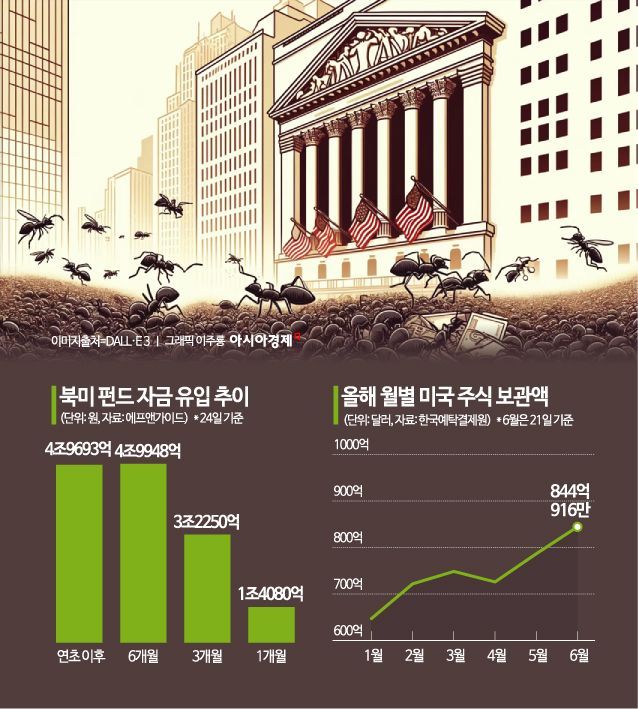
According to financial information provider FnGuide on the 26th, as of the 24th, 4.9693 trillion KRW has flowed into North American funds since the start of the year. The assets under management of North American funds grew from 11.8226 trillion KRW at the beginning of the year to 16.7918 trillion KRW.
North American funds show a dominant capital inflow among major regional and country-specific funds. North American funds are the only ones to have attracted capital in the trillion-KRW range. India funds, which attracted 634.3 billion KRW, and Japan funds, which attracted 126.4 billion KRW, followed.
The overwhelming capital inflow into North American funds is due to their high returns. Since the beginning of the year, North American funds have posted a return of 24.58%, the highest among major regional and country-specific funds. Besides North American funds, Asia Pacific (23.51%) and India (21.10%) funds also recorded returns in the 20% range.
As Seohak Gaemi (domestic investors investing in overseas stocks) continue to buy U.S. stocks, the custody amount of U.S. stocks also shows an all-time high. According to the Korea Securities Depository’s SEIBRO, as of the 21st of this month, the custody amount of U.S. stocks held by domestic investors reached 84.4916 billion USD (approximately 117.008 trillion KRW), surpassing 80 billion USD. This is the largest scale since related statistics began in 2011. In January this year, the amount was 64.69353 billion USD, below 70 billion USD, but it exceeded 70 billion USD in February and increased by another 10 billion USD in just over three months.
The personal investment boom in the U.S. is also clearly reflected in exchange-traded funds (ETFs). According to the Korea Exchange, the ETF most net-purchased by individuals this year is TIGER U.S. S&P 500, with net purchases totaling 746.7 billion KRW as of the 24th of this month. Among the top 10 ETFs net-purchased by individuals, nine are U.S.-related ETFs except for KODEX CD Interest Rate Active (Synthetic). TIGER U.S. Dividend Dow Jones (534 billion KRW), TIGER U.S. Nasdaq 100 (309.4 billion KRW), TIGER U.S. Dividend +7% Premium Dow Jones (290.6 billion KRW), ACE U.S. 30-Year Treasury Active (H) (275.1 billion KRW), KODEX U.S. S&P 500 TR (266.3 billion KRW), KODEX U.S. Semiconductor MV (201.8 billion KRW), ACE U.S. S&P 500 (188 billion KRW), and KODEX U.S. Nasdaq 100 TR (176.4 billion KRW) ranked high in individual net purchases.
While the U.S. stock market has recently taken a breather amid fatigue from the rising trend, attention is focused on how much longer the U.S. stock market’s upward momentum will continue. The securities industry forecasts that the U.S. stock market’s dominance will continue in the second half of the year. Kim Seonghwan, a researcher at Shinhan Investment Corp., said, "Although the U.S. stock market seemed to allow non-U.S. markets to catch up, it will still maintain leadership in the third quarter. Economic indicators have entered a lull, but the momentum is still superior compared to other countries. The earnings improvement of big tech companies is solid, and the artificial intelligence (AI) investment cycle has not yet shown signs of fatigue." He added, "The only concern is price burden, but it is difficult to discuss price burden in a period where earnings forecasts are being revised upward and a second-quarter earnings surprise is expected."
© The Asia Business Daily(www.asiae.co.kr). All rights reserved.

















