'Domestic ESG Disclosure System Economic Forum'
"Corporate Preparation Speed Must Consider Logistics Complexity"
There is a claim from the business community that more detailed guidelines reflecting industry-specific characteristics need to be established to solidify the mandatory disclosure system for Environmental, Social, and Governance (ESG) reporting. The current principle-based standards make it difficult for companies to carry out ESG disclosures.
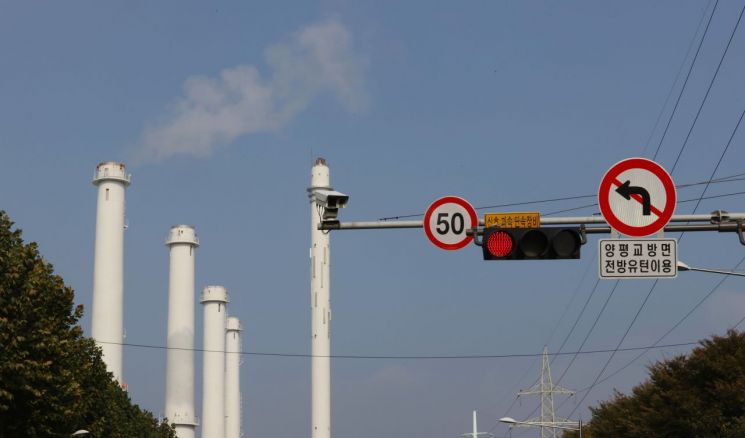 Chimney of the combined heat and power plant in Mokdong, Yangcheon-gu, Seoul.
 [Photo by Yonhap News]
The Korea Chamber of Commerce and Industry (KCCI) announced on the 25th that it jointly held an 'Economic Forum on the Domestic ESG Disclosure System' with the Korea Economic Association, the Korea Employers Federation, and the Korea Listed Companies Association. This was in response to heightened corporate interest following the recent release of the draft domestic sustainability disclosure standards by the Korea Sustainability Standards Board (KSSB). Participants included Park Il-jun, Executive Vice President of KCCI; Kang Gam-chan, Director at the Ministry of Trade, Industry and Energy; Kim Jeong-nam, Group Leader at the law firm Hwawoo; Lee Jun-hee, Center Director at the law firm Jipyong; Yoo In-sik, Head of ESG Department at IBK Industrial Bank of Korea; and Moon Sang-won, Managing Director at Samjong KPMG.
There was an opinion that the system should be introduced considering the realities of companies. Group Leader Kim Jeong-nam said, "Like the European Union (EU) and the United States, it is necessary to consider factors such as sales scale and number of employees and to reflect sufficient grace periods for certain disclosure items." He added, "The optional disclosure items for government policy objectives (No. 101) were added at the direct request of each ministry, so they inevitably become a burden for companies. Rather than adding disclosure items from a regulatory perspective, it is necessary to provide support measures that promote voluntary disclosure, such as building an ESG data platform."
Advice was also given to prepare detailed guidelines by industry. Center Director Lee Jun-hee said, "The recently announced draft ESG disclosure standards are composed only of broad principle-based frameworks, making it difficult for companies to prepare disclosures based on them alone." He added, "It is necessary to prepare specific detailed guidelines and guides that consider industry-specific characteristics and issues." He further stated, "The mandatory ESG disclosure should shift to a bottom-up approach centered on corporate opinions, including first- and second-tier suppliers by industry."
There was also an opinion that the characteristics of the financial sector should be considered. Financial institutions have perspectives both as disclosure preparers and users. Deputy Head Yoo In-sik said the key preparer-side issues unique to financial institutions are financial emissions (carbon emissions from asset portfolios) and greenwashing. The key user-side issues are the corporate information requirements and utilization related to climate risks and opportunities under the Task Force on Climate-related Financial Disclosures (TCFD) guidelines. He said, "When establishing detailed standards for mandatory disclosure, it is necessary to operate a joint working group of preparers and users."
There was a call to consider the complexity of the distribution and logistics industry. This is due to the characteristic of many suppliers providing products to many distributors. Managing Director Moon Sang-won said, "It is necessary to present appropriate guidelines for calculating and reporting carbon emissions considering the complexity and diversity of logistics networks." He added, "Since many suppliers are small businesses, it is difficult to grasp emission information, so it is expected to take a long time to disclose 'Scope 3' emissions, and investment in related infrastructure such as ESG data platforms is also needed."
During the free discussion following the keynote presentations, panelists agreed that disclosure items that companies find burdensome should be eased. They concurred on the need to prepare more concrete practical guidelines to enable companies to predict the time and resources required for ESG disclosure. Executive Vice President Park Il-jun said, "To reduce trial and error, it is necessary to introduce mandatory ESG disclosure when the majority of companies are prepared." He added, "Disclosure standards should also be eased by granting grace periods for burdensome content, and specific guidelines related to ESG disclosure need to be established."
© The Asia Business Daily(www.asiae.co.kr). All rights reserved.
![Clutching a Stolen Dior Bag, Saying "I Hate Being Poor but Real"... The Grotesque Con of a "Human Knockoff" [Slate]](https://cwcontent.asiae.co.kr/asiaresize/183/2026021902243444107_1771435474.jpg)















