Negligence in Safe Storage of General Chemicals
Concerns of Chain Explosion in Primary Batteries During Fire
Difficulty in Initial Suppression Due to Absence of Class D Fire Extinguisher
Need to Establish Approval Standards for Fire Suppressants
The Hwaseong fire, which resulted in 23 deaths, is being pointed out as a foreseeable disaster caused by the poor management of primary lithium batteries and the absence of safety devices. Primary batteries pose a risk of chain explosions when ignited, but they were stored without separate management standards, which exacerbated the damage. Moreover, there was no dedicated fire extinguisher to suppress metal fires, causing the golden time to extinguish the initial fire to be missed. There are concerns that without improvements in blind spots in management and safety devices, a second Hwaseong fire could recur.
On the morning of the 25th, the National Fire Agency held a briefing and explained the cause of the fire, stating, "Smoke and small sparks occurred where battery cells were gathered." The fire, which broke out at around 10:31 a.m. the previous day at the Aricell factory in Hwaseong-si, Gyeonggi Province, was fully extinguished at 8:48 a.m. on the same day. It took about 22 hours to put out the fire. The accident resulted in 23 deaths, 2 seriously injured, and 6 minor injuries, totaling 31 casualties.
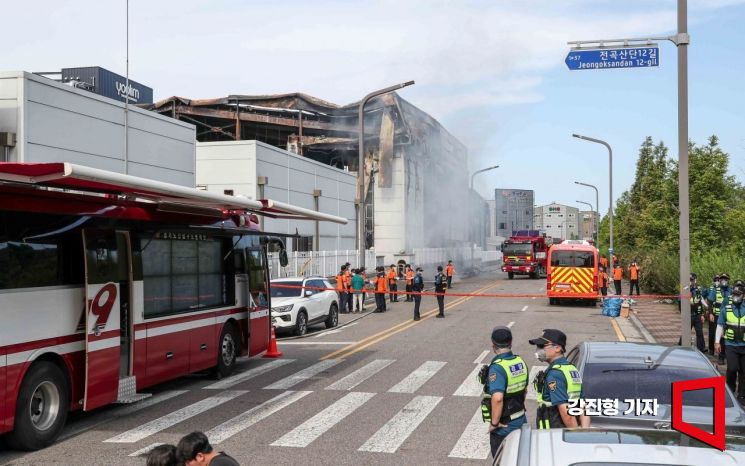 On the 25th, firefighters are busily moving at the scene of a fire at a primary battery manufacturing factory in Hwaseong-si, Gyeonggi Province.
 [Photo by Kang Jin-hyung]
◆Primary batteries classified as general chemicals... no separate safety storage standards
Experts unanimously agree that the characteristics of lithium exacerbated the fire. Lithium is highly reactive to heat and can cause explosions and fires when exposed to high temperatures or in contact with steam. In fact, in this fire, the flame attached to one lithium battery rapidly spread, causing chain explosions and resulting in many casualties. Professor Gong Ha-seong of the Department of Fire and Disaster Prevention at Woosuk University explained, "In the case of lithium primary batteries, when the temperature rises due to external impact and a fire occurs, the fire spreads to other batteries, causing chain explosions."
Moreover, metal fires caused by flammable metals like lithium are difficult to extinguish using the typical firefighting method of spraying water. Although it may appear that the fire is out, internal temperatures exceeding 1000 degrees Celsius can cause flames to reignite. As a result, firefighting authorities also faced difficulties in deciding how to extinguish the fire. They considered using dry sand for suppression but confirmed that the amount of lithium in the batteries was small, so they used water-based suppression methods.
Despite the risk of chain explosions during fires, primary batteries are classified as "general chemicals" and stored without separate safety standards. This is because it is judged that the possibility of fire is low unless the battery is deliberately disassembled or subjected to external impact. In contrast, hazardous chemicals are required by the "Hazardous Chemical Substances Handling Facility Safety Regulations" to take accident prevention measures to prevent temperature rise when substances are stacked.
Professor Son Won-bae of the Department of Fire Administration at Chodang University pointed out, "Lithium is classified as a Class 3 hazardous material with established storage standards, but substances containing hazardous materials partially, like primary batteries, are not classified as hazardous chemicals," adding, "To prevent a second accident, safety management regulations should be established for general chemicals containing hazardous materials."
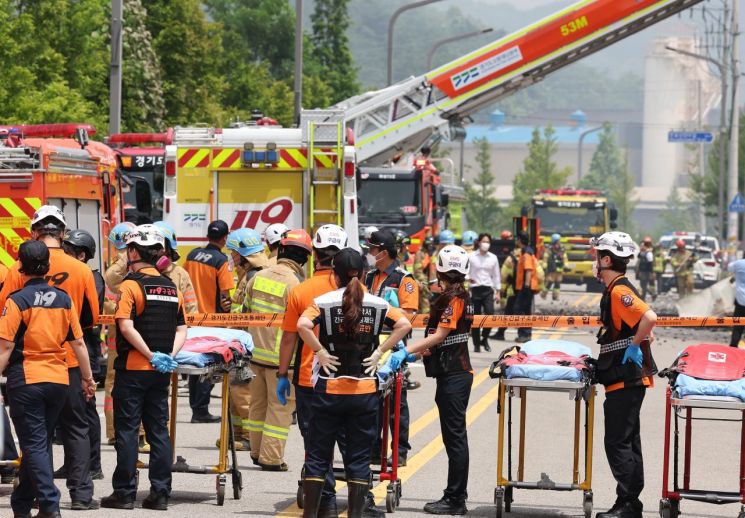 On the 24th, paramedics from the 119 emergency service are waiting with a stretcher prepared at the scene of a fire at a primary battery manufacturing factory located in Seosin-myeon, Hwaseong-si, Gyeonggi-do. [Image source=Yonhap News]
◆No development standards for metal fire-specific extinguishers
The absence of safety devices to suppress the fire early on is also cited as one of the reasons the disaster worsened. According to the National Fire Agency, workers used fire extinguishers at the initial stage of the fire but failed to extinguish it. In the case of metal fires caused by flammable metals such as lithium, it is difficult to extinguish the fire using ABC powder extinguishers used for general fires. Metal fire extinguishers must be used to easily suppress the fire in its early stages.
However, there are no type approval standards for extinguishing agents for metal fires, making it impossible to develop powder extinguishers. The National Fire Agency's notice, "Type Approval and Testing Technology for Fire Extinguishers," regulates extinguishing agent types only for four types of fires: general fires (Class A), oil fires (Class B), electrical fires (Class C), and kitchen fires (Class K). Most D-class extinguishers sold online currently have unverified fire suppression effectiveness.
Experts advise that as battery development using lithium becomes more active, regulations for developing extinguishers should be established to prepare for fire recurrence. Professor Lee Yong-jae of the Department of Fire Safety Management at Kyungmin University said, "Using ABC powder extinguishers for metal fires is like taking cold medicine for stomach pain," pointing out, "It has no effect at all." He added, "Since the same risk can occur in electric vehicles, standards for developing extinguishing agents that can effectively suppress fires caused by lithium batteries must be established."
© The Asia Business Daily(www.asiae.co.kr). All rights reserved.
![Clutching a Stolen Dior Bag, Saying "I Hate Being Poor but Real"... The Grotesque Con of a "Human Knockoff" [Slate]](https://cwcontent.asiae.co.kr/asiaresize/183/2026021902243444107_1771435474.jpg)
















