Since the launch of the 7th and 8th local governments, Dong-gu, Gwangju Metropolitan City has achieved visible results in key priority projects across various fields, including earning the highest grade (SA) for five consecutive years in the 'National Basic Local Government Mayor Pledge Fulfillment and Information Disclosure Evaluation.'
In particular, efforts such as 'urban image renewal and population increase,' 'establishment of a stay-type cultural tourism city infrastructure,' 'warm and meticulous Dong-gu-style empathetic welfare policies,' 'achieving the 2nd grade in public institution integrity for five consecutive years,' and 'creation of a humanities city and birth of an urban brand' have been notably recognized.
This year marks the fruition of six years of dedication since the launch of the 7th local government to create a 'humanities city,' establishing a unique urban brand for Dong-gu, Gwangju, and setting a new vision. On July 1, the 'humanities city,' which has been aligned with the 7th and 8th local governments, will be officially announced as the city brand to the entire nation, heralding a new turning point on the 2nd anniversary of the 8th local government’s launch and raising expectations.
● Fruitful achievements over six years of the 7th and 8th local governments
Thanks to continuous efforts to change the declining urban image caused by the past phenomenon of downtown hollowing and to restore the old reputation as the 'No. 1 place in Honam,' Dong-gu has successfully transformed into a 'hopeful city with a promising future' where people want to live and visit. This transformation is credited to improvements in residential environments through urban development and redevelopment projects, expansion of social and childcare infrastructure, increased operation of national and public daycare centers, and various customized childcare policies.
Despite being known as a city with a rapidly declining population and a high proportion of elderly residents, Dong-gu recovered its population to 100,000 in September 2020 and has maintained a steady increase, ranking among the top nationwide for net population inflow over the past three years. Among the five autonomous districts of Gwangju, it recorded the highest total fertility rate of 0.960 (compared to the Gwangju average of 0.844), a 12% increase in elementary school students, and youth (ages 19-39) accounting for 28.1% of the population.
● Infrastructure development centered on the 'Three Pillars of Dong-gu Tourism'
While the steady population growth positively influenced the change in urban image, it was realistically judged difficult to continue increasing the population. Therefore, efforts have been focused on creating a 'stay-type cultural tourism city' where many people can visit and feel the city's vitality. Infrastructure development has been actively pursued around the 'Three Pillars of Dong-gu Tourism': the National Asia Culture Center area, Mudeungsan National Park area, and Jisan Amusement Park area.
As a result, following the creation of the 'Fountain of Light' and 'Music Fountain' through the National Asia Culture Center fountain project, the 'Light Fortress,' a reinterpretation of the 5th gate of Gwangju Eupseong by a media artist, was recently officially opened with a project budget of 4.5 billion KRW. Plans are underway to sequentially establish the 'Light Museum,' 'Light Street,' and 'Light Yard,' combining media art and artificial intelligence (AI).
The 28 billion KRW 'Art-Integrated Night Tourism Space Production Project' underway in the Uijae Cultural Heritage area of Mudeungsan has also gained momentum. Having passed the Ministry of the Interior and Safety’s central investment review, from this year until 2027, the project plans to create the Chunsultee Museum, Uijae House, Owl Garden, and operate various programs to activate stay-type tourism.
Additionally, as part of the 'Smart Art Village Pilot Project,' the only one selected among Gwangju’s autonomous districts, the development of an integrated platform for smart tourism based on ICT (Information and Communication Technology) has been completed. The 'Gwangju Art Pass' and 'Attrang,' which fuse cultural, artistic, and tourism resources with smart technology to enable easy and convenient 'alley art travel' in daily life, have been in full operation since May.
Regarding the Jisan Amusement Park area, with the re-designation of the amusement park operator (private business), future development strategies will be explored in cooperation with Gwangju Metropolitan City, linked to the development plan for the former Shinyang Park site.
● Warm and meticulous 'Dong-gu-style empathetic welfare policies'
Building on past achievements, the 8th local government is focusing on strengthening the foundation for a 'welfare community where neighbors care for neighbors.' Starting with a visit to the Daedong-dong slum village earlier this year, Dong-gu became the first local government in Gwangju and Jeonnam to establish a comprehensive plan to support non-housing residents. Facilities such as the 'Deullangnallang Everyone’s Space' for these residents and the 'Dong-gu Stepping Stone House' for those needing temporary shelter due to fire, long-term hospitalization, etc., have been opened and are in operation.
Alongside this, a large-scale 'survey of single-person households aged middle-aged and above' is underway, with plans to complete the assessment by August. High-risk groups considering daily isolation, social and economic isolation, and physical vulnerability will be identified to connect them with services for preventing and managing solitary deaths. Furthermore, as part of the second year of the Gwangju-style integrated care program, the 'Dong-gu-style Gwangju Integrated Care' has provided daily living, meal, companionship, health, safety support, and residential convenience services to over 4,100 people in the past year, with plans for continued support.
● Establishing a clean and trusted 'Integrity Dong-gu'
Dong-gu has dramatically improved its public institution integrity rating from grade 5 to grade 2, achieving the 2nd grade for five consecutive years in the 'Public Institution Integrity Evaluation.' Through organizational culture improvement, establishment of a system to block corruption at its source, and the creation of the Integrity Dong-gu Promotion Team, differentiated and high-intensity integrity policies have been implemented with the cooperation of all public officials and residents, establishing a clean and trusted 'Integrity Dong-gu.'
Building on this, three major strategies have been established to leap to grade 1, and all departments have voluntarily selected and promoted 42 policies under the 'One Department, One Integrity Activity' initiative to help spread the culture of integrity.
● Establishing urban competitiveness identity as a 'Humanities City'
A key priority project inseparable from Dong-gu, Gwangju is the creation of a 'humanities city.' Since the launch of the 7th local government, Dong-gu uniquely established a Humanities City Policy Division and has devoted six years to this effort, yielding numerous achievements. Instead of unilateral government-led projects, it has been praised for actively encouraging resident participation through lectures, experiences, and programs mediated by book-related content.
Representative initiatives include spreading humanities spirit in residents’ daily lives, remembering and recording humanities assets, and projects for future generations, such as 'Reading Dong-gu,' 'Humanities Clubs,' 'Senior Autobiography Writing,' 'Humanities Golden Bell,' 'Humanities Global Leader Training,' and 'One Person, One Instrument Support.' Based on these, Dong-gu was selected as the 6th host city for the nationwide touring event 'Korea Regional Book Fair' in 2022. The 'Dong-gu Humanities School,' a learning and cultural enjoyment space for residents, won the Presidential Award at the 'Korea Spatial Culture Awards.'
Moreover, the '2nd Dong-gu Mudeungsan Humanities Festival,' held June 1-2 in the Jeungsimsa area of Mudeungsan, attracted over 30,000 visitors and concluded successfully. These accumulated achievements have differentiated Dong-gu from other local governments nationwide, leading to the birth of an urban brand. On July 1 at 3 p.m., the vision proclamation ceremony will officially declare 'Humanities City Gwangju Dong-gu.'
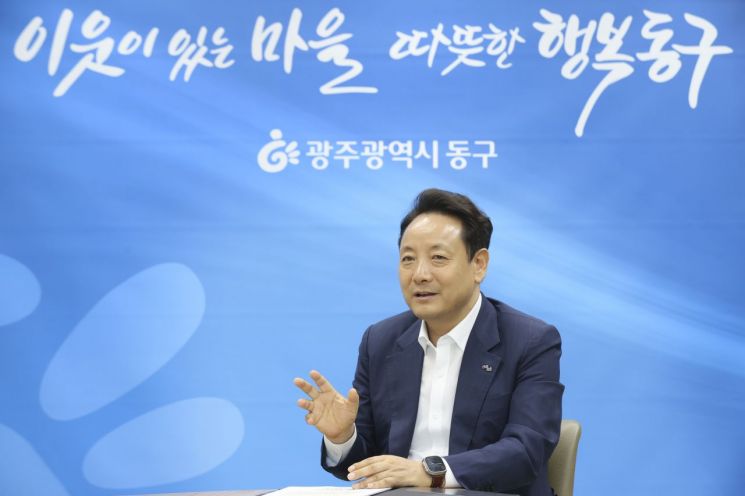
Mayor Im Taek of Dong-gu stated, “Throughout the 7th and 8th local governments, we have consistently prioritized residents’ convenience, happiness, and safety, striving to create a 'village with neighbors, warm and happy Dong-gu' filled with neighborly affection.” He added, “In the remaining two years, we will diligently promote key projects based on various achievements to wholeheartedly build 'Humanities City Gwangju Dong-gu.'”
© The Asia Business Daily(www.asiae.co.kr). All rights reserved.
![Clutching a Stolen Dior Bag, Saying "I Hate Being Poor but Real"... The Grotesque Con of a "Human Knockoff" [Slate]](https://cwcontent.asiae.co.kr/asiaresize/183/2026021902243444107_1771435474.jpg)















