Number of Illegal Employment Cases Among International Students Increasing Annually
Less Than 10% of International Students Receive Work Permits
On the morning of the 24th, around 10 a.m., two young part-time workers at a snack bar in Daechi-dong, Gangnam-gu, Seoul, were serving customers in hesitant Korean. When asked by reporters whether they were international students, the two showed signs of nervousness despite their consistently polite service.
Only after talking at length about their hometown, Vietnam, did they hint that they were international students from Vietnam. Afterwards, when directly asked the snack bar owner whether the students had work eligibility and why they were employed, there was no response.
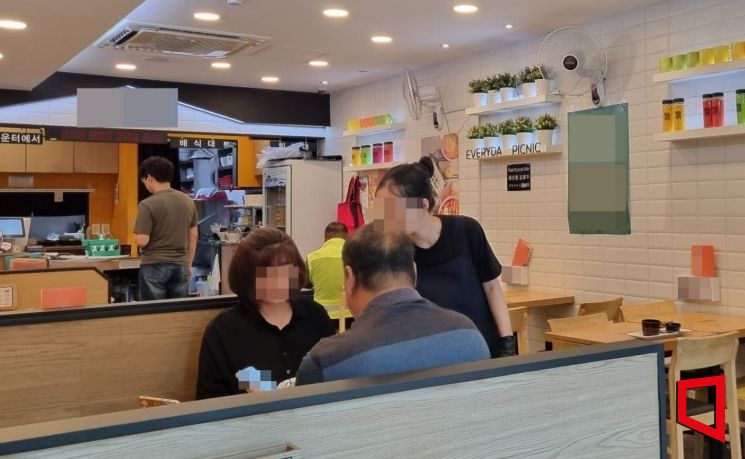 Around 10 a.m. on the 24th, a Vietnamese international student is working as a part-time employee at a snack bar in Daechi-dong, Gangnam-gu, Seoul.
 [Photo by Shim Seong-a]
As the number of young part-time job applicants decreases, self-employed business owners are facing deep concerns. Some self-employed owners are secretly hiring foreign international students to cope with labor shortages, but there are no practical measures in place.
Self-employed business owners say that even when they post job advertisements, the number of part-time job applicants has noticeably declined, causing labor shortages. Mr. Lee (67), who runs a convenience store in Samseong-dong, Gangnam-gu, Seoul, said, "I can feel that fewer young people are applying recently," and sighed, "Foreign international students keep applying even though we can't hire them, which is troublesome." Mr. Kim (30), who operates a barbecue restaurant in Jamsil-dong, Songpa-gu, Seoul, also said, "Even after raising the hourly wage to 13,000 won, there were no applicants," and added, "I wondered if the long working hours were the reason for no applications, so I allowed shifts of 5 hours or 3 hours, but it had no effect."
This phenomenon is also reflected in statistical data. According to the Ministry of Agriculture, Food and Rural Affairs' "Survey on the Management Status of Food Service Businesses," the percentage of respondents who find it difficult to hire part-time workers for "cooking (kitchen)" and "hall serving and counter" jobs has increased every year. The proportion of self-employed owners reporting difficulties in hiring was 43.6% and 45.3% for cooking and hall serving/counter respectively in 2020, 45.4% and 44.5% in 2021, and 52% and 55.9% in 2022.
As the situation worsens, self-employed business owners are turning their attention to foreign international students. The government, in principle, prohibits foreign international students holding student visas (D2·D4) from working part-time, but if they apply for work permission through the Immigration Office, they can work up to 30 hours per week depending on their Korean language proficiency and university type. However, according to the Ministry of Justice, among 226,507 international students in Korea last year, only 21,437 received part-time work permits.
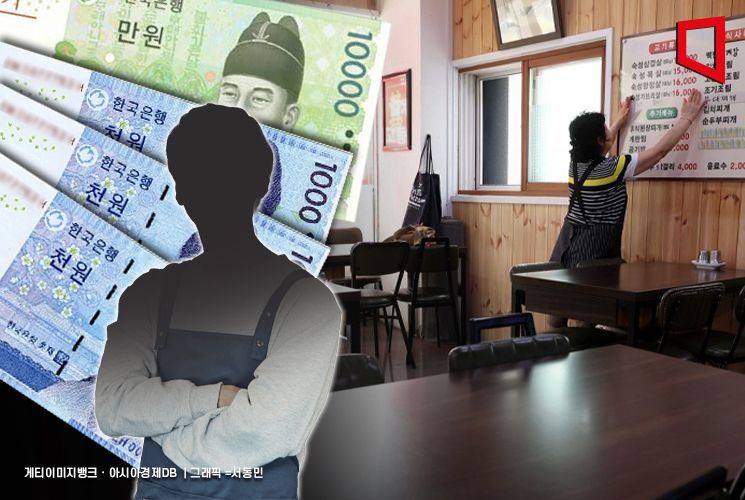
In fact, the number of illegal employment cases involving foreign international students has been increasing: 407 cases in 2021, 948 in 2022, and 1,306 in 2023. Under Article 18 of the Immigration Control Act, those who engage in employment activities without the proper residence status or those who employ such individuals may face imprisonment of up to three years or fines of up to 30 million won.
Experts advise that it is time to prepare alternatives suitable for the current situation. Professor Gu Jeong-woo of the Department of Sociology at Sungkyunkwan University diagnosed the current situation, saying, "Recently, the number of young people not even seeking jobs has increased by nearly 400,000. In the past, young people worked part-time to save money and hold hope for the future, but now those motivations have weakened, and the demand for part-time workers needed by industries and self-employed businesses is not being met." He added, "The number of foreign international students coming to Korea is increasing, so we need to move toward providing them with appropriate opportunities to work while also meeting the demands of self-employed business owners."
© The Asia Business Daily(www.asiae.co.kr). All rights reserved.
![Clutching a Stolen Dior Bag, Saying "I Hate Being Poor but Real"... The Grotesque Con of a "Human Knockoff" [Slate]](https://cwcontent.asiae.co.kr/asiaresize/183/2026021902243444107_1771435474.jpg)
















