Police, Fire Authorities Begin Joint Investigation
Battery Cell Explosion and Combustion Cited as Cause
Lithium Reacts with Water Producing Toxic Gas and Explosion
Lack of Response Manual... Development of Cooling Technology
On the 25th, a joint investigation began to determine the cause of the fire that occurred at the Arisell factory, a primary battery manufacturer in Hwaseong, Gyeonggi Province. According to the fire authorities, the flames started in the battery finished product inspection building located in the northwest of the factory on the day of the fire, and it is reported that explosive combustion occurred in some of the battery cells at the scene.
On the same day, the Hwaseong Arisell factory fire investigation headquarters of the Gyeonggi Southern Provincial Police Agency conducted a joint investigation with the fire authorities, the National Forensic Service, the Korea Land and Housing Corporation, the Ministry of Employment and Labor, and the Korea Occupational Safety and Health Agency to determine the cause of the fire.
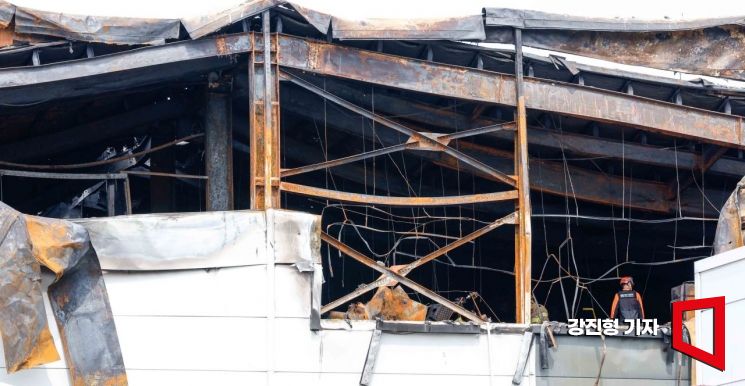 On the 25th, firefighters are searching for missing persons at the site of a fire at a primary battery manufacturing factory in Hwaseong-si, Gyeonggi Province. Photo by Jin-Hyung Kang aymsdream@
The factory where the fire occurred is owned by a company that manufactures lithium batteries and delivers finished products. It is known that more than 35,000 cylindrical lithium batteries were stored in the three-story steel frame building. The lithium-based batteries, which are difficult to extinguish, were the main cause of the fire. Lithium reacts with water to produce harmful gases and has explosive properties.
The fire authorities also reported from the scene that "the battery cells inside the fire could not be extinguished with water during the initial stage of the fire, causing difficulties in firefighting." Alkaline metals like lithium show temperatures above 1000 degrees Celsius even when it seems extinguished, posing risks and the possibility of additional explosions, making firefighting very difficult. Moreover, if a fire breaks out inside the battery, the separator, a safety device that prevents the cathode and anode materials from coming into contact, can be damaged, causing the temperature to soar. This can lead to damage and thermal runaway in surrounding batteries, and even if the fire is extinguished, there is a high risk of re-ignition.
The fire authorities who arrived at the scene after the report reportedly considered using dry sand for firefighting in the early stages of the fire, but ultimately confirmed that the amount of lithium in the battery was small and chose the conventional method of using water for extinguishing.
Some point to the lack of detailed response manuals as a cause. Manuals such as the Ministry of Environment's "Chemical Accident Crisis Response Manual" focus on preventing human and environmental damage caused by hazardous chemical spills. In contrast, accidents involving general chemicals like lithium are handled mainly by fire authorities. Furthermore, primary batteries are considered to have a relatively lower fire risk compared to secondary batteries and do not emit toxic substances like hydrofluoric acid gas, so no separate safety standards have been established.
The problem is that lithium is present in many aspects of our daily lives, including electric vehicles, mobile phones, laptops, and eco-friendly energy storage systems (ESS). The fire at the SK Pangyo data center on October 15, 2022, which caused the KakaoTalk outage, was also attributed to lithium-ion batteries. Accordingly, the battery industry and firefighting-related industries are developing cooling technologies and extinguishing agents capable of suppressing battery fires.
© The Asia Business Daily(www.asiae.co.kr). All rights reserved.
![Clutching a Stolen Dior Bag, Saying "I Hate Being Poor but Real"... The Grotesque Con of a "Human Knockoff" [Slate]](https://cwcontent.asiae.co.kr/asiaresize/183/2026021902243444107_1771435474.jpg)















