Development of Fire Extinguishing Agents for Chemical Substances Including Lithium Batteries
Inter-Ministerial Government Efforts to Seek Fundamental Improvement Measures
One Missing Person Still Being Searched... Rescue Dogs Deployed
Calls for "Separate Manual" for Lithium Battery Fires
The government has decided to form a joint task force (TF) with related ministries to respond to the fire at the lithium primary battery manufacturing plant in Hwaseong, Gyeonggi Province. The fire resulted in the deaths of 22 factory workers, and one foreign worker remains missing, with search operations ongoing.
On the 25th, Minister of the Ministry of the Interior and Safety, Lee Sang-min, held a meeting of the Central Disaster and Safety Countermeasures Headquarters and stated, "The Central Disaster and Safety Countermeasures Headquarters, led by the Ministry of the Interior and Safety, will form a government-wide TF including related ministries and private experts to thoroughly investigate the cause of the accident and prepare measures to prevent recurrence, aiming to devise fundamental improvement plans." The related ministries will conduct safety inspections of similar facilities, strengthen fire safety education for foreign workers, and develop extinguishing agents for chemical substances such as lithium batteries.
Search Underway for One Missing Person... 'Identification Challenges'
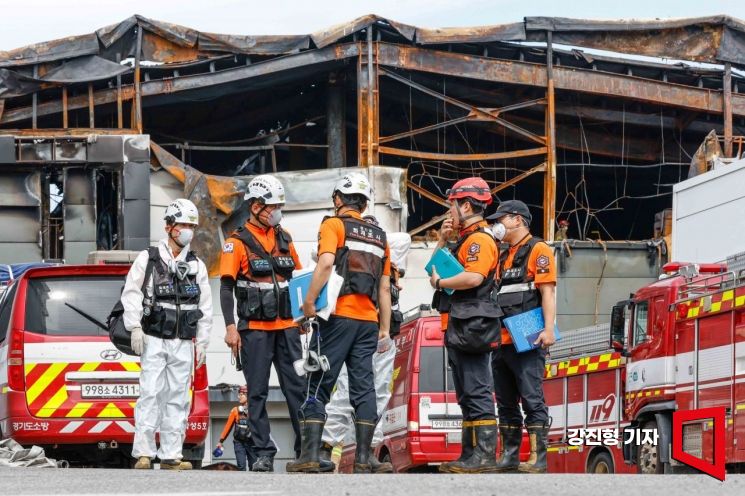 On the 25th, firefighters and the scientific investigation team are busily moving to conduct an on-site inspection at the fire scene of a primary battery manufacturing factory in Hwaseong-si, Gyeonggi Province. Photo by Jinhyung Kang aymsdream@
On the morning of the same day, firefighting authorities deployed about 100 personnel and two rescue dogs to resume search operations for one missing factory worker. Based on the worker’s mobile phone location near the factory, the search is focused inside the plant. The fire was completely extinguished around 8:48 a.m. that day.
The fire broke out around 10:31 a.m. the previous day on the second floor of the factory building, near the battery finished product inspection area. Although the exact cause of the fire has not been determined, it is estimated that a fire started in one battery and rapidly spread explosions to other cells. Cho Sun-ho, head of the Gyeonggi Fire and Disaster Headquarters, explained at a briefing on-site the previous day, "(From CCTV footage) white smoke initially began rising from the battery section, and the smoke rapidly spread, covering the entire workspace in about 15 seconds." Workers initially attempted to extinguish the fire using fire extinguishers, but due to the nature of lithium fires, these efforts were ineffective.
The fire department arrived at the scene at 10:40 a.m. on the day of the fire, but due to the intense flames caused by the chain explosion of tens of thousands of batteries, they could not enter the building and focused on preventing the fire from spreading to adjacent structures. Only after the fire was controlled at 3:10 p.m. that day were they able to enter the building and discover the deceased who had been missing on the second floor.
A total of 22 people died in the fire. Along with Mr. A, who was found in cardiac arrest at the early stage of the fire and later died, 21 deaths were confirmed inside the factory after initial treatment. Most of the bodies were severely damaged, making identification difficult; however, the identity of Korean national Mr. B was additionally confirmed that day. Mr. B was known to have naturalized from Chinese nationality to Korean. According to the police, the nationalities of the 23 victims (22 deceased and 1 missing) are 5 Koreans (including naturalized), 17 Chinese, and 1 Laotian.
The prosecution and police have begun follow-up actions such as identifying the victims and determining causes of death. The Suwon District Prosecutors’ Office formed a dedicated investigation team with seven prosecutor offices, including the Public Investigation Division and Criminal Division 3, the previous day. The investigation team conducted direct autopsies at five locations, including hospitals and funeral homes where the bodies were kept, to determine the causes of death. The Gyeonggi Southern Provincial Police Agency also organized a dedicated investigation headquarters with about 130 personnel, led by the head of the Metropolitan Investigation Unit. The investigation headquarters conducted a joint on-site inspection that morning with the fire department, National Forensic Service, Korea Land and Housing Corporation, Ministry of Employment and Labor, and Korea Occupational Safety and Health Agency to determine the cause of the fire.
The deceased are currently laid to rest at five locations, including Hwaseong Songsan Funeral Culture Center, Hwaseong Funeral Culture Center, and Hambaksan Memorial Park. Most bodies were severely damaged, preventing identification and the establishment of mourning rooms. The police have requested autopsies from the National Forensic Service to determine the causes of death.
'Lithium Fire' Difficult to Extinguish... Calls for Separate Response Manual
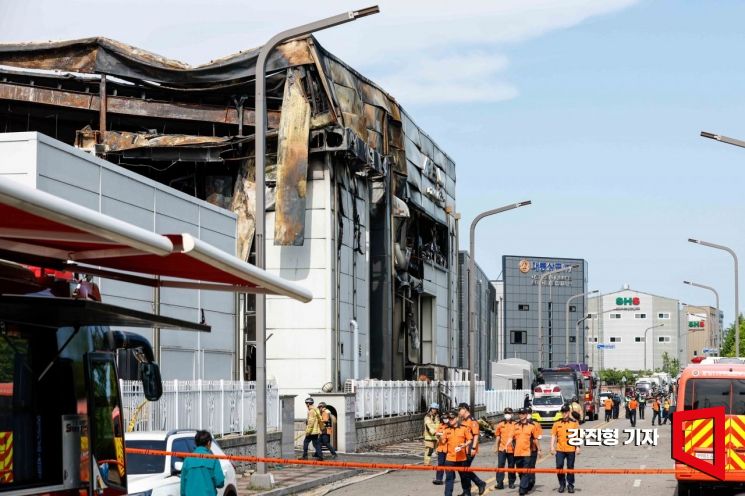 On the 25th, firefighters are busily working at the scene of a fire at a primary battery manufacturing factory in Hwaseong-si, Gyeonggi Province. Photo by Jinhyung Kang aymsdream@
The factory where the fire occurred is owned by a company that manufactures lithium batteries and delivers finished products. The three-story steel-framed building reportedly stored more than 35,000 cylindrical lithium batteries. The fire’s main cause was the lithium-based batteries, which are difficult to extinguish. Lithium reacts with water to produce harmful gases and can explode.
The fire department reported from the scene that "the battery cells inside the building could not be extinguished with water during the early stages of the fire, causing difficulties in firefighting." Alkaline metals like lithium can appear to be extinguished but still maintain temperatures above 1000 degrees Celsius, posing risks of additional explosions and making extinguishing very challenging. Furthermore, if a fire occurs inside a battery, the separator?a safety device that prevents contact between the cathode and anode?can be damaged, causing temperatures to soar. This can lead to damage and thermal runaway in surrounding batteries, increasing the risk of re-ignition even after the fire is extinguished.
Although the fire department considered using dry sand to extinguish the fire during the initial response, it was ultimately confirmed that the lithium content in the batteries was small, so they used conventional water-based extinguishing methods.
Some point out that the lack of detailed response manuals was also a cause. Manuals such as the Ministry of Environment’s "Chemical Accident Crisis Response Manual" focus on preventing human and environmental damage caused by hazardous chemical spills. However, accidents involving lithium and other general chemicals are primarily handled by firefighting authorities. Moreover, primary batteries are considered to pose less fire risk than secondary batteries and do not emit toxic substances like hydrofluoric acid gas, so no separate safety standards had been established.
The problem is that lithium is present in many aspects of daily life, including electric vehicles, mobile phones, laptops, and eco-friendly energy storage systems (ESS). The fire at the SK Pangyo data center on October 15, 2022, which caused a KakaoTalk outage, was also attributed to lithium-ion batteries. Accordingly, the battery and firefighting industries are developing cooling technologies and extinguishing agents capable of suppressing battery fires.
© The Asia Business Daily(www.asiae.co.kr). All rights reserved.
![Clutching a Stolen Dior Bag, Saying "I Hate Being Poor but Real"... The Grotesque Con of a "Human Knockoff" [Slate]](https://cwcontent.asiae.co.kr/asiaresize/183/2026021902243444107_1771435474.jpg)
















