Preventing the Spread of Anthracnose and Other Pests Before and After Rain
Minimizing Damage from Withering, Heat, and Sudden Increase in Solar Radiation
The Jeonbuk Special Self-Governing Province Agricultural Research and Extension Services (Director Choi Jun-yeol) urged thorough maintenance of facilities and drainage channels within orchards during the rainy season, as well as meticulous orchard management to prevent the spread of pests and diseases such as anthracnose, which occurred frequently last year, on the 24th.
According to the provincial agricultural research institute, pests and diseases such as anthracnose and brown spot disease rapidly spread in the hot and humid environment of the rainy season. Early control is important to minimize the density of pathogens within the orchard.
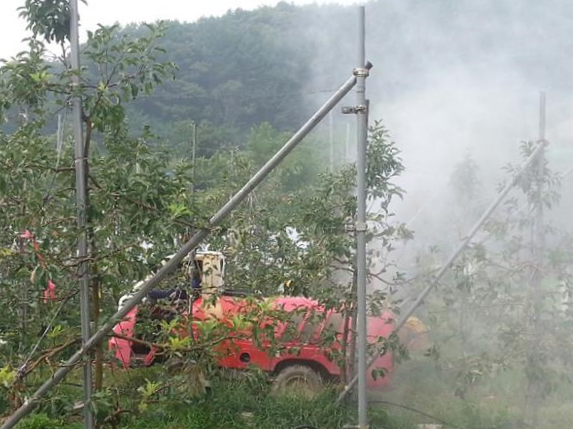 Summer rainy season and heatwave preparation for orchard pesticide management. [Photo by Jeonbuk Agricultural Research Institute]
When applying pest control before and after rain, it is recommended to alternate pesticides with different active ingredients even for the same pests to enhance control effectiveness. Not only diseased branches or fruits but also fallen fruits generate a large amount of pathogens and become sources of infection, so prompt removal is crucial.
After the rainy season, rapid changes in soil moisture and temperature rise can cause heat damage such as fruit sunburn and heat injury. Heat damage occurs when the fruit skin cracks due to rapid water absorption following drought during the fruit enlargement period, mainly in varieties with thin skins. To prevent this, maintain appropriate irrigation to minimize soil moisture stress and ensure smooth drainage in the orchard during the rainy season. During heat waves, it is advisable to spray a 0.3% calcium chloride solution on leaves and fruits 3 to 4 times at weekly intervals to strengthen the fruit skin.
Sunburn mainly occurs on leaves and fruits exposed to direct sunlight for extended periods; severe damage can cause tissue injury and secondary infections such as anthracnose. To reduce damage, manage irrigation to avoid excessive humidity or dryness. Operating micro-sprinkler systems during heat waves to lower orchard temperature is recommended. When fruits are exposed to strong direct sunlight, guide branches to protect the fruits and block direct sunlight, ensuring thorough management.
Kwon Taek, Head of the Technology Extension Division, stated, "We ask for thorough preparation not only to minimize crop damage caused by summer heat waves and the rainy season but also to ensure safe farming operations by paying attention to heat-related illnesses."
© The Asia Business Daily(www.asiae.co.kr). All rights reserved.

















