First IND Approval in Australia
Entering Clinical Trials in Q4, Completion Targeted for 2027
Global Study Involving 8,000 Participants
Aiming for 'World's Largest' 21 Serotypes
SK Bioscience has officially launched the Phase 3 clinical trial of the next-generation pneumococcal vaccine "SkyPack (GBP410, Sanofi development name SP0202)," which is being developed in collaboration with global big pharma Sanofi.
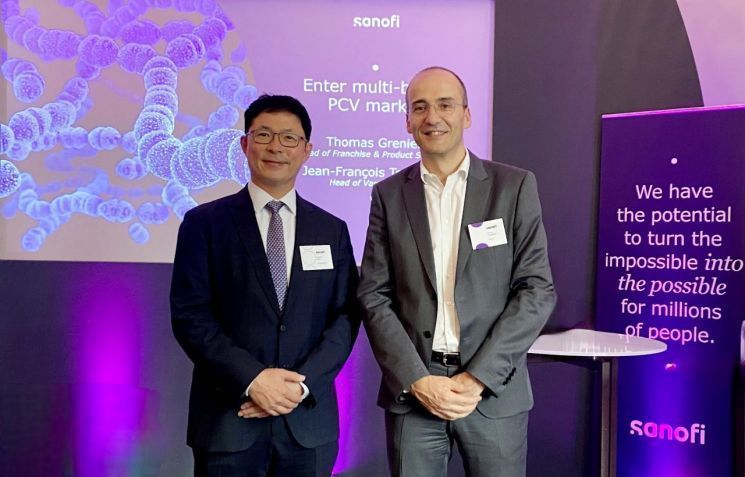 In June last year, at a vaccine investor event hosted by Sanofi in London, UK, Jae-yong Ahn, President of SK Bioscience (left), and Thomas Triomphe, Senior Vice President of Sanofi's Vaccine Division, posed for a commemorative photo. At the event, the two companies disclosed the Phase 2 clinical trial results of the 21-valent protein-conjugate vaccine "SkyPack," which they are jointly developing.
 [Photo by SK Bioscience]
On the 25th, SK Bioscience and Sanofi announced that they received approval for the Phase 3 clinical trial plan (IND) of SkyPack from the Human Research Ethics Committee (HREC) in Australia on the 21st. SkyPack is currently pursuing or planning to pursue IND approval procedures to conduct clinical trials not only in Australia but also in the United States, Korea, Europe, and Honduras.
With this IND approval, the actual patient dosing for the Phase 3 clinical trial, initially expected next year, is scheduled to begin within this year. The company stated, "We are preparing for the first dosing in Australia in the fourth quarter of this year," and explained their future plans: "We aim to complete the Phase 3 trial by 2027 and submit approval applications to the U.S. Food and Drug Administration (FDA) and the European Medicines Agency (EMA)."
This Phase 3 trial will evaluate the immunogenicity and safety of SkyPack through up to four doses (three primary doses and one booster dose) administered to approximately 8,000 healthy infants, children, and adolescents aged 6 weeks to 17 years.
SkyPack is a protein-conjugate vaccine candidate created by conjugating specific proteins to pneumococcal capsular polysaccharides that cause pneumonia and invasive diseases. The protein-conjugate method is known to enhance immunogenicity through T-cell immune responses, making it one of the most effective pneumococcal vaccines in terms of prevention. Notably, it is being developed as a vaccine that protects against the largest number of 21 pediatric serotypes globally (1, 3, 4, 5, 6A, 6B, 7F, 8, 9N, 9V, 10A, 11A, 12F, 14, 15B, 18C, 19A, 19F, 22F, 23F, 33F). If commercialized, it is expected to provide 5-7% broader protection against invasive pneumococcal diseases compared to existing 20-valent vaccines. On the 17th, MSD’s 21-valent adult vaccine, Vaxneuvance, also received accelerated approval from the FDA.
SkyPack already confirmed its immunogenicity and safety through a Phase 2 clinical trial last year. In a comparative clinical trial involving 140 children aged 12 to 15 months and 712 infants aged 42 to 89 days, it demonstrated immunogenicity equivalent to Pfizer’s pneumococcal vaccine, Prevnar 13. Regarding safety, no serious adverse events related to GBP410 were reported, and when co-administered with recommended infant and pediatric vaccines such as tetanus, diphtheria, pertussis, polio, and Haemophilus influenzae type B vaccines, it showed immunogenicity and safety comparable to the control vaccine.
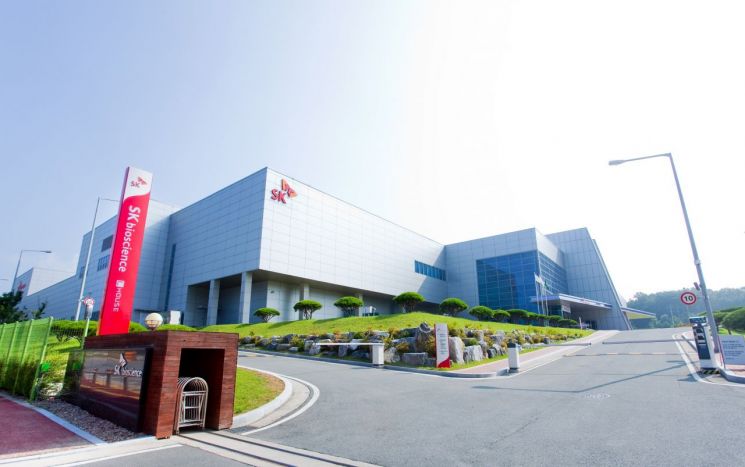
SK Bioscience has begun reorganizing the L House facility in Andong, Gyeongbuk, in preparation for the commercialization of SkyPack. In March, they started an expansion project to increase the vaccine production building from one floor to three floors, securing a new space of 4,200㎡, and plan to obtain current Good Manufacturing Practice (cGMP) certification, the U.S. standard for pharmaceutical manufacturing and quality control. The EMA’s EU-GMP certification was already acquired in 2021.
Jae-yong Ahn, CEO of SK Bioscience, said, “Having already secured successful Phase 2 clinical trial results, we are confident that Phase 3 will also proceed successfully. We will actively cooperate with Sanofi to introduce this blockbuster vaccine developed in Korea to the world and further strengthen SK Bioscience’s position as a global vaccine company.”
© The Asia Business Daily(www.asiae.co.kr). All rights reserved.
![Clutching a Stolen Dior Bag, Saying "I Hate Being Poor but Real"... The Grotesque Con of a "Human Knockoff" [Slate]](https://cwcontent.asiae.co.kr/asiaresize/183/2026021902243444107_1771435474.jpg)
















