Starting This September, Secondary Financial Institutions' Mortgage Loans and Bank Credit Loans Will Also Apply
Starting from September, the loan limits for mortgage loans in the banking sector and the secondary financial sector will be reduced by approximately 3-9% depending on the loan type. The credit loan limits for borrowers with outstanding credit loans exceeding 100 million KRW in the banking sector will also decrease by about 1-2%.
On the 25th, financial authorities announced that they will implement the "Stress Debt Service Ratio (DSR) Phase 2 measure" containing these details from September 1. Initially, the financial authorities had planned to apply Stress DSR Phase 2 from July 1, but the implementation has been postponed by two months.
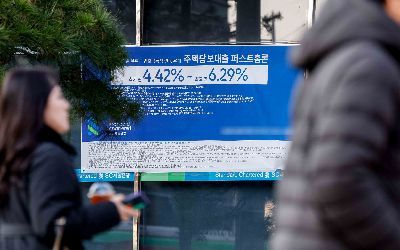 On the 26th, when the 'Stress DSR,' which precisely reflects future interest rate fluctuation risks in the Debt Service Ratio (DSR), was implemented, a real estate mortgage loan interest rate table was posted on the exterior wall of a branch of a commercial bank in Seoul. The Stress DSR system is a measure that applies an additional interest rate (stress interest rate) when calculating the DSR, considering the possibility that borrowers using variable interest rate loans may face increased principal and interest repayment burdens due to rising interest rates during the loan period. The stress interest rate applied until the first half of this year is 0.38%. Photo by Kang Jin-hyung aymsdream@
Stress DSR is a system that calculates loan limits by applying a certain level of additional interest rate (stress rate) when calculating the DSR, considering the possibility that borrowers using variable interest rate loans may face increased principal and interest repayment burdens due to interest rate hikes during the loan period.
The stress rate to be applied from September is 0.75%. This is due to the increase in the weighting applied to the basic stress rate (1.5%) from 25% to 50% with the implementation of Phase 2. Additionally, bank credit loans and secondary financial sector mortgage loans will be added to the scope of Stress DSR application. For multiple credit loans, the stress rate will be applied to calculate the DSR only if the credit loan balance exceeds 100 million KRW.
Accordingly, the maximum DSR loan limits per borrower are expected to decrease by approximately 3-9% for mortgage loans in the banking and secondary financial sectors depending on the loan type (variable, mixed, periodic), and by about 1-2% for bank credit loans depending on interest rate type and maturity. However, the financial authorities expect that since the proportion of high DSR borrowers whose loan limits are actually restricted by Stress DSR is about 7-8%, more than 90% of borrowers will be able to apply for loans with the same limits and interest rates as before.
The authorities plan to tentatively implement Stress DSR Phase 3, which applies the stress rate to all household loans subject to DSR, around July next year, but will decide on the implementation after monitoring the stabilization of the system.
The financial authorities cited the difficulties faced by low-income earners and self-employed individuals and issues related to real estate project financing (PF) as reasons for postponing the implementation of Stress DSR Phase 2 by two months. They explained that comprehensive government support measures to alleviate difficulties for low-income earners and self-employed individuals have been announced and implemented, and that the postponement also takes into account the smooth landing process of real estate project financing (PF), which is expected to intensify from the end of this month.
With the delay in introducing Stress DSR Phase 2, some have expressed concerns that the recent decline of mortgage loan interest rates in the banking sector to the 2% range might fuel household debt demand. A financial authority official stated, "We are alert to the recent significant drop in interest rates," and added, "We will closely manage the increase in household loans considering the effects of interest rate cuts and seasonal factors."
A financial authority official said, “Stress DSR contributes to the qualitative improvement of household debt by clearly recognizing the interest rate fluctuation risks associated with long-term loans, and especially serves as an ‘automatic control device’ that can curb the loan limit expansion effect caused by interest rate declines. Therefore, its significance will increase further when interest rates fall in the future.” The official added, “We plan to steadily implement Stress DSR Phase 2 from September and closely monitor the increase trends of household debt by type and sector, managing household debt stably within the range of the gross domestic product (GDP) growth rate.”
© The Asia Business Daily(www.asiae.co.kr). All rights reserved.
![Clutching a Stolen Dior Bag, Saying "I Hate Being Poor but Real"... The Grotesque Con of a "Human Knockoff" [Slate]](https://cwcontent.asiae.co.kr/asiaresize/183/2026021902243444107_1771435474.jpg)















