South Korean Industry on High Alert Amid China's Ultra-Low-Price Push
All-Out Assault on Half-Price Semiconductors, Ship Parts, Solar Power, Automobiles
Hana Financial Research: "Bleeding Competition with China Impossible, Must Consider Coexistence"
Analysis shows that China's dumping exports (selling products at prices lower than normal) of low-priced products are actively penetrating the Korean domestic market, directly impacting our key industries. Unlike in the past when Chinese products were low-quality and cheap, they now possess quality as well, posing a significant threat to domestic companies and necessitating proactive responses.
Ultra-low-priced products pushed by China threaten our domestic market
According to the Hana Financial Management Research Institute's Hana Financial Focus on the 25th, as China's ultra-low-priced dumping exports have intensified recently, Korea's global export competitiveness, which competes with China, is weakening, and Chinese low-priced products are infiltrating the domestic market, threatening major domestic industries.
China, facing a prolonged real estate crisis and economic downturn, has seen a significant weakening in domestic consumption capacity and has begun to resolve unsold inventory through low-priced dumping exports. Major countries such as the United States and the European Union (EU) are significantly raising or planning to raise tariffs on key Chinese products such as semiconductors, steel, and batteries to counter China's unfair trade practices and protect their domestic industries.
According to the institute, China's dumping exports are also directly impacting the Korean domestic market. This year, imports of low-priced Chinese products, especially in materials and components such as steel, chemicals, displays, and aircraft parts, have surged.
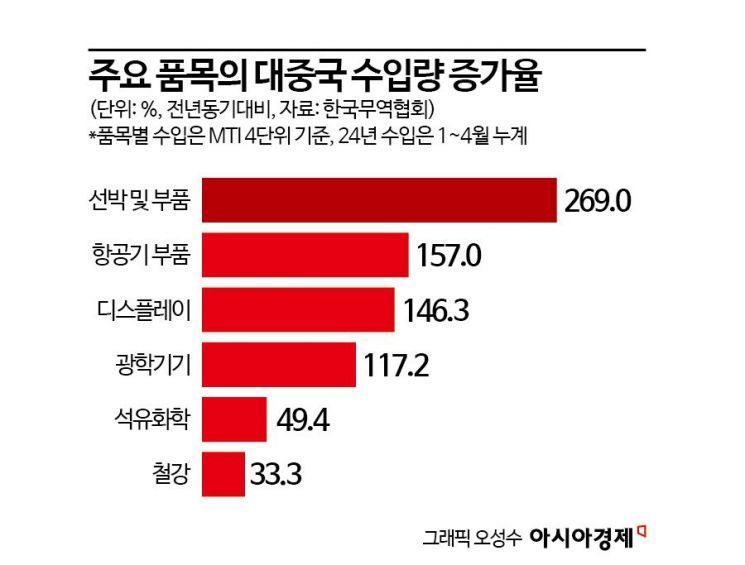
From the beginning of this year to April, the import growth rates from China were 269% for ship structures and parts, 157% for aircraft parts, 146% for displays, 117% for optical devices, 49% for petrochemicals, and 33% for steel compared to the previous year.
Many of the items for which China is explosively increasing production overlap with Korea's main export items, making Korea the most severely affected among major countries. Ten out of the top 15 export items of Korea and China overlap.
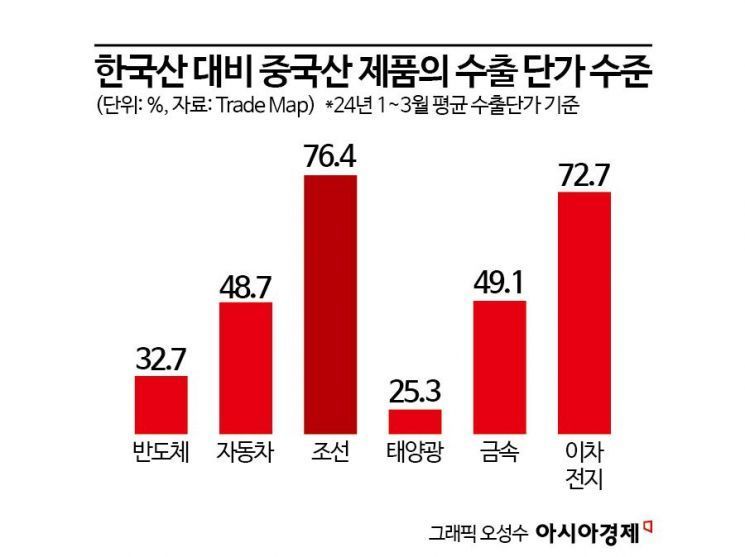
In particular, the export unit prices of Chinese products in key competitive items such as semiconductors, automobiles, batteries, shipbuilding, and steel were only 30-70% of Korean products. Compared to Korean products, the export unit price levels of Chinese products were only 25.3% for solar power, 32.7% for semiconductors, 48.7% for automobiles, 49.1% for metals, 72.7% for secondary batteries, and 76.4% for shipbuilding.
Ahn Hye-young, a research fellow at Hana Financial Management Research Institute, stated, "Companies facing prolonged economic downturns and increased cost reduction needs are increasing purchases of Chinese materials and components priced at 50-60% of domestic products, weakening the position of domestic materials and component companies."
Ahn warned, "Due to recent tariff measures strengthened by the US and EU, Chinese products that have lost price competitiveness in those countries may flood into Korea, where tariff barriers are relatively lower."
High price competitiveness combined with quality also threatens us
The bigger problem is that China threatens Korea not only with 'low prices and volume' but also with 'technology and quality.' Until now, domestic finished product manufacturers avoided using Chinese materials and components except for some generic products, but as the quality of Chinese materials and components has improved, more domestic companies are seeking them.
According to the Nikkei newspaper's "World Market Share Survey of 63 Items by Industry," China ranked second with 16 items where it holds the number one market share, following the United States, while Korea held the top market share in only six items, tied with Japan. Chinese companies have shown superiority in advanced industries such as smartphones, displays, and batteries, where Korean companies had previously been strong.
The institute diagnosed that Korea's options for response are limited due to close economic ties with China and constraints in cooperation with the US and others. Korea's high dependence on China means that retaliatory damage from export sanctions against China would be greater, making a tough response difficult.
Therefore, it argued that instead of engaging in a destructive competition with China, it is necessary to seek coexistence-based response measures and diversify trade partner countries.
Ahn emphasized, "For items where China's pursuit has intensified, rather than engaging in destructive competition, it is necessary to include Chinese products in the domestic supply chain to reduce costs and secure resource supply stability, while focusing on securing new technologies to widen the technological gap with China."
She added, "In global trade, it is necessary to seek diversification of trade partner countries and resource acquisition strategies by closely cooperating with developing countries, moving away from a trade structure concentrated on major powers such as the US and China."
© The Asia Business Daily(www.asiae.co.kr). All rights reserved.
![Clutching a Stolen Dior Bag, Saying "I Hate Being Poor but Real"... The Grotesque Con of a "Human Knockoff" [Slate]](https://cwcontent.asiae.co.kr/asiaresize/183/2026021902243444107_1771435474.jpg)
















