Correction of Daehan Telecom Stock Value in 1988
Choi Side: "Error Affecting the Substance of the Judgment"
Supreme Court Conducts Simultaneous Appeal and Re-Appeal Proceedings
Choi Tae-won, chairman of SK Group, has decided to seek a separate Supreme Court ruling after disagreeing with the appellate court's correction (revision) of the judgment in his divorce lawsuit with No So-young, director of Art Center Nabi. As a result, the Supreme Court will now review not only the main appeal of the divorce lawsuit but also the re-appeal regarding the decision to revise the judgment.
On the 24th, Choi's side filed a re-appeal against the decision to revise the judgment with the Family Division 2 of the Seoul High Court (Presiding Judges Kim Si-cheol, Kim Ok-gon, Lee Dong-hyun), which handled the appellate trial. Choi's legal representative explained, "This error cannot be resolved by simply correcting the judgment but affects the substance of the judgment's content, so we intend to seek the Supreme Court's ruling."
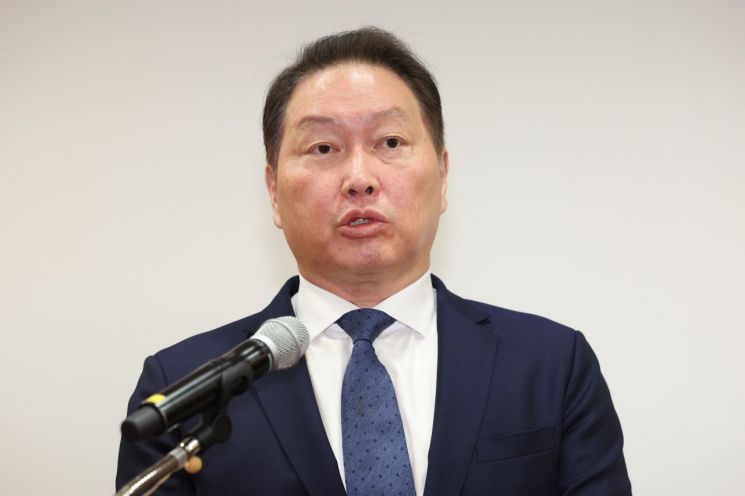 SK Group Chairman Chey Tae-won is speaking about his position on the appeal trial of the divorce lawsuit with No So-young, director of the Art Navi Center, at the SK Seorin Building in Jongno-gu, Seoul, on the morning of the 17th.
 [Image source=Yonhap News]
On the 30th of last month, the appellate court ordered Choi to pay No So-young approximately 1.3 trillion won as property division. On the 17th of this month, the court revised part of the judgment. The main point was changing the stock value of Korea Telecom (the predecessor of SK C&C) from 100 won per share to 1,000 won per share as of May 1998, just before the passing of former chairman Choi Jong-hyun. Accordingly, the degree of contribution to the increase in SK stock value by former chairman Choi Jong-hyun and Chairman Choi Tae-won changed respectively.
The court maintained the order, stating that the conclusion of the property division ratio of 65:35 would not change despite the revision of the judgment. However, Choi's side pointed out this as a "fatal error" and argued that the judgment should change since the contribution ratio to the stock increase had changed.
If the Supreme Court accepts Choi's re-appeal, the main appeal trial of the divorce lawsuit will be conducted based on the judgment before the revision. Conversely, if the re-appeal is dismissed, the appeal trial will proceed based on the revised judgment.
Some in the legal community have raised doubts about the legality of Choi's re-appeal. Article 211, Paragraph 3 of the Civil Procedure Act states, "When a proper appeal against a judgment exists, an immediate appeal against the correction decision cannot be made." If this provision is interpreted to apply to 'appeal to the Supreme Court' as well, Choi's re-appeal may fail to meet legal requirements and be dismissed.
However, Choi's side maintains that "this provision applies only to appeals" and "there are Supreme Court precedents stating it does not apply to appeals to the Supreme Court."
© The Asia Business Daily(www.asiae.co.kr). All rights reserved.
![Clutching a Stolen Dior Bag, Saying "I Hate Being Poor but Real"... The Grotesque Con of a "Human Knockoff" [Slate]](https://cwcontent.asiae.co.kr/asiaresize/183/2026021902243444107_1771435474.jpg)
















