Heatwave Around 35 Degrees Continues
Crop Cultivation Area Down 4.3% Year-on-Year
Farmers "Government Must Strengthen Responsibility"
Kim Deok-su (53), who cultivates 2,000 pyeong of napa cabbage in Seomyeon, Chuncheon-si, Gangwon-do, is feeling distressed due to the early June heatwave. The abnormal high temperatures have caused the cabbage leaves to wither, damaging two-thirds of the cabbage field to the point where it cannot be shipped.
Every year, Kim cultivates an average of 3,000 heads of cabbage per 500 pyeong and fills one 5-ton truck to send to the wholesale market. However, this year, due to the heatwave causing the cabbage to wither, he is unable to fill even one truckload from his 2,000 pyeong farm.
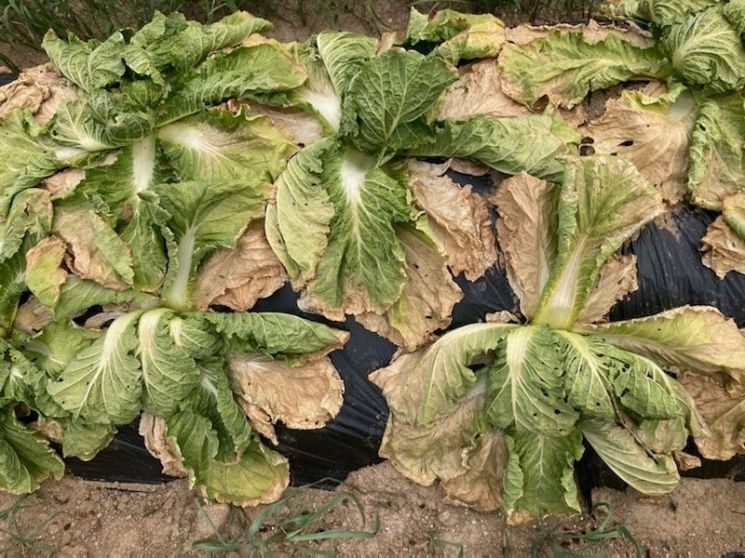 On the 22nd, in a cabbage field in Seomyeon, Chuncheon-si, Gangwon-do, cabbages with leaves melting away were planted.
 [Photo by Kim Deok-su]
The damage to cabbage crops has worsened due to the heatwave that started earlier than usual, deepening the worries of cabbage farmers. As more farmers give up on cabbage cultivation due to ongoing damage, there are calls for fundamental compensation measures to address climate disasters.
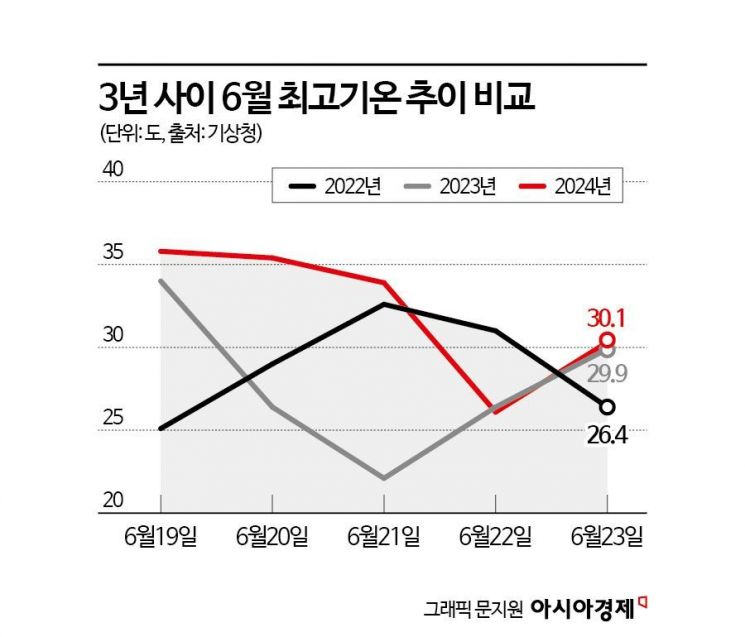
Chuncheon-si, where Kim cultivates cabbage, experienced a heatwave with maximum temperatures exceeding 35 degrees Celsius for three consecutive days starting June 19. Considering that the highest temperature in Chuncheon-si last year in the same month was 33.3 degrees Celsius and the average temperature hovered around 30 degrees, this is an unprecedented heatwave.
The damage to farmers caused by the heatwave is severe. Although cabbage prices fluctuate greatly depending on the crop yield, after deducting transportation costs, the profit margin for farmers per 5-ton truckload is about 2 to 3 million KRW. Typically, Kim filled four truckloads of cabbage from his 2,000 pyeong farm. However, this year, he barely managed to harvest enough cabbage to fill one truck. Kim lamented, "I only made about 2 million KRW from a season's farming," adding, "Considering the cost of farming materials, there is practically no profit."
Farmers cultivating highland cabbage, scheduled for shipment between July and August, are also worried about the upcoming rainy season. If water touches the cabbage exposed to the heatwave, the roots may rot.
Jung Deok-gyo (64), who cultivates highland cabbage on 150,000 pyeong in Hwaam-myeon, Jeongseon-gun, Gangwon-do, said, "Last year, the temperature rose to around 30 degrees for three days in June, then it rained a few days later, causing 30% of the cabbage to rot," and appealed, "Climate disasters repeat every year, but farmers bear the brunt of the damage. Who would want to farm under these conditions?"
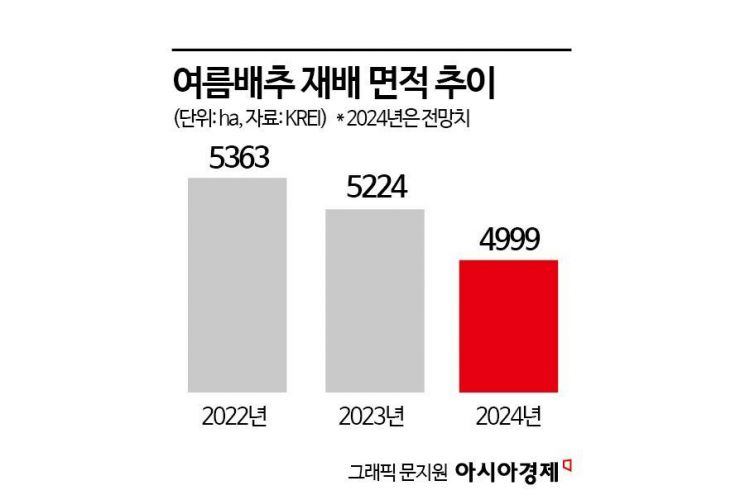
Crop damage caused by abnormal climate conditions is leading to a decrease in cabbage cultivation area. According to the Agricultural Outlook Center of the Korea Rural Economic Institute (KREI), the nationwide summer cabbage cultivation area is expected to decrease by 4.3% to 4,999 hectares this year compared to 5,224 hectares last year. The cultivation area has been declining annually since it recorded 5,363 hectares in 2022.
Farmers emphasize the need for measures to ensure stable cabbage supply in the future in response to climate disasters. Currently, the Ministry of Agriculture, Food and Rural Affairs operates agricultural disaster countermeasures divided into disaster recovery support, which provides aid for damage restoration, and 'Crop Disaster Insurance,' which pays compensation. Disaster recovery support is only a supplementary means for damage restoration, so to cover direct economic losses, farmers must pay a portion of the cost themselves to enroll in crop disaster insurance. According to the Ministry, farmers' average self-pay rate for crop disaster insurance is 12.5%.
Kang Soon-jung, Policy Committee Chair of the National Farmers Federation, said, "Crop disaster insurance has subscription restrictions depending on the variety and region, so nationwide damage compensation has not been realized. Also, disaster recovery support does not guarantee production costs," adding, "It is necessary to enact the Agricultural Disaster Compensation Act to strengthen the state's responsibility for climate disasters."
© The Asia Business Daily(www.asiae.co.kr). All rights reserved.
![Clutching a Stolen Dior Bag, Saying "I Hate Being Poor but Real"... The Grotesque Con of a "Human Knockoff" [Slate]](https://cwcontent.asiae.co.kr/asiaresize/183/2026021902243444107_1771435474.jpg)

















