Changwon National Industrial Complex 2.0, Advanced Multi-Beam Irradiation Facility
Building the Growth Foundation for the Next 50 Years with Digital Masan Free Trade, etc.
In July, it will mark the halfway point of the four-year term for Mayor Hong Nam-pyo's administration in Changwon Special City, Gyeongnam, under the 8th popularly elected government. Over the past two years, Mayor Hong's journey has been a relentless marathon, equivalent to circling the globe several times. He has tirelessly traveled to the National Assembly, central government departments, major cities and industrial sites both domestically and abroad. Through these efforts, he has steadily achieved results such as securing seed budgets, attracting government-funded projects, promoting core industries, and supporting local companies' entry into overseas markets, thereby laying the foundation for change and innovation for Changwon's next 50 years.
◆ Strengthening the Foundation for Innovative Growth = Last April, Changwon Special City established a 50-year vision for the Changwon National Industrial Complex. The vision presents the Changwon Industrial Innovation Park, where companies grow and young people are drawn to, and announced strategies and policy directions based on four core values: innovation, eco-friendliness, learning, and vitality. The city also secured momentum for the digital transformation of the machinery industry, such as building a support center for digital transformation (DX) in machinery and defense manufacturing, and developing and testing global manufacturing convergence software.
In March last year, the Changwon Defense and Nuclear Fusion National Industrial Complex (also known as Changwon National Industrial Complex 2.0) was selected as a candidate site. The city plans to develop this area into a new specialized industrial complex for the Fourth Industrial Revolution, connecting cutting-edge research facilities and talent cultivation. The advanced composite beam irradiation facility, which will be a core facility, is currently undergoing a preliminary feasibility study.
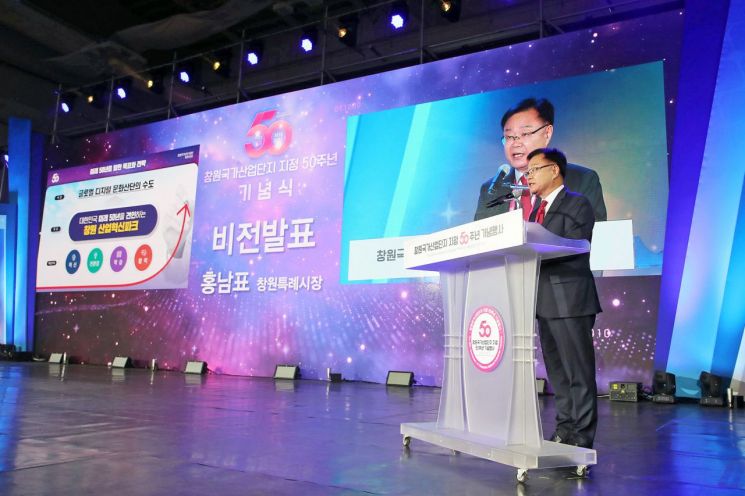 At the Changwon National Industrial Complex designation ceremony, Hong Nampyo, Mayor of Changwon Special City, is presenting the vision for the next 50 years.
The Masan Free Trade Zone was designated as a national industrial complex this January. With the building-to-land ratio raised from 70% to 80%, factory expansions, production line additions, and increased employment are expected. A digital Masan Free Trade Zone will be established in Masan Marine New City, where a high-tech urban industrial complex for data, networks, and artificial intelligence companies suitable for the Fourth Industrial Revolution will be created. The Bongam and Jungri industrial complexes, which are being upgraded, will be transformed into innovative industrial spaces integrating industry, business, residential, and cultural functions. Centered around Jinhae New Port, the city has begun designating an international logistics special zone based on a tri-port (port, airport, railway) system. The goal is to establish a basic plan in the first half of 2025 and enact special legislation and reflect it in the national master plan in the second half.
The city has also accelerated the advancement of its core industries. In April, it was selected for the Ministry of Industry's SMR Manufacturing Support Center project. The city aims to preemptively capture the rapidly growing SMR core equipment market. Following the establishment of a bridgehead for hydrogen companies to enter the Middle Eastern market in January last year, the city is also promoting the designation of specialized complexes within the existing national industrial complex. Moving forward, the city will also pioneer new markets in defense and special mobility sectors. The Yi Sun-shin Defense Industry Exhibition held in April was the largest ever, and with visits from officials from the Polish Ministry of Defense, the momentum for Changwon's K-defense industry continues to rise.
The city has attracted 1.1483 trillion won in investment from 35 companies in strategic and new growth industries. It has also established a foundation for fostering future industries, such as being selected for the drone demonstration city project for two consecutive years since last year.
◆ Enhancing the Quality of Citizens' Lives = Changwon Special City has extensively overhauled its district unit plans, which were previously aligned with the urban planning of the industrial complex era. By easing usage restrictions, residential areas will be transformed into convenient spaces, and commercial areas will become future-oriented mixed-use spaces integrating business, residential, and daily life functions.
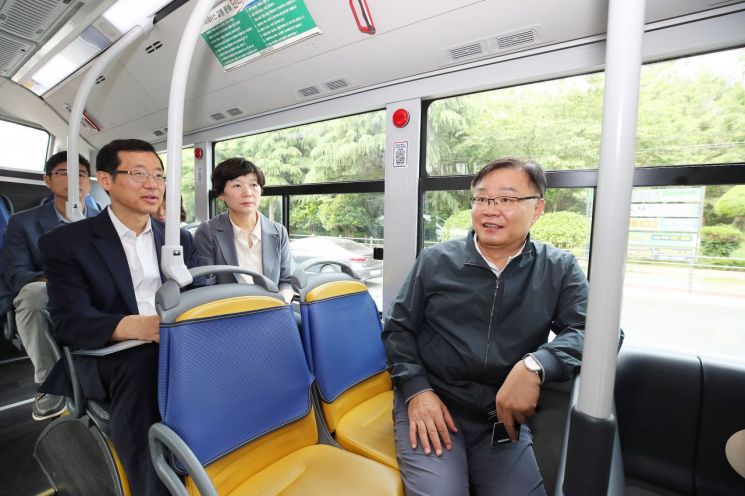
The city is also transitioning to a public transportation-centered city. The S-BRT on Wonui-daero, which opened temporarily in May, has entered a stabilization phase. In June last year, the city completely revamped its city bus routes for the first time in 18 years to enhance the efficiency of public transportation. The first step toward introducing urban rail, the urban rail network construction plan, has received approval from the Ministry of Land, Infrastructure, and Transport. The demand-responsive bus service Nubida, introduced last year, has received such a positive response that its pilot operation has been extended.
New tourism content has also been developed, with five projects, including the creation of a Hallyu-themed tourism garden, selected for the government's Southern Region Wide-Area Tourism Development Plan. Four water purification plants in the region have obtained ISO 22000 (Food Safety Management System) international certification, managing tap water at food-grade standards.
The city has also worked to create leisure spaces for citizens in their daily lives. Recently, a sports and culture complex was attracted next to the main gate of Changwon University. The largest pet culture complex in the Yeongnam region, Pet Village, will be completed and begin full operation in July. In addition, 12 barefoot walking trails closely linked to daily life have been established. The park golf course, aiming to create 500 holes?the largest in the country?has normalized the Daesan Golf Course and is proceeding with the construction of 18 holes at the Sosa Golf Course.
◆ Laying the Foundation for Youth Dreams = Changwon Special City has taken the lead in creating a city where young people want to live by opening Sponge Park, a space for youth cultural and artistic creation and consumption, operating the Youth Network as a channel for youth participation in municipal affairs, and enacting the Youth-Friendly City Ordinance. The city also provides support for youth in housing costs, asset formation, job seeking, and transportation, and this year introduced a new support fund for freshmen entering universities in Changwon.
In February, the city was designated as the first pilot area for the Special Education Development Zone, laying the foundation for region-led educational innovation. Changwon University and Gyeongnam University have been selected as preliminary candidates for the 2024 Glocal University designation and are preparing for final approval. Once designated, each university will receive 100 billion won to promote joint growth projects with the region, such as building a digital ecosystem.
◆ Boldly Breaking from Existing Conventions = Changwon Special City has accurately diagnosed long-stalled projects and devised new paths forward. The Gusan Marine Tourism Complex project has secured the legal basis for land expropriation, which was a major obstacle, and the Changwon Culture Complex Town is normalizing by expanding facility functions and finalizing the operational system.
Internally, the city has conducted precise analysis and diagnosis of its finances and launched financial innovation to address the absolute shortage of available resources and rapidly increasing debt. The city is also pushing for customized organizational restructuring to proactively respond to changes in the administrative environment, preparing measures to innovate staff capabilities, and has completely revamped the performance management system to focus on work and results. In addition, the city has standardized procedures for public building construction projects and introduced automated work systems to improve accuracy and efficiency.
◆ Future Administrative Directions (Tasks) = For the success of Changwon National Industrial Complex 2.0, the advanced composite beam irradiation facility, and the Digital Masan Free Trade Zone?Changwon's key projects for the next 50 years?the crucial first step is passing the preliminary feasibility study. The city is meticulously planning in preparation for this study. Mayor Hong has also visited relevant central government departments several times to request prompt selection of these projects as preliminary feasibility study targets and their subsequent approval.
In particular, the advanced composite beam irradiation facility is capable of detecting defects in large products and parts without disassembly. Last year, the city secured 500 million won for planning services, and this year, 3 billion won for basic design. If the project passes the preliminary feasibility study, the total project cost, funded entirely by the national government, is expected to reach 500 billion won. The city expects to attract and cluster domestic and international defense companies in Changwon by building advanced science and technology infrastructure.
To overcome the threat of the population falling below one million, it is essential to create a city where young people want to work and stay. The direction of nurturing local talent should also expand from a focus on manufacturing to the service sector. To this end, efforts should be made with local universities to establish not only future industry departments but also specialized departments such as pharmacy, veterinary medicine, and law schools. In addition, more cultural complex spaces should be created throughout the city to provide a work-life balance environment where work and cultural life are harmonized.
Furthermore, the city must establish firm countermeasures for private investment projects that are placing a heavy burden on municipal finances, such as the Ungdong District and Pallyong Tunnel, and must continue to petition the government and political circles to attract the long-awaited Changwon Medical School, a goal for 30 years.
Mayor Hong Nam-pyo stated, "If the first two years of the 8th popularly elected administration were a time to plan innovative strategies for the next 50 years and lay the foundation for economic vitality, the next two years will be a time to complete the foundation for Changwon's innovative growth over the next 50 years through change and innovation." He added, "We will strive to achieve results in innovative projects and balanced growth by region, actively reflect stakeholder opinions in policy development, implementation, and evaluation, and expand lifestyle-oriented projects directly linked to citizens' daily lives to enhance convenience and the sense of policy effectiveness for our citizens."
© The Asia Business Daily(www.asiae.co.kr). All rights reserved.
![Clutching a Stolen Dior Bag, Saying "I Hate Being Poor but Real"... The Grotesque Con of a "Human Knockoff" [Slate]](https://cwcontent.asiae.co.kr/asiaresize/183/2026021902243444107_1771435474.jpg)












