Visa 'Usage Status of Domestic Cards by Foreign Visitors to Korea'
Among foreign visitors to Korea, Americans spent the most on food and beverages, Japanese on medical services, and Chinese on shopping. The place where contactless payment was most actively used was Pyeongchang.
According to global payment technology company Visa on the 24th, the nationalities of foreigners who spent the most money in Korea were in the order of the United States, Japan, and China, accounting for more than half of the total payment amount. Taiwan, Singapore, Thailand, and Hong Kong followed. Visa analyzed and announced payment data from overseas-issued personal Visa cards at domestic merchants from April last year to March this year.
Looking at offline payment data of visitors from the top seven countries, shopping and food and beverage consumption were predominant. By industry, payments at restaurants and retail stores including duty-free shops accounted for about 15%. Hospitals and department stores accounted for 10-15%, while accommodation, clothing and accessory stores, and discount stores accounted for 5-10%. Transportation accounted for about 1-5%, which is analyzed to be due to the difficulty of using overseas-issued credit cards for domestic public transportation.
By country, American visitors to Korea had a high proportion of payments in food-related sectors such as restaurants (21%) and grocery stores (5%). The proportion of transportation usage such as taxis was also in the 4% range, higher than other countries. In contrast, Asian countries and regions generally showed a payment tendency focused on shopping. Japanese visitors spent particularly a lot on medical services (17%) such as hospitals, and payments at retail stores (15%) also accounted for a high proportion. On the other hand, consumption at restaurants (11%) and department stores (8%) was below average. Mainland Chinese visitors also showed high consumption proportions at retail stores (21%), department stores (15%), and clothing and accessory stores (11%). Taiwanese, Thai, and Hong Kong tourists also showed shopping-oriented consumption patterns, while only Singaporean tourists had the highest proportion of spending related to accommodation.
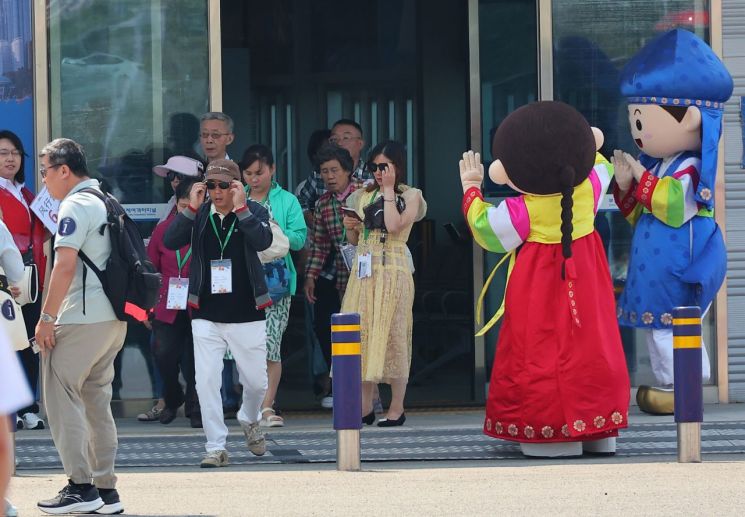
It was found that more than half of the tourists visiting Korea stayed in Seoul. Analyzing the number of accommodation-related payment transactions of visitors from the seven countries, Seoul was the most popular destination with about 55%. Incheon (10%), Busan (9%), Jeju (7%), and Pyeongchang (2%) followed. Mainland Chinese tourists visited Jeju Island (19%) the most after Seoul, while Taiwanese tourists relatively frequently visited Busan (16%) influenced by the Busan-Taipei route.
Contactless payment patterns also stood out. Visitors from the seven major countries frequently used contactless payments at discount stores, fast food outlets, grocery stores, and retail stores. This is attributed to the launch of Apple Pay in March last year, which led to the proactive introduction of contactless payment infrastructure in large franchise stores. Regionally, the usage rate of contactless payments in Pyeongchang was about twice that of Seoul. Visitors from the seven countries used contactless payment methods for about 14% of their transactions in Pyeongchang. This is attributed to the early introduction of contactless payment terminals in Pyeongchang city following the 2018 Pyeongchang Winter Olympics. Since contactless payment is a common payment method overseas, it is expected that the usage rate by travelers will increase when contactless payment terminals and systems are established.
Patrick Storey, President of Visa Korea, said, “It is interesting that foreign tourists show different consumption patterns and payment behaviors depending on their region and culture,” adding, “As the number of foreign tourists visiting Korea has greatly increased, we hope that the analysis of payment trends of foreign visitors will provide useful information to domestic financial companies and merchants.”
© The Asia Business Daily(www.asiae.co.kr). All rights reserved.
![Clutching a Stolen Dior Bag, Saying "I Hate Being Poor but Real"... The Grotesque Con of a "Human Knockoff" [Slate]](https://cwcontent.asiae.co.kr/asiaresize/183/2026021902243444107_1771435474.jpg)















