Ahead of Next Month's Tax Law Revision
Reviewing Exemption Reform for Low-Value Imported Goods
Concerns Over Repeated Backlash if Taxes Imposed
Customs Duty Exemption and VAT Imposition
Korea Likely to Follow Major Countries' Trends

The government is considering reforming regulations on overseas direct purchases (direct imports) ahead of next month's tax law revision. Although momentum for adjusting the duty-free allowance has weakened due to public backlash against overseas direct purchase regulations, there are many opinions that "the system cannot be left as it is." However, considering the trend in major countries around the world to exempt customs duties but impose value-added tax (VAT), there is a high possibility that our government will also focus on imposing VAT.
According to related ministries on the 24th, the Ministry of Economy and Finance, about a month before the tax law revision bill is made public, is reviewing the reform of the small-value import goods duty exemption system, which currently exempts customs duties and VAT on goods under $150 (and $200 for goods from the U.S.). However, since the Ministry of Economy and Finance announced last month the "Measures to Strengthen Consumer Safety and Enhance Corporate Competitiveness Due to the Surge in Overseas Direct Purchases," which included a review of the duty exemption system reform, it has not yet made a decision on the system reform due to public backlash.
Officials from the Ministry of Economy and Finance said, "In the current situation where citizens are very angry about the so-called 'direct purchase incident,' we cannot hastily make changes to the system, but it is also difficult to leave it as it is," adding, "From now until the remaining period, we will continue to consider the issue while monitoring public opinion trends." If the duty exemption system is reformed to impose taxes, there is a possibility that the prices of overseas direct purchase products will rise, which could reignite public opposition that had calmed down.
The Ministry of Economy and Finance is considering system reform because the issue of tax fairness between domestic products and direct purchase products continues. Small-value overseas direct purchase products are brought into the country without special import declarations and are exempt from customs duties and VAT. On the other hand, domestic businesses must go through complicated procedures such as KC certification and pay VAT, raising concerns about reduced competitiveness. According to a survey conducted in March by the Korea Federation of Small and Medium Business targeting 320 small and medium enterprises (manufacturing and retail), 53.1% of the affected SMEs cited "loss of price competitiveness due to excessive duty-free benefits" as the main type of damage.
Major Countries' Trend: 'Customs Duty Exemption' and 'VAT Imposition'
Therefore, there are opinions inside and outside the government that if the duty exemption system is reformed, the focus will likely be on imposing VAT. Customs duties, which apply different rates to various goods, are somewhat complicated administratively, but VAT can be uniformly applied at a 10% rate regardless of the type of goods, making it administratively convenient. There is also a logical aspect to imposing VAT. Since VAT is a tax imposed when a specific product is consumed, if VAT is not imposed at the final consumption destination where the product is exported, no tax is imposed in any country simply because the amount is small.
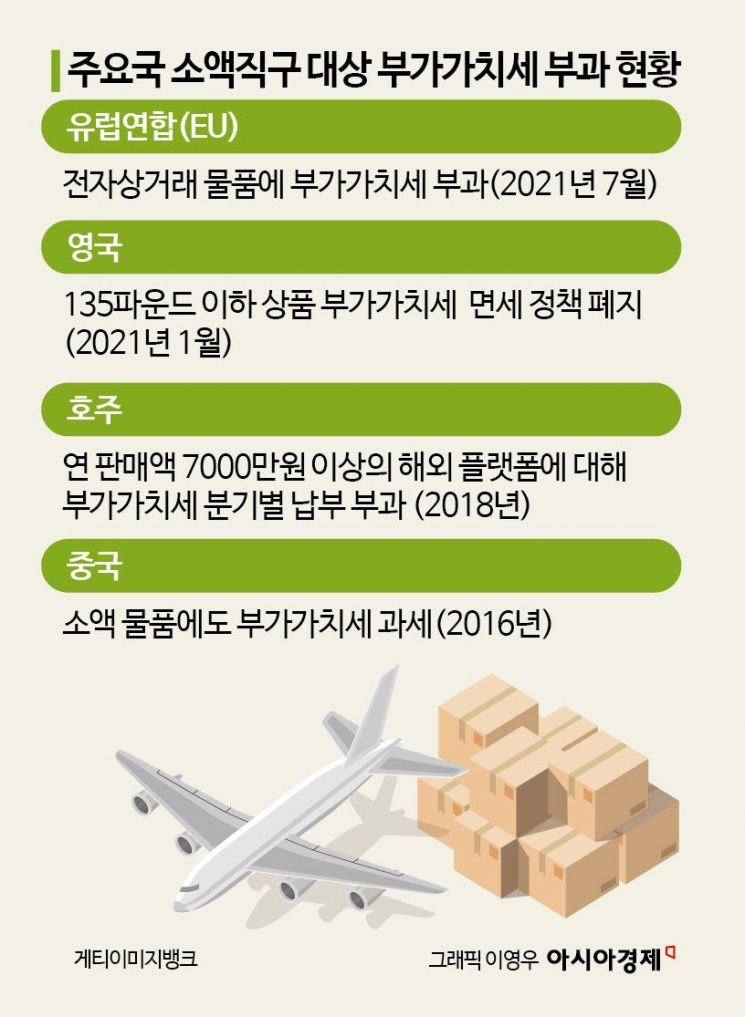
Most major countries that have started imposing taxes on small-value direct purchase products in recent years operate systems that do not impose customs duties but do impose VAT. The European Union (EU) has been charging VAT on e-commerce import goods since July 2021. Although the EU Commission announced plans to impose customs duties starting March 2028, parliamentary discussions have not yet begun.
Australia has required overseas platforms with annual sales exceeding 70 million KRW since 2018 to register as businesses and pay VAT quarterly. It views importers of goods as consumers and platforms as suppliers responsible for paying VAT on their behalf. The United Kingdom also abolished the VAT exemption policy for goods under ?135 after 2021. China has been collecting VAT on small-value direct purchase goods since 2016.
However, some argue that it may be difficult to impose VAT on small-value overseas imports under the Korea-U.S. Free Trade Agreement (FTA). Since the government has separately set the small-value import goods threshold at $200 only for the U.S. under the FTA, imposing VAT only on imports from China or Europe without amending the Korea-U.S. FTA could provoke strong opposition from those countries, making implementation practically difficult. A government official explained, "Even if VAT is imposed, it is not a measure targeting China, and since China also collects VAT on small-value direct purchase goods, we believe the possibility of Chinese opposition is low."
© The Asia Business Daily(www.asiae.co.kr). All rights reserved.
![Clutching a Stolen Dior Bag, Saying "I Hate Being Poor but Real"... The Grotesque Con of a "Human Knockoff" [Slate]](https://cwcontent.asiae.co.kr/asiaresize/183/2026021902243444107_1771435474.jpg)

















