University of Tokyo and Japan Foundation Joint Survey
"Large-scale Harvesting to Begin in 2026... Commercialization"
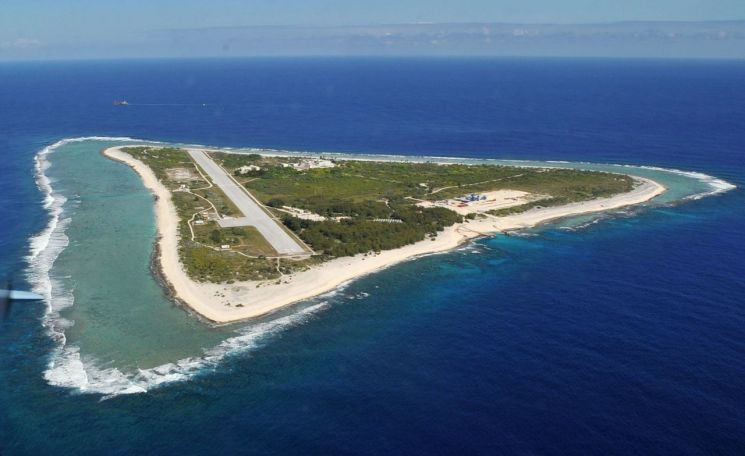
It has been confirmed that 230 million tons of manganese nodules rich in rare minerals are distributed within the exclusive economic zone (EEZ) around Minamitorishima (南鳥島) in the Ogasawara Islands, Japan.
According to Japanese foreign media on the 22nd, the Yomiuri Shimbun reported on the 21st that the University of Tokyo and the nonprofit organization Japan Foundation recently identified this fact through investigation and analysis. Manganese nodules are lumps containing manganese, nickel, cobalt, copper, and other elements, known to lie on the seabed at depths below 4,000 meters. Minamitorishima is located about 1,900 km southeast of Tokyo. The presence of manganese nodules in the surrounding waters was already known from a 2016 research team survey by the University of Tokyo.
Manganese nodules are metal oxides precipitated by chemical reactions at the deep seabed from metal components in seawater and sediments. They contain over 40 types of metal components and rare earth metals, with manganese being the most abundant, hence the name manganese nodules. The four major metal components of manganese nodules are manganese, copper, nickel, and cobalt. These metals are used as raw materials in steelmaking, alloys, communications, and power industries, and are widely applied in automotive, electrical and electronic, aerospace, and medical industries. Recently, they have also been widely used as raw materials for high-efficiency electric batteries.
The Japan Foundation estimated through additional surveys conducted from April to June that 610,000 tons of cobalt and 740,000 tons of nickel are also deposited. Regarding this, Yomiuri explained that this deposit corresponds to about 75 years of cobalt consumption and about 11 years of nickel consumption based on Japan’s usage.
Yomiuri reported, "The Japan Foundation and others plan to launch a joint venture as early as 2026 to begin large-scale extraction of manganese nodules and start commercialization," adding, "The technology to pump up seabed manganese nodules is established abroad, and they will seek extraction cooperation with Western companies." It also stated, "Initial extraction costs are expected to exceed 5 billion yen (approximately 43.7 billion KRW)," and "The Japan Foundation will mainly bear the extraction costs, and the extracted manganese nodules will be provided to Japanese companies that have secured smelting technology." The University of Tokyo plans to support the project academically, including mineral analysis work.
Yomiuri explained, "Rare earth deposits such as cobalt and nickel are concentrated in some regions like Africa and China," and added, "If Japan’s public and private sectors succeed in commercialization, it will have advantages in terms of economic security."
© The Asia Business Daily(www.asiae.co.kr). All rights reserved.
![Clutching a Stolen Dior Bag, Saying "I Hate Being Poor but Real"... The Grotesque Con of a "Human Knockoff" [Slate]](https://cwcontent.asiae.co.kr/asiaresize/183/2026021902243444107_1771435474.jpg)















