K-Battery Future Materials Global Leading City Foundation Laid
Gwangyang National Industrial Complex, Sepung Industrial Complex, Yulchon 1 Industrial Complex Designated 470,000 Pyeong
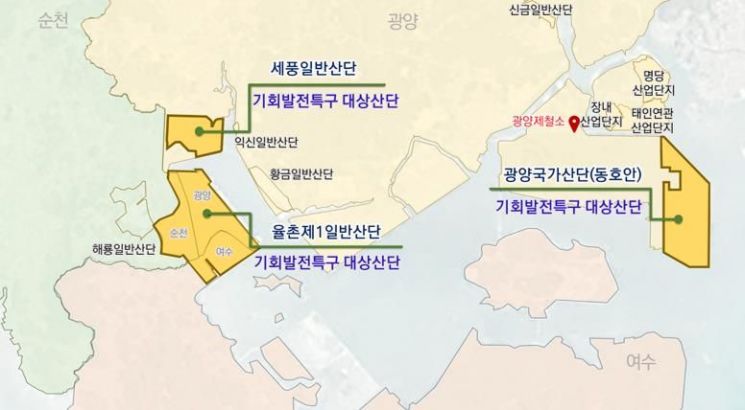
Gwangyang City in Jeollanam-do announced on the 20th that 470,000 pyeong of the Gwangyang National Industrial Complex (Donghoan), Sepung Industrial Complex, and Yulchon 1 Industrial Complex have been designated as a secondary battery opportunity development zone, laying the foundation as a ‘K-Battery Future Materials Global Leading City.’
According to the city, to promote balanced regional development, encourage corporate investment in local areas, and revitalize the regional economy, a total of 470,000 pyeong in the Gwangyang Bay area was designated as a secondary battery opportunity development zone after evaluation by the Ministry of Trade, Industry and Energy and review and resolution by the Local Era Committee.
The opportunity development zone is one of the four major special zones for realizing the current government’s local era, providing a package of support including tax and financial incentives, regulatory exemptions, and improvements in residential conditions to attract large-scale corporate investments to local areas.
The Ministry of Trade, Industry and Energy announced the ‘Guidelines on Designation and Operation of Opportunity Development Zones’ in March and accepted applications. Jeollanam-do applied for a total of 1.25 million pyeong across three sectors. Among them, the secondary battery opportunity development zone promoted as Gwangyang City’s future strategic industry accounts for the largest area of 470,000 pyeong.
This opportunity development zone targets sites with concrete investment plans from companies that have signed investment agreements. The secondary battery sector in the Gwangyang Bay area reflects investment plans from eight companies, including POSCO Future M.
Gwangyang City plans approximately 4 trillion KRW in investment over about 400,000 pyeong in Sepung Industrial Complex, Yulchon 1 Industrial Complex, and Donghoan National Industrial Complex, establishing the only full-cycle ecosystem for the domestic secondary battery materials industry.
With this designation, companies can receive various benefits. When companies from the metropolitan area relocate to the special zone after disposing of real estate, income and corporate taxes on capital gains are deferred until the real estate within the special zone is disposed of. Startup companies establishing business sites in the special zone can receive tax reductions on business income and corporate taxes.
Additionally, support includes ▲increased financial subsidies for local investment promotion grants (an additional 5%p) ▲improvements in residential conditions for workers ▲a set of three regulatory innovations (rapid confirmation, demonstration special cases, temporary permits) ▲special supply of private housing (10%) for workers in companies within the special zone.
Mayor Jeong In-hwa of Gwangyang City contributed significantly to the achievement of this opportunity development zone designation through persistent efforts. Since the designation is directly linked to corporate investment, he personally met with POSCO Holdings Chairman Jang In-hwa to request investment in Gwangyang and held meetings with executives of secondary battery companies to identify and resolve regulatory obstacles and difficulties hindering investment.
In particular, the Donghoan reclaimed shared water area in the Gwangyang National Industrial Complex, which had been unable to attract new industry investments such as hydrogen and secondary batteries due to location regulations for advanced strategic industries, saw regulatory easing led by the government through amendments to the Industrial Location Act in October last year.
Furthermore, to resolve power supply issues for secondary battery investment companies in the Yulchon Industrial Complex, the city took the lead by directly visiting Korea Electric Power Corporation (KEPCO) to find solutions.
For the designation of the secondary battery opportunity development zone, Gwangyang City closely consulted with Jeollanam-do, the applicant, and jointly proposed through the research project “Designation and Ecosystem Formation of the Gwangyang Bay Area Secondary Battery Specialized Complex (Special Zone)” the goals of ▲completing the only full-cycle supply chain for secondary battery materials in Korea and ▲establishing the largest domestic production base for secondary battery raw materials, presenting the vision of Gwangyang City as a ‘K-Battery Future Materials Global Leading City.’
Mayor Jeong In-hwa of Gwangyang City said, “I would like to thank Governor Kim Young-rok of Jeollanam-do and related organizations for their support and generous cooperation in the designation of the Gwangyang secondary battery opportunity development zone.”
He added, “Taking this designation as an opportunity, Gwangyang City will establish a system where the region and companies coexist, create a new industry cluster unique to Gwangyang Bay, and develop our city into the largest domestic production base for secondary battery raw materials.”
Meanwhile, Gwangyang City is actively supporting companies to foster the secondary battery materials industry through initiatives such as ▲signing agreements to establish a secondary battery recycling industry cluster ▲attracting the Advanced New Materials Research Center of Suncheon National University ▲building an eco-friendly lithium secondary battery recycling testbed.
© The Asia Business Daily(www.asiae.co.kr). All rights reserved.
![Clutching a Stolen Dior Bag, Saying "I Hate Being Poor but Real"... The Grotesque Con of a "Human Knockoff" [Slate]](https://cwcontent.asiae.co.kr/asiaresize/183/2026021902243444107_1771435474.jpg)















