About 20 Corporate Executives Attend KEF Meeting
"Investment Contraction" "Property Rights Infringement" Backlash
With the so-called Yellow Envelope Act (Amendment to the Labor Union and Labor Relations Adjustment Act, etc.) having been vetoed by the president and discarded in the previous National Assembly, the business community has launched an urgent response as the amendment is being swiftly pushed in the current National Assembly. The amendment expands the scope of workers and employers while limiting damages for losses caused by labor disputes. The National Assembly’s Environment and Labor Committee tabled the amendment to the Labor Union Act on the 20th.
The Korea Employers Federation held an emergency meeting on the 21st with HR and labor management executives from major companies. About 20 people attended from Samsung, SK, Hyundai Motor, LG, POSCO, and others.
One corporate executive said at the meeting, "The amendment indefinitely expands the scope of workers and employers without clear criteria, effectively causing the Labor Union Act to lose its function as a legal definition, which will create significant confusion in the industrial field. Especially, with multiple criminal penalties for employers under the Labor Union Act, vague and non-objective judgment criteria will excessively increase legal risks in management, inevitably leading to a reduction in domestic investment."
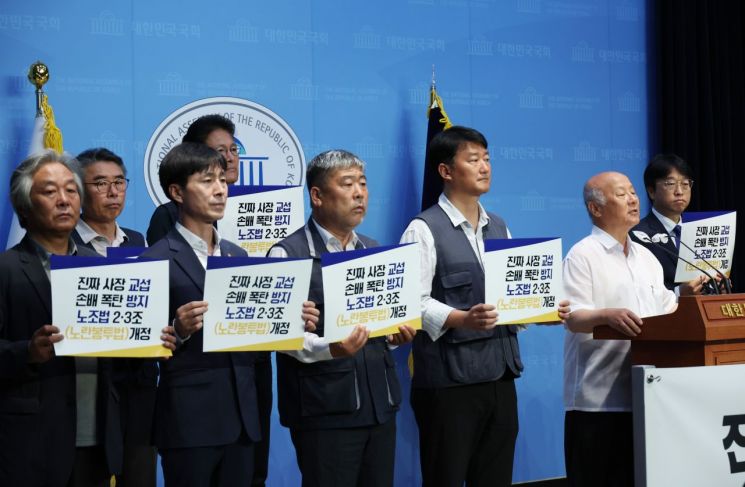 On the 18th, Lee Yong-woo of the Democratic Party of Korea, Shin Jang-sik of the New Justice Party, Yoon Jong-oh of the Progressive Party, along with Yang Kyung-soo of the Korean Confederation of Trade Unions and Kim Dong-myung of the Federation of Korean Trade Unions, held a joint press conference at the National Assembly as opposition co-representatives for Articles 2 and 3 of the Trade Union Act.
 [Photo by Yonhap News]
Another meeting participant said, "By including labor providers as workers, business operators such as special employment types and self-employed individuals can organize labor unions, demand collective bargaining, and engage in labor disputes, which will seriously disrupt market order."
There were also criticisms that the amendment effectively blocks claims for damages caused by illegal labor disputes, encouraging illegal strikes and infringing on property rights. The amendment prohibits claims for damages against individual workers for losses caused by union decisions and also prohibits claims for damages against unions that would threaten their existence.
One attendee said, "Even now, violent and destructive acts by militant unions, illegal occupation of workplaces, and other illegal activities frequently occur in industrial sites. If claims for damages are fundamentally blocked, the industrial field will become a lawless zone." Lee Dong-geun, Vice Chairman of the Korea Employers Federation, said, "The amendment is a bad law that will destroy our labor-management relations, shake the industrial ecosystem to its roots, and threaten jobs for future generations. We will actively inform the public about the problems with this bill."
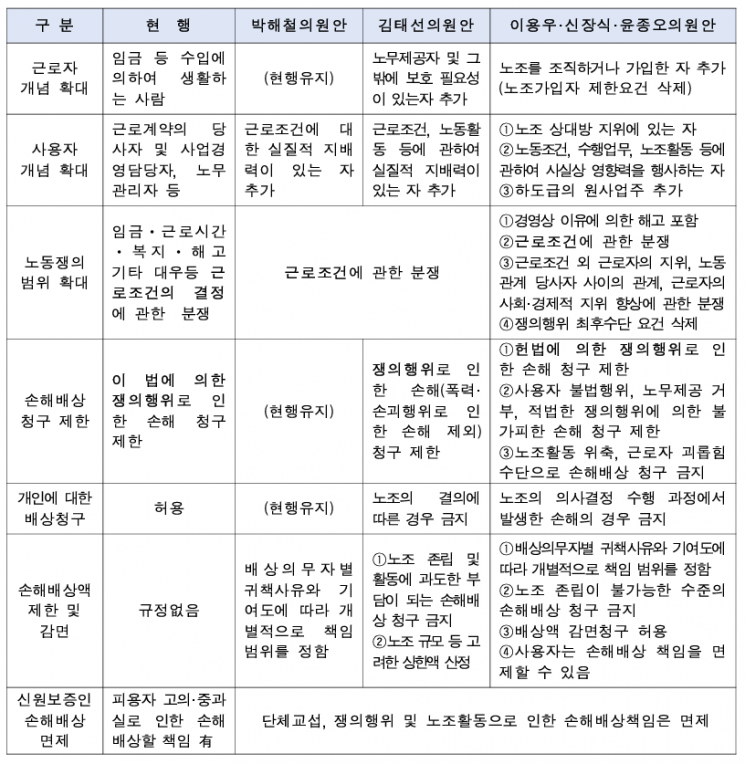 Comparison of the Current Labor Union and Labor Relations Adjustment Act and the Proposed Amendments [Source: National Assembly Environment and Labor Committee]
The speed of bill processing in the National Assembly is fast. Due to prolonged confrontation between the ruling and opposition parties over the composition of standing committees, opposition lawmakers have already scheduled public hearings and hearings as early as next week. Although the standing committee’s expert reviewer pointed out in the review report that there are conflicting views on key issues requiring deliberation, in reality, such deliberation is not taking place.
The amendment presumes that those who organize or join a union are workers and expands the scope of employers to those who have a labor relations counterpart status with workers or unions. The amendments, respectively proposed by Democratic Party lawmakers Park Hae-cheol and Kim Tae-seon, allow subcontractors within companies to regard the primary contractor as the employer. This was also included in the amendment discarded in the previous National Assembly.
Additionally, 87 opposition lawmakers including Lee Yong-woo included provisions recognizing platform workers such as delivery and substitute drivers, and special employment workers such as private tutors, as labor unions. The current Labor Union Act does not recognize unions if non-workers join, but the amendment removes this clause and allows union formation.
The labor community welcomed the amendment. Kim Dong-myeong, Chairman of the Federation of Korean Trade Unions, said, "The amendments to Articles 2 and 3 of the Labor Union Act are issues as vital as the blood and heart of our workers that we absolutely cannot back down from."
© The Asia Business Daily(www.asiae.co.kr). All rights reserved.
![Clutching a Stolen Dior Bag, Saying "I Hate Being Poor but Real"... The Grotesque Con of a "Human Knockoff" [Slate]](https://cwcontent.asiae.co.kr/asiaresize/183/2026021902243444107_1771435474.jpg)
















