"Won't Return to Required Courses and Majors in a Situation Where Trust Has Disappeared"
Former KMA President Choi Dae-jip, Medical Resident Agreement Without Discussion
"Current KMA President Repeatedly Unilaterally Announces Undecided Matters"
It has been four months since the residents submitted their resignation letters and left the hospital on February 20, but there is still no sign of their return. Despite medical school professors and the Korean Medical Association (KMA) consecutively going on strike to provide support, the residents remain unmoved. The reasons why many residents are not budging include a significant number having given up on their training and distrust stemming from the forced 2020 medical agreement.
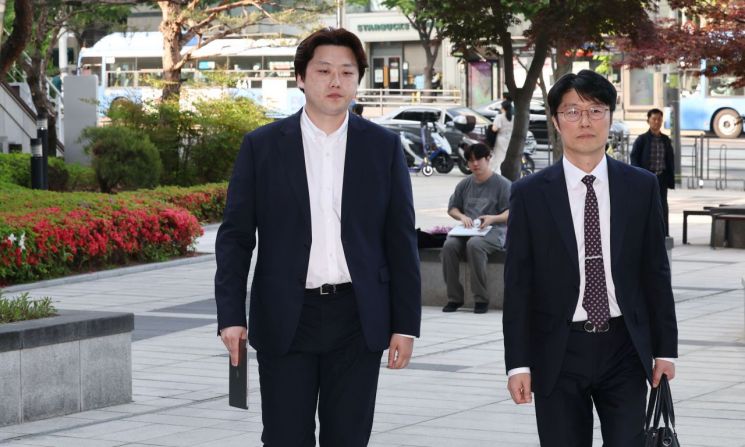 Park Dan, Emergency Response Committee Chairman of the Korean Intern Resident Association, is moving on the afternoon of the 3rd of last month in front of the Seoul Administrative Court in Seocho-gu, Seoul, to file a lawsuit against Health and Welfare Minister Cho Kyu-hong seeking cancellation of the work commencement order, cancellation of the treatment maintenance order, and cancellation of the order prohibiting acceptance of resignation letters.
 [Image source=Yonhap News]
The residents have repeatedly rejected the KMA's proposal to unite in solidarity. On the 20th, when Park Dan, the emergency committee chair of the Korean Intern Resident Association (KIRA), refused to join the pan-medical community consultative body, the KMA again offered him the co-chair position of the "Special Committee for Proper Medical Care (Special Committee)." Anna Choi, the KMA spokesperson, said, "The reason residents have not been part of the discussion structure so far is that they feel their opinions were not sufficiently reflected in the committee," adding, "Resident members participating in the special committee will have equal status with professors, and all decisions will be made unanimously by 14 members."
However, Chair Park Dan declined the offer once again. After the KMA's announcement that day, he stated on his personal social media, "I refer to my previous statement." Park said the day before, "Even if a pan-medical community consultative body is formed under the current circumstances, KIRA will continue to refuse participation," and added, "The demands of the residents who resigned are clear. If the government wants the resigned residents to return, they should talk directly with the residents."
Meanwhile, the resigned residents are reportedly spending their time volunteering or doing short-term part-time jobs. Due to disagreements between the government and the medical community over the timing of accepting resignation letters, reemployment at other medical institutions is difficult. Ryu Okhada, former representative of interns at the Catholic Central Medical Center, said, "I have been volunteering at a local public health center for about one or two months," adding, "The government has taken away all public health doctors, so there is a shortage of medical personnel at local public health centers. Even if I want to work officially here, it is impossible because the medical license is tied to the training hospital." Another resigned resident, A, said, "At first, the hospital said they would accept the resignation letters as of February when they were submitted, so I believed them, but later they reversed the decision, saying according to the Ministry of Health and Welfare guidelines, acceptance would not be possible before June," and added, "I am helping out at a friend's cafe."
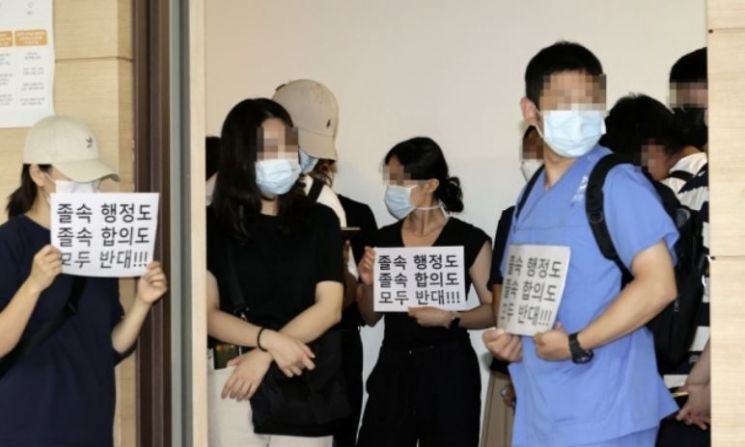 On September 4, 2020, residents protested with placards in front of the signing ceremony venue for the government ruling party and medical community's public healthcare expansion policy negotiations held at the Korea Health Promotion Institute in Jung-gu, Seoul, opposing the hasty agreement. [Image source=Yonhap News]
The reasons why residents are not uniting to fight the government despite the KMA demanding the cancellation of administrative sanctions against residents and the difficulty of reemployment at other medical institutions appear to be a loss of will to continue training, distrust stemming from the 2020 conflict, and unilateral decision-making by the KMA executive.
First, the medical community consensus is that many residents have lost their will to train due to the government's hostile attitude. Former representative Ryu said, "When residents realized that the government's conciliatory measures, such as accepting resignation letters in early June, were ultimately deceptive, they became more hardened," adding, "In this situation where trust in the government has disappeared, residents in essential departments like obstetrics, internal medicine, and surgery are unlikely to return."
Distrust and poor communication with the KMA are also cited as causes. A physician who was active in KIRA during the 2020 medical conflict said, "Seeing residents betrayed in 2020 and the current KMA president unilaterally announcing matters not agreed upon with KIRA seem to have had an impact."
He explained, "In 2020, then KMA president Choi Daejip lost the trust of residents by negotiating with the government without sufficient communication with KIRA," and added, "Choi Daejip was from the National Doctors' Alliance, and I understand that many current executives are from the same group." He continued, "Initially, the relationship between the current executive Im Hyuntaek and Chair Park Dan did not seem bad, but after repeatedly announcing unagreed matters as if they were agreed upon, trust was lost."
In fact, Chair Park Dan stated in a statement the day before, "I clearly said I would draw a line if unagreed matters were mentioned in the media. It is very regrettable that such wasteful remarks are circulating within the medical community." He also rejected the KMA's three major demands, saying, "They are clearly a retreat from KIRA's seven demands, and we cannot agree. I hope KMA president Im Hyuntaek does not follow in the footsteps of former president Choi Daejip."
Notably, those currently residents in 2024 were medical students who took collective action during the 2020 medical conflict and faced the risk of being unable to take the national medical licensing exam. In 2020, only 14% of targeted medical students took the exam after refusing to apply. The government stated that since the agreement did not include a clause for retaking the exam, it would only allow a retake after nearly four months of struggle following the agreement.
There are also calls for the government and KMA to adopt a more progressive attitude for the resigned residents to come to the negotiation table. The physician said, "Because the government has emphasized legal responses so much, it is difficult for residents to reconcile differences," adding, "If the KMA was going to announce three demands after KIRA's seven demands were made public, they should have coordinated or communicated with KIRA beforehand. These issues must be clearly improved, and they must persuade residents that a situation like the 2020 conflict will not happen again."
However, it is expected that additional conciliatory measures from the government and KMA toward the resigned residents will be difficult to come by. A Ministry of Health and Welfare official said, "The government's position to be lenient if they return has not changed," but added, "We have already said it is difficult to accept requests to cancel all administrative sanctions."
© The Asia Business Daily(www.asiae.co.kr). All rights reserved.
![Clutching a Stolen Dior Bag, Saying "I Hate Being Poor but Real"... The Grotesque Con of a "Human Knockoff" [Slate]](https://cwcontent.asiae.co.kr/asiaresize/183/2026021902243444107_1771435474.jpg)

















