Won-Dollar Exchange Rate Opens at 1,392 Won, Highest in 1 Year and 8 Months Based on Opening Price
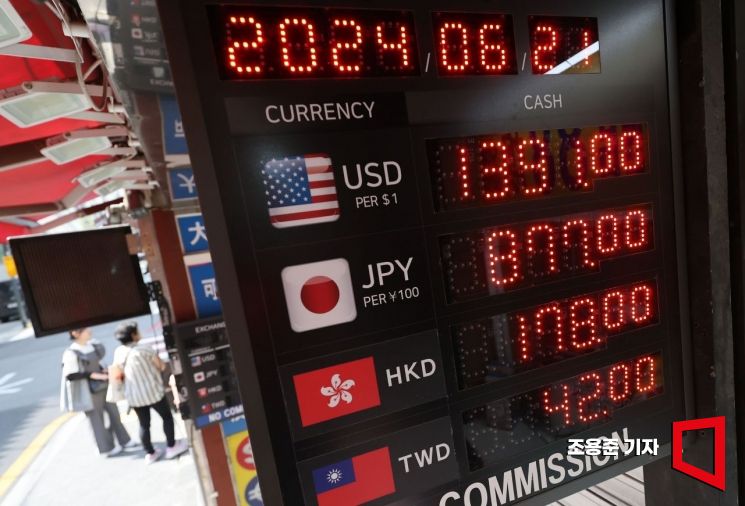 The won/dollar exchange rate started at 1,392.0 won, up 7.4 won. On the 21st, at a currency exchange booth in Myeongdong, Seoul, the won/dollar exchange rate was trading around 1,391.0 won. On this day, South Korea was excluded from the US currency watchlist again in the first half of this year, following the second half of last year. Photo by Jo Yongjun jun21@
The won-dollar exchange rate hit its highest level in 1 year and 8 months based on the opening price due to the strong dollar. As concerns over exchange rate instability persist, foreign exchange authorities have significantly increased the foreign exchange swap transaction limit with the National Pension Service to enhance market stability.
On the 21st, in the Seoul foreign exchange market, the won-dollar exchange rate opened at 1,392 won, up 7.3 won from the previous trading day. This is the highest level in 1 year and 8 months since the 1,394 won recorded on November 8, 2022, based on the opening price. During the session, the won-dollar exchange rate rose to 1,393.50 won but was at 1,390.22 won as of 10:27 AM.
The rise in the exchange rate on this day is analyzed to be due to the strong dollar caused by the weak euro, which led to a simultaneous weakening of Asian currencies. The previous day, the dollar strengthened following the Swiss National Bank’s surprise interest rate cut and expectations of a rate cut by the Bank of England in August.
Choi Ye-chan, a researcher at Sangsangin Securities, explained, "The Swiss National Bank cut policy rates twice consecutively, contrary to market expectations, causing advanced country currencies to weaken due to the interest rate gap with the U.S., resulting in a relatively strong dollar. China and Japan also showed weakness as they pursued more accommodative monetary policies compared to the U.S."
Ha Geon-hyung, a researcher at Shinhan Investment Corp., explained, "The exchange rate rose as Asian currencies weakened alongside the strong dollar caused by the weak euro."
The won-dollar exchange rate has exceeded an average of 1,300 won per month for 11 consecutive months from August last year to this month. This is the first time that the 1,300 won level has persisted for such a long period.
The main reason for the exchange rate’s high-level trend is the very strong dollar. Due to high inflation and strong employment, the timing of the U.S. base interest rate cut has been delayed, causing the strong dollar as a safe asset to persist for a long time.
From August last year to the first quarter of this year, the won-dollar exchange rate stayed in the low 1,300 won range, but in the second quarter, it rose to the high 1,300 won range. In April, it even reached 1,400 won during the session.
As the won-dollar exchange rate continues its high-level trend, responses from foreign exchange authorities such as the Ministry of Economy and Finance and the Bank of Korea are also intensifying. On this day, foreign exchange authorities announced that they agreed to increase the foreign exchange swap transaction limit with the National Pension Service from the existing 35 billion dollars to 50 billion dollars until the end of 2024.
Foreign exchange authorities emphasized that the foreign exchange swap with the National Pension Service can absorb the National Pension Service’s demand for spot foreign exchange purchases during foreign exchange market instability, thereby helping to alleviate supply-demand imbalances in the foreign exchange market.
If the National Pension Service’s demand for dollar purchases to invest in overseas stocks is replaced by the Bank of Korea’s foreign exchange reserves, it will have the effect of curbing won depreciation.
An official from the foreign exchange authorities explained, "This measure is to strengthen the response capacity of the two institutions, considering the experience of effectively responding to increased volatility in the foreign exchange market through foreign exchange swap transactions and the continued overseas investment by the National Pension Service."
After the announcement of the swap by the foreign exchange authorities, the won-dollar exchange rate slightly reduced its upward momentum.
Meanwhile, Korea was removed from the U.S. currency watchlist again in the first half of this year, following the second half of last year. Korea was excluded from the U.S. currency watchlist once again in November last year, seven years after 2016. The U.S. Treasury Department designated seven countries including China, Japan, Malaysia, Singapore, Taiwan, Vietnam, and Germany as currency watchlist countries the previous day.
© The Asia Business Daily(www.asiae.co.kr). All rights reserved.
![Clutching a Stolen Dior Bag, Saying "I Hate Being Poor but Real"... The Grotesque Con of a "Human Knockoff" [Slate]](https://cwcontent.asiae.co.kr/asiaresize/183/2026021902243444107_1771435474.jpg)















