Maturity of Redeemable Convertible Preferred Shares Approaching
Financial Burden Increases Upon Redemption
SK Inc.'s Value and Dividends Also Decline
SK E&S, a key affiliate in SK Group's business restructuring (rebalancing), is confirmed to have over 3 trillion won in funds to repay in two years. Recently, a prominent restructuring scenario within SK Group involves the merger of SK E&S and SK Innovation, but considering the increasing financial burden, the integration of the two companies is expected to be difficult.
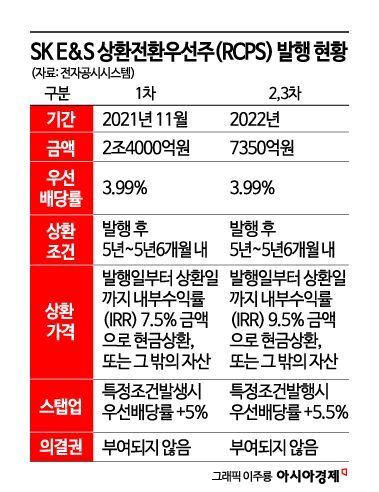
According to industry sources on the 21st, SK E&S will face significant financial burdens in two years due to redeemable convertible preferred shares (RCPS) issued since 2021. RCPS are preferred shares that can be redeemed in cash or converted into common stock upon maturity. SK E&S raised 3.1 trillion won through RCPS from the global private equity firm Kohlberg Kravis Roberts (KKR) in 2021 and 2022. The first RCPS maturity is in the second half of 2026.
The RCPS worth 2.4 trillion won issued in November 2021 requires an annual dividend payment of about 96 billion won at a preferred dividend rate of 3.99% at maturity. This means an additional 480 billion won must be paid over five years separately from the principal amount. Separately, an internal rate of return (IRR) of 7.5% (489.3 billion won) was guaranteed at the time of RCPS issuance.
Therefore, if KKR exercises the redemption right against SK E&S, a total of 3.3693 trillion won will be needed, including the principal of 2.4 trillion won, dividends of 480 billion won, and additional IRR guarantee costs of 489.3 billion won. Since the redemption terms include 'other assets' besides cash, SK E&S could also sell its city gas subsidiary, but giving up the city gas business, which accounts for 46% of sales (power generation business accounts for 42%), would inevitably have a significant impact on the overall business.
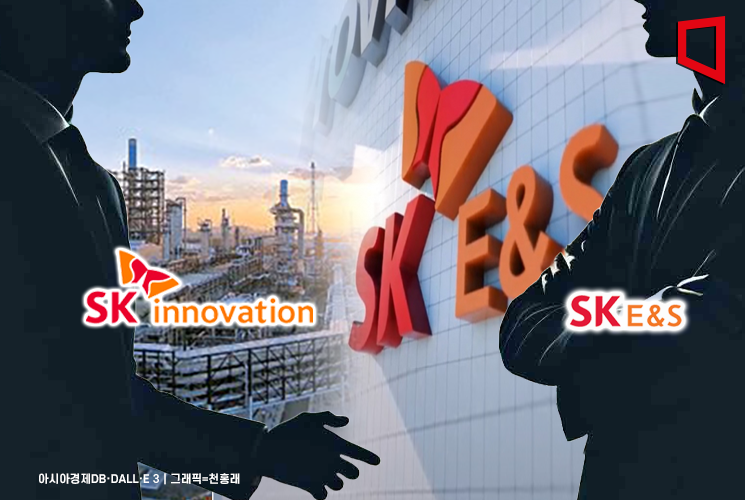
SK intends to revive its struggling battery business by merging E&S and SK Innovation, but the reason why the response is "not easy" is because it is uncertain whether SK E&S can support the battery business while simultaneously raising these funds.
An industry insider expressed concern, saying, "The role SK E&S can play is limited to paying dividends worth several hundred billion won, which is not a significant contribution compared to the trillion-won scale battery investment. The crisis could spread across the entire group, causing difficulties for everyone."
SK E&S has so far served as a cash cow for the holding company SK Inc. However, if SK E&S merges with SK Innovation, it will no longer be able to pay dividends to SK Inc. as it does now. This will directly affect SK Chairman Chey Tae-won. Amid his ongoing divorce lawsuit, the merger of the two companies will not only lower the value of SK Inc., his core asset, but also impact dividend income.
Since shareholder opposition is also expected, persuading the board of directors to agree to the merger does not seem easy. Financial burdens from the merger, shareholder backlash, and the reduction of dividends to SK Inc. are complicating the rebalancing scenario further.
© The Asia Business Daily(www.asiae.co.kr). All rights reserved.
![Clutching a Stolen Dior Bag, Saying "I Hate Being Poor but Real"... The Grotesque Con of a "Human Knockoff" [Slate]](https://cwcontent.asiae.co.kr/asiaresize/183/2026021902243444107_1771435474.jpg)


















