Even if a driver causes an accident by crossing a white solid line on a general road while driving, the Supreme Court's full bench has ruled that prosecution is not possible if the driver has comprehensive insurance or if the victim does not wish to press charges.
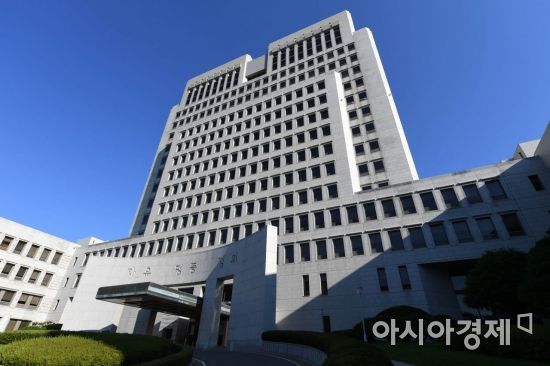
On the 20th, the Supreme Court full bench (Presiding Justice Lee Dong-won) unanimously upheld the lower court's ruling to dismiss the indictment against Mr. A, who was charged with violating the Traffic Accident Processing Act.
The court stated, "The white solid line does not fall under the category of 'safety signs indicating prohibition of passage,' so special punishment provisions apply to drivers who cause traffic accidents by crossing it."
The key issue in the trial was whether the white solid line, which signifies 'lane change restriction,' can be considered a passage prohibition sign. Under current law, if a driver causes a traffic accident resulting in injury, prosecution is not pursued if the victim expresses a desire not to press charges or if the driver has comprehensive automobile insurance. However, if the driver violates a safety sign that prohibits passage or commits certain negligent acts, punishment is warranted.
The Supreme Court focused on the fact that the Road Traffic Act separately stipulates punishment provisions for 'prohibition of passage' and 'prohibition of lane changes.' The court explained, "Although different prohibitory norms are defined, interpreting a violation of the lane change prohibition as a violation of passage prohibition to apply the first proviso is an interpretation unfavorable to the defendant that deviates from the objective meaning of the text."
Furthermore, the court concluded, "While it is prohibited to change lanes by violating the lane change restriction line, if it is possible to continue driving in that direction after changing lanes, the violation can be seen as a breach of 'restriction on passage method,' but it cannot be regarded as a 'violation of passage prohibition' as stated in the legal text."
Mr. A was indicted in July 2021 for changing lanes by crossing a white solid line on a one-way four-lane road in Dalseo-gu, Daegu, which caused a taxi following behind to brake suddenly, resulting in a sprain.
The prosecution filed charges, arguing that the lane was "a place where a white solid line, a safety sign restricting lane changes, was installed." However, the first and second instance courts ruled that the white solid line could not be considered an exception to the special provisions and dismissed the indictment because Mr. A had comprehensive insurance.
The prosecutor appealed, but on this day, the Supreme Court also found no issue with the lower court's judgment.
A Supreme Court official stated, "This ruling changes previous precedents that held the provisions on offenses requiring victim's consent or special provisions for comprehensive insurance do not apply to traffic accidents caused by crossing white solid lines," adding, "The significance of the ruling lies in strictly interpreting the meaning of 'prohibition of passage' according to the principle of legality, so that the scope of criminal punishment is not unjustly expanded contrary to the legislative intent of the Traffic Accident Processing Act."
© The Asia Business Daily(www.asiae.co.kr). All rights reserved.
![Clutching a Stolen Dior Bag, Saying "I Hate Being Poor but Real"... The Grotesque Con of a "Human Knockoff" [Slate]](https://cwcontent.asiae.co.kr/asiaresize/183/2026021902243444107_1771435474.jpg)
















