Workers wearing safety helmets and safety vests gather in small groups to perform plastering work. They fill small gaps between large stones to prevent cracks. Before noon, the site temperature was 32 degrees Celsius, and the forecast predicted a peak temperature of up to 34 degrees Celsius at midday. Although the scorching sunlight feels harsh on the skin, the workers do not pause their hand movements. This is the scene at the landslide recovery site where the final installation of sabangdam is underway. Sabangdam is a type of embankment installed to prevent landslides or floods.
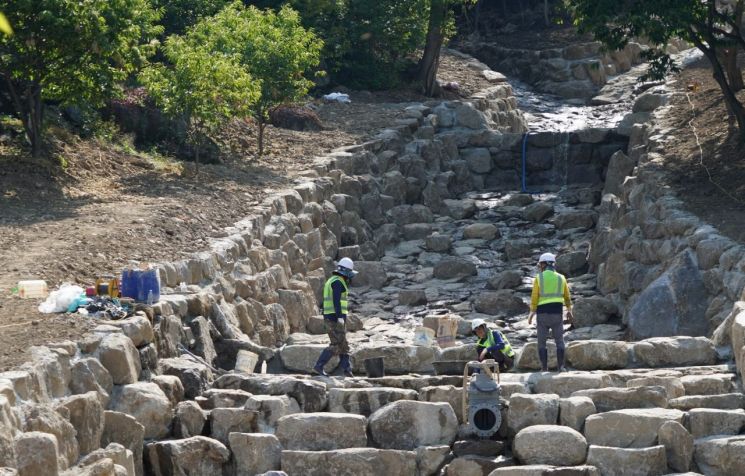 Under the blazing sun exceeding 30 degrees Celsius at midday, officials at the landslide restoration site in Hoehak-ri, Sagok-myeon, Gongju are carrying out the final plastering work. Photo by Korea Forest Service
On the 19th, we visited Hoehak-ri, Sagok-myeon, Gongju-si, Chungnam Province. Sagok-myeon is located in a deep mountain valley, so remote that it is said residents were unaware of wars during the Japanese colonial period and the Korean War.
This peaceful village, which remained undisturbed even during wartime, suffered a disaster last July. Due to heavy rainfall, the soil moisture content increased rapidly, causing a landslide that collapsed and washed away soil from high mountain areas down to near the village.
At the time of the landslide, about 20 residents from around 10 households lived near the affected area. However, thanks to rapid communication and evacuation, no casualties occurred, and only 1.94 hectares of forest were lost. The people working under the blazing sun are officials in charge of installing sabangdam at the landslide site in Hoehak-ri, Sagok-myeon.
As of that day, the recovery work progress rate exceeded 90%. Site officials expected to complete the construction before the rainy season begins at the end of this month.
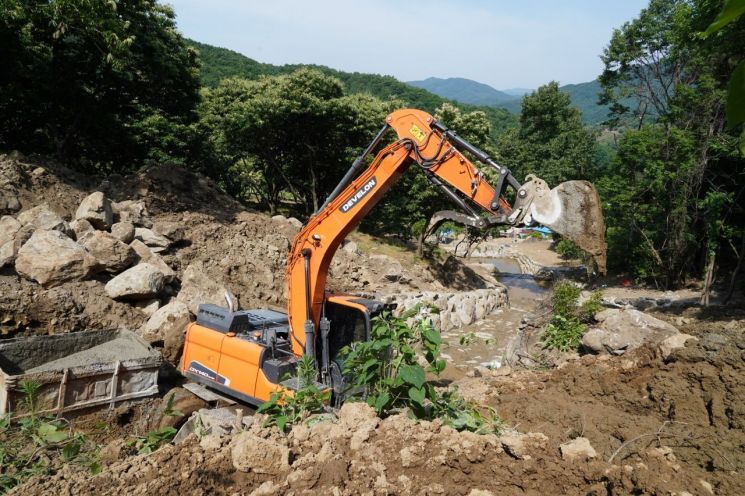 Heavy machinery is conducting restoration work in the Hoihak-ri area of Sagok-myeon, Gongju-si, Chungnam, where a landslide occurred due to heavy rain in July last year. Provided by the Korea Forest Service
According to the Korea Forest Service, around July last year, a total of 2,410 landslides occurred nationwide, causing forest damage over 459 hectares and property damage amounting to 85.9 billion KRW.
There were also significant casualties. Human losses due to landslides were concentrated in Gyeongbuk and Chungnam. In Gyeongbuk, 4 people in Yecheon, 4 in Bonghwa, and 2 in Yeongju lost their lives, while in Chungnam, 2 in Nonsan and 1 in Cheongyang died due to landslides.
Landslides are heavily influenced by rainfall. The Korea Forest Service issues landslide prediction alerts to local residents and officials based on soil moisture content: a 'caution' at 80%, a 'preliminary warning' at 90%, and a 'warning' at 100%.
Soil moisture content refers to the amount of water held in the soil. When a large amount of rain falls at once or rain continues over several days, the soil moisture content rises, increasing the risk of landslides. Ultimately, rainfall has an absolute impact on landslides.
In fact, last year's rainy season rainfall (648.7 mm) was the third highest since 1973. Especially in July, when casualties were concentrated, localized heavy rain fell mainly along the frontal cloud band in the central region, causing numerous landslides in Gyeongbuk, Chungbuk, and Chungnam, according to the Korea Forest Service.
There is also analysis that landslide damage increased as landslides starting in mountainous areas met adjacent farmland (such as orchards), or soil runoff from farmland led to landslides in mountainous areas.
The case of Sagok-myeon is no different. Most residents of Sagok-myeon cultivate chestnut trees deep in the mountains or farm rice paddies and fields. When a landslide occurs, soil and debris flow down from above, posing a significant threat to residents' living areas and farmland.
Landslides also have a high risk of recurrence. If heavy rain falls again on weakened mountain ground, secondary damage is highly likely. This is why the Korea Forest Service is rushing recovery work such as installing sabangdam around landslide sites.
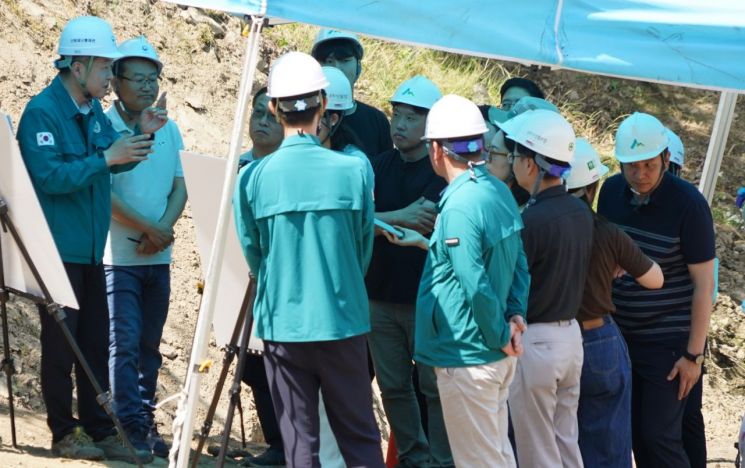 Jongsoo Lee, Forest Disaster Control Officer at the Korea Forest Service (first from the left), is explaining the progress of the restoration work for the landslide in the Hoihak-ri area of Sagok-myeon, Gongju, on the 19th. Courtesy of the Korea Forest Service
As of the 16th of this month, the nationwide landslide recovery work progress rate is 86%, with most projects in their final stages. However, due to limited equipment and manpower, there are concerns that progress may be relatively slow. The Korea Forest Service plans to allocate resources such as equipment and personnel by 'selection and concentration' to raise the recovery progress rate to 100% before the rainy season fully begins at the end of this month.
Lee Jong-su, Disaster Control Officer at the Korea Forest Service, said, “This summer is forecasted to have more rainfall than usual, making the possibility of landslides very high. The Korea Forest Service is committed to completing the ongoing sabangdam installation work to minimize landslide damage and will also check and establish a rapid evacuation system for residents in case of emergencies.”
He added, “There is a saying that natural disasters like landslides ‘cannot be prevented, but can be avoided.’ Residents in landslide-prone areas should pay close attention to landslide risk warnings during the rainy season, and if an evacuation alert is issued, they should promptly leave the area and move to a safe place.”
© The Asia Business Daily(www.asiae.co.kr). All rights reserved.



















