Won-Dollar Exchange Rate in the 1300 Won Range Continues for 8 Months
US Interest Rate Cut Expected to Be Delayed
Possibility of Maintaining 1300 Won Range in the Second Half of the Year
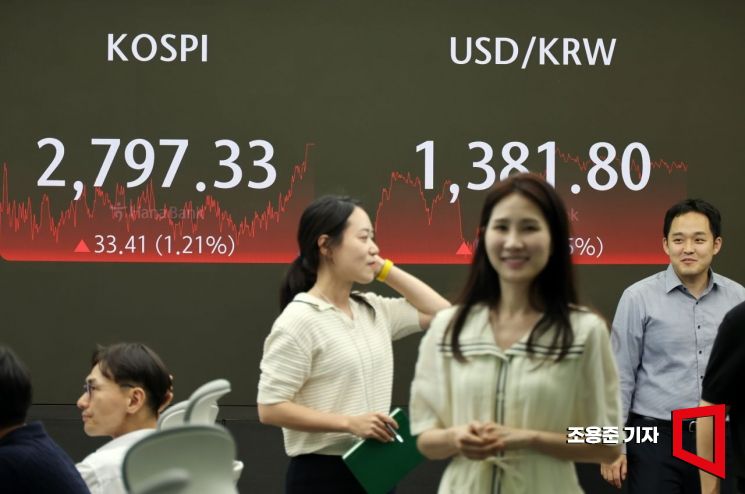 On the 19th, buoyed by the strong performance of the U.S. stock market, the KOSPI surpassed the 2,790 mark for the first time in 2 years and 5 months, setting a new yearly high. Employees are seen working in the dealing room at the Hana Bank headquarters in Jung-gu, Seoul. Photo by Jo Yongjun jun21@
The won-dollar exchange rate has remained in the 1300 won range for eight consecutive months. As the expected timing for the U.S. Federal Reserve's interest rate cut is pushed back, there are forecasts that the high exchange rate era will continue for a considerable period.
According to the Seoul foreign exchange market, on the 19th, the won-dollar exchange rate closed at 1381.8 won, up 0.7 won from the previous trading day. This is the highest level since the 31st of last month based on the closing price.
The won-dollar exchange rate has exceeded an average of 1300 won per month for 11 consecutive months from August last year to this month. This is the first time that the 1300 won range exchange rate has persisted for such a long period.
From August last year to the first quarter of this year, the won-dollar exchange rate stayed in the low 1300 won range, but in the second quarter, it rose to the high 1300 won range. In April, it even reached 1400 won intraday.
The main reason for the high exchange rate rally is the very strong flow of the dollar. Due to high inflation and strong employment, the timing of the U.S. Federal Reserve's interest rate cut has been delayed, causing the dollar's strength as a safe-haven asset to persist for a long time. It is not only the Korean won that is weak; other currencies such as Japan's yen and China's yuan are also weakening due to the strong dollar.
An increase in overseas investments by domestic residents is also cited as a cause of the won's weakness. Kim Ho-jung, an economist at Yuanta Securities, explained, "Currently, the won-dollar exchange rate is judged to have risen to an unusual level despite Korea's economic indicators. From a structural perspective, the increase in external assets and the rapid growth in external securities investment are factors that raise the fundamental level of the won-dollar exchange rate." He added, "Given the current structure, it seems difficult to return to the 1100 won range exchange rate experienced in the past."
U.S. Interest Rate Cut Needed to Lower Exchange Rate
Experts believe that a U.S. interest rate cut is necessary for the exchange rate to decline. However, with the timing of the U.S. rate cut being pushed back and uncertainty about the extent of the cut remaining high, many forecasts expect the high exchange rate in the 1300 won range to continue for the time being.
The Federal Reserve (Fed) lowered its previous forecast of three interest rate cuts to one in the new dot plot (a chart showing future interest rate projections) released on the 12th. Accordingly, the market expects the Fed to cut rates around September or November.
The Fed still intends to lower interest rates while monitoring the data. Thomas Barkin, President of the Richmond Fed, said in an interview with local media on the 18th, "A scenario of one rate cut within this year is reasonable," but added, "The extent and timing of adjustments will depend on the data." Earlier, Fed Chair Jerome Powell also stated, "We do not think it is appropriate to cut rates without confidence that inflation will come down to the 2% target."
As the expected timing of the U.S. interest rate cut is delayed and the magnitude of the cut remains uncertain, there are expectations that the timing for the won-dollar exchange rate to turn downward will be postponed. Choi Jae-min, an economist at Hyundai Motor Securities, diagnosed, "The dollar will weaken in line with the Fed's rate cut timing, but the decline is expected to be limited, and it will take time for a trend reversal to a downward trajectory."
Lee Joo-won, an economist at Daishin Securities, predicted, "The Fed has delayed the start of the rate cut from July to September, and with the expansion of uncertainties outside the U.S., such as European political risks, the period for a sharp dollar weakening will be delayed."
© The Asia Business Daily(www.asiae.co.kr). All rights reserved.
![Clutching a Stolen Dior Bag, Saying "I Hate Being Poor but Real"... The Grotesque Con of a "Human Knockoff" [Slate]](https://cwcontent.asiae.co.kr/asiaresize/183/2026021902243444107_1771435474.jpg)
















