Former Lawmaker Choi Un-yeol Elected as 47th President of Hangonghoe
Led Revision of External Audit Act (New External Audit Act) in National Assembly
"If Value-Up Succeeds, Audit Designation Exemption? It Will Value-Down"
Former Democratic Party of Korea lawmaker Choi Un-yeol was elected as the 47th president of the Korean Institute of Certified Public Accountants (KICPA). Upon his election and immediate assumption of office, President Choi expressed his ambition to uphold systems for accounting transparency, including the amendment of the External Audit Act (New External Audit Act).
Overwhelming Vote Share... "Will Also Review Other Candidates' Pledges"
On the 19th, KICPA held its regular general meeting at the 63 Convention Grand Ballroom in Yeouido, Seoul, announcing that former lawmaker Choi was elected as the new president. Choi said, "Although I have no practical accounting experience, I felt the earnest wishes of everyone who elected me," adding, "I will actively implement other candidates' pledges if they are necessary and feasible for the development of the accounting industry."
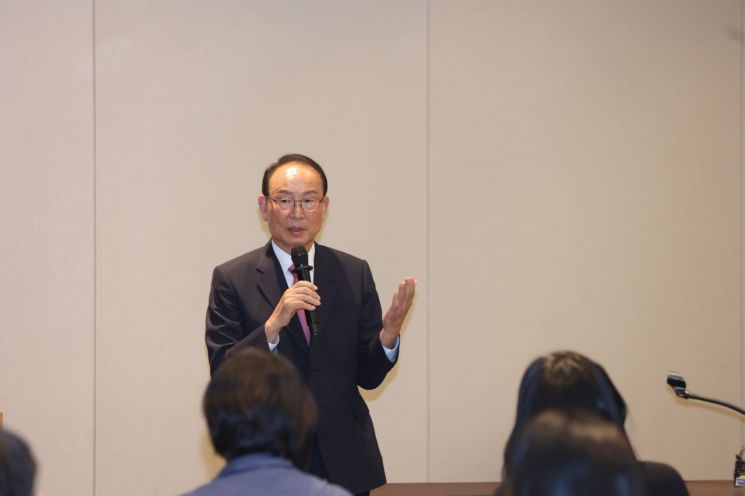 Choi Un-yeol, the 47th president of the Korean Institute of Certified Public Accountants, is giving his acceptance speech at a press meeting.
 [Photo by Korean Institute of Certified Public Accountants]
Among 22,304 members with voting rights, 14,065 (63.06%) voted in this election, where President Choi secured first place with 46.06% of the votes. Running alongside him were Na Cheol-ho, CEO of Jaejeong Accounting Corporation, and Lee Jeong-hee, Deloitte Anjin's president, who received 28.35% and 25.59% of the votes, respectively.
President Choi graduated from Gwangju Jeil High School and Seoul National University with a degree in Business Administration, and earned his master's and doctoral degrees from the University of Georgia. He later worked as a professor in the Business Administration Department at Sogang University and served as chairman of the KOSDAQ Committee, president of the Korean Securities Association, and a member of the Bank of Korea's Monetary Policy Committee. He also served as a proportional representative lawmaker for the Democratic Party of Korea in the 20th National Assembly.
He is recognized as a key figure who led the legislation for the advancement of corporate accounting. While active in the National Assembly's Political Affairs Committee, he designed the periodic auditor designation system (Designated Audit System) and led the legislation of the New External Audit Act based on it. The Designated Audit System is a system where a company autonomously appoints an external auditor for six years, after which the auditor is designated by the Securities and Futures Commission under the Financial Services Commission for the next three years.
Former KICPA president Kim Young-sik concluded the general meeting by saying, "(If KICPA) fulfills its social responsibilities, it will naturally be recognized by the nation and society," adding, "From the perspective that public interest takes precedence over private interest, I hope accountants unite tightly and become the most respected and beloved expert group in Korea. I will now step down."
"Exemption from Designated Audit System Cannot Be a Value-Up Incentive"
At the subsequent press meeting with the new president, President Choi emphasized the necessity of systems to secure accounting transparency, saying, "I believe the slogan by former KICPA president Choi Joong-kyung, 'The economy stands straight only when accounting stands straight,' should remain a continuous motto."
Regarding the New External Audit Act, he said, "From a businessperson's perspective, I understand that it is perceived as regulation and that costs have risen significantly, causing difficulties," but added, "I consider external audit costs as investments that increase corporate value. This is something I emphasized whenever I faced protests in the National Assembly, and I believe accounting transparency suitable for the company's scale is necessary. Accounting transparency is essential for startups, investment, and deregulation. Based on this, I will meet and communicate one by one with political circles, the media, and lawmakers who hold negative opinions."
Regarding the promotion of the 'Basic Accounting Act,' which encompasses accounting-related laws, he said, "We need to fundamentally resolve issues related to audits. There are many cases where the domain of accountants is encroached upon by holders of other qualifications, so I will create a Basic Accounting Act containing fundamental provisions," adding, "I will form a task force (TF) immediately after taking office. Although it may take a long time to enact, considering the role accounting plays in the economy, it is an issue to be resolved with various policy and supervisory departments."
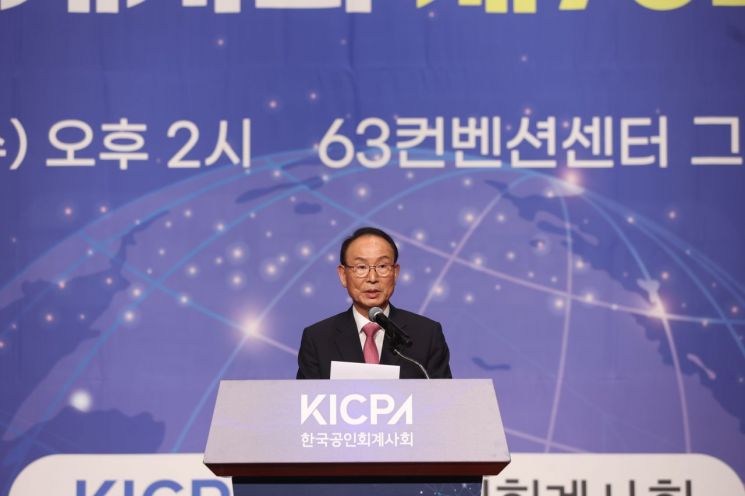 On the 19th, at the Grand Ballroom of the 63 Convention Center in Yeouido, Choi Un-yeol, the 47th president, delivered his inaugural speech at the 70th Regular General Meeting of the Korean Institute of Certified Public Accountants.
 [Photo by Korean Institute of Certified Public Accountants]
In response to criticism that "the policy direction differs from that of the Yoon Seok-yeol administration," he said, "It does not conflict from the perspective of being 'pro-business.'" He commented on the government's value-up program, saying, "If corporate value rises, neither shareholders, creditors, nor even tax authorities suffer losses," but added, "However, major shareholders may be skeptical about the increase in corporate value. Since inheritance and gift taxes are punitively high at 65%, the burden on major shareholders or companies can be significant, but this part just needs to be resolved well."
However, regarding the government's earlier announcement that "exemption from the Designated Audit System will be granted as part of incentives for value-up excellent companies," he drew a clear line, saying, "It will be value-down, not value-up." President Choi pointed out, "Value-up means properly evaluating corporate value," adding, "Value-up and accounting transparency are not mutually exclusive. Internationally, the value of accounting transparency is prioritized more."
Additionally, President Choi expressed confidence, saying, "I will have frank conversations with financial authorities. (Including during my time as a lawmaker,) I have had various exchanges with the Financial Services Commission and the Financial Supervisory Service," and added, "I believe we can communicate without major issues." He also said, "I will meet with Financial Supervisory Service Governor Lee Bok-hyun as soon as possible," adding, "Governor Lee has likely had a strong awareness of accounting transparency issues since his time in the legal field. Meeting and talking will broaden our consensus."
President Choi's term is two years starting from this day. Vice President elected without opposition is accountant Moon Byung-moo (Future Accounting Corporation), and auditor elected without opposition is accountant Park Geun-seo (Seonghyeon Accounting Corporation).
© The Asia Business Daily(www.asiae.co.kr). All rights reserved.
![Clutching a Stolen Dior Bag, Saying "I Hate Being Poor but Real"... The Grotesque Con of a "Human Knockoff" [Slate]](https://cwcontent.asiae.co.kr/asiaresize/183/2026021902243444107_1771435474.jpg)

















