Stacking Battery Cells in Large Container Boxes
Projected to Grow to 362 Trillion KRW by 2030
Battery companies are consecutively unveiling new energy storage systems (ESS). Analysts say this is related to the growing need for energy storage as renewable energy generation expands. There are also forecasts that the demand will surpass that of electric vehicles.
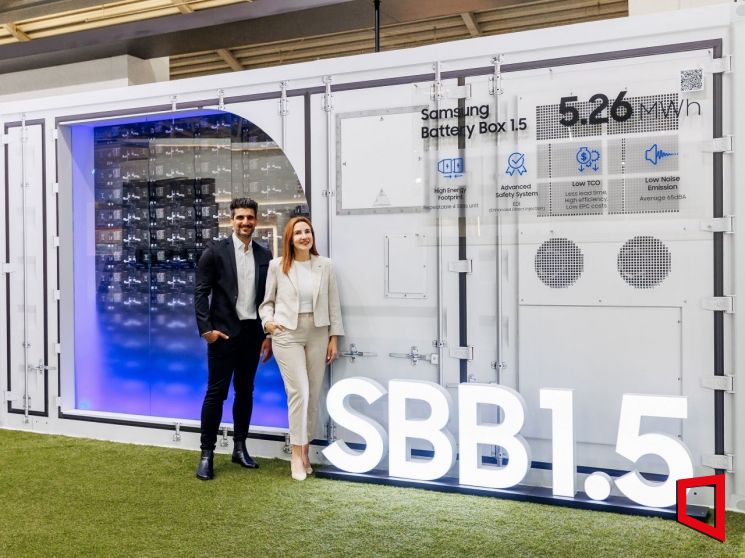 On the 19th (local time), Samsung SDI showcased the upgraded Samsung Battery Box (SBB) 1.5 at 'InterBattery Europe 2024' held in Munich, Germany. (Provided by Samsung SDI)
On the 19th (local time), Samsung SDI unveiled the ‘Samsung Battery Box (SBB) 1.5’ at the European InterBattery exhibition held in Munich, Germany. It is an ESS installed with high-nickel NCA (nickel-cobalt-aluminum) battery cells, modules, and racks inside a container box, and can be used immediately once connected to the power grid.
LG Energy Solution also introduced its first residential ESS and grid products using LFP cells on the same day. The residential ESS is modular, allowing easy insertion of packs to adjust capacity, with expansion possible up to 15.5kWh.
ESS has the advantage of storing surplus electricity or electricity generated from renewable energy when power demand is low, and using it when power demand surges. This plays an important role in compensating for the intermittency issues of renewable energy. It complements the drawbacks, enabling a more stable and sustainable energy supply.
ESS typically takes the form of thick, book-shaped battery cells placed inside large containers. Visually, it resembles a container storage yard. It not only improves power efficiency but also greatly helps stabilize voltage and frequency, thereby enhancing power quality.
The growth of the ESS market is expected to bring significant changes across the energy industry. Bloomberg New Energy Finance (BNEF) predicted that the global ESS market will grow from $11 billion (approximately 15.2 trillion KRW) in 2021 to $262 billion (approximately 362.1 trillion KRW) by 2030.
There are also forecasts that it will grow beyond the scale of the electric vehicle market. Elon Musk, CEO of Tesla, said in January, "For years, the ESS business will grow much faster than electric vehicles, and it actually is." The expansion of the artificial intelligence (AI) industry and aggressive data center construction, which will cause a surge in power demand, is also seen as a major opportunity for ESS market growth.
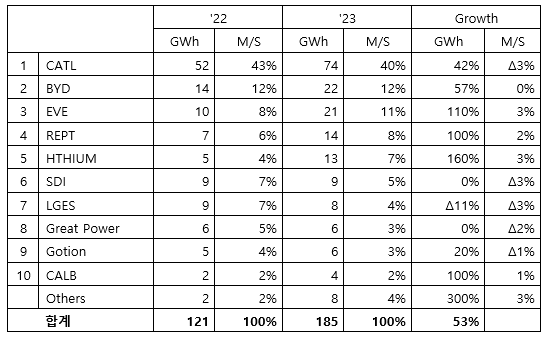
China still holds significant influence in the ESS market. According to SNE Research, China is the largest ESS market (84GWh), accounting for 45% of the total market, followed by North America (55GWh) at 30%, and Europe and other regions (23GWh) at 12%. Looking at sales performance by battery companies, Chinese battery manufacturers based on LFP (lithium iron phosphate) have shown significant growth. Chinese-made batteries, which are not subject to the Inflation Reduction Act (IRA), dominate not only the North American but also the European markets.
Domestic battery companies view the expansion of eco-friendly energy as an opportunity for ESS growth. According to the 11th Basic Plan for Electricity Supply and Demand, the government plans to increase the share of renewable energy in power generation and estimates that an ESS capacity of 21.5GW will be needed by 2038, which will be met through pumped storage and ESS.
Samsung SDI plans to add LFP batteries to its battery lineup for power ESS starting in 2026, while Hanwha Solutions Q CELLS division is responsible for the world’s largest ESS project, the ‘Cunningham Energy Storage Project Development and EPC (Engineering, Procurement, and Construction).’ This project is operated by the Spanish energy company Acciona and has a capacity of 380MWh. This amount of power can supply approximately 63,000 average U.S. households for five hours.
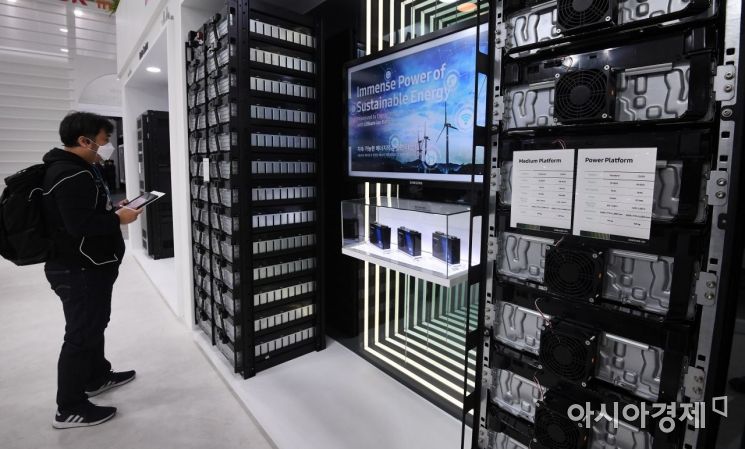 On the 21st, visitors are touring the Samsung SDI exhibition hall at 'InterBattery 2020,' a battery industry exhibition held at COEX in Gangnam-gu, Seoul. Now in its 8th year, InterBattery showcases the core technologies of 'K-Battery,' including batteries and key materials for automobiles, smartphones, and energy storage systems (ESS). Photo by Hyunmin Kim kimhyun81@
© The Asia Business Daily(www.asiae.co.kr). All rights reserved.
![Clutching a Stolen Dior Bag, Saying "I Hate Being Poor but Real"... The Grotesque Con of a "Human Knockoff" [Slate]](https://cwcontent.asiae.co.kr/asiaresize/183/2026021902243444107_1771435474.jpg)

















