"Lysosomal Storage Disease (LSD) requires early diagnosis before damage occurs to prevent the progression of symptoms above all else."
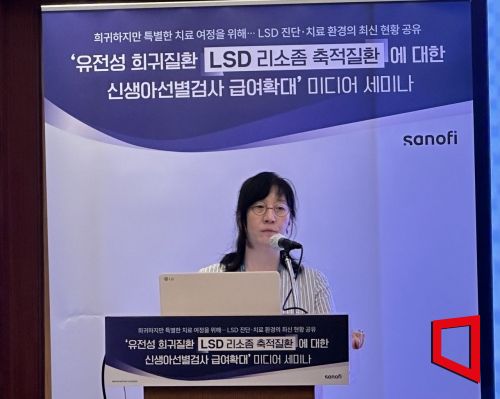 Professor Chae Jong-hee from the Department of Clinical Genomic Medicine at Seoul National University Hospital is presenting at the seminar on "Expansion of Newborn Screening Coverage for Hereditary Rare Disease LSD" held on the morning of the 19th in Jung-gu, Seoul.
 [Photo by Lee Chun-hee]
LSD, a rare disease occurring in about 1 in 7,000 to 8,000 people, has recently seen an expansion in newborn screening coverage starting this January. At the seminar titled 'Expansion of Newborn Screening Coverage for Hereditary Rare Disease LSD' held on the morning of the 19th in Jung-gu, Seoul, experts welcomed the expanded coverage but also suggested that support for early diagnosis and early treatment should be further increased.
LSD is a disease caused by genetic factors that disrupt normal metabolism in the body. Lysosomes, which are organelles within cells, contain enzymes that break down substances unnecessary for the body. When these enzymes are not produced or malfunction, substances that should be degraded accumulate inside the cells, leading to destruction of cells and organs.
Depending on which enzyme among various intracellular enzymes is deficient, different diseases such as Pompe disease, Fabry disease, mucopolysaccharidosis, and Gaucher disease manifest. Pompe disease causes motor function impairment and can lead to fatal symptoms such as muscle weakness and cardiomyopathy. Fabry disease can also cause organ dysfunction or destruction as the disease progresses, often resulting in death from related complications in the 40s to 50s.
Treatment for LSD includes enzyme replacement therapy, which involves administering enzymes that perform similar functions to the deficient ones. Among the more than 50 to 100 types of LSD, treatments have been developed for Pompe disease, mucopolysaccharidosis (types 1 and 2), Fabry disease, and Gaucher disease.
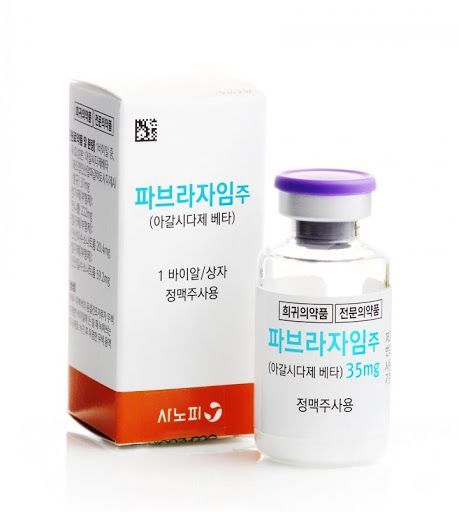
In Korea, Sanofi’s Nexviazyme (Pompe disease), Aldurazyme (mucopolysaccharidosis), Fabrazyme (Fabry disease), Cerezyme (Gaucher disease), and GC Green Cross’s Hunterase (mucopolysaccharidosis type 2) have been approved. GC Green Cross is also developing Fabry disease treatment GC1134A with Hanmi Pharmaceutical and is jointly developing GC1130A, a treatment for the currently untreatable LSD disease Sanfilippo syndrome type A (mucopolysaccharidosis type 3), with Nobelpharma.
However, even with treatments available, LSD cannot restore cells that have already been destroyed, making early diagnosis and early treatment critically important. Professor Jae Jong Chae of the Department of Clinical Genomic Medicine at Seoul National University Hospital stated, "In overseas cases, a sister diagnosed with mucopolysaccharidosis at age 5 showed skeletal deformities as an adult due to multiple bone dysplasia. In contrast, her younger brother, diagnosed and treated from 5 months old, showed normal appearance and growth," emphasizing "this case highlights the importance of early diagnosis and early treatment." For patients with mucopolysaccharidosis type 2, treatment started before age 6 falls within the normal range, whereas treatment started after age 6 results in growth that does not reach normal levels.
 Professor Lee Jeong-ho of the Department of Pediatrics at Soonchunhyang University Seoul Hospital is giving a presentation at the seminar on "Expansion of Newborn Screening Coverage for Hereditary Rare Disease LSD" held on the morning of the 19th in Jung-gu, Seoul.
 [Photo by Lee Chun-hee]
The government has recognized the seriousness of LSD and has begun supporting early testing. Since January, LSD screening has been added to the congenital metabolic disorder tests provided to all newborns. This screening can test the activity of enzymes related to Pompe disease, Fabry disease, Gaucher disease, and mucopolysaccharidosis.
Professor Jeong Ho Lee of the Department of Pediatrics at Soonchunhyang University Seoul Hospital said, "If treatment is delayed or not provided, the social costs for rare disease patients increase," and added, "When cost-benefit evaluations are considered, early diagnosis and treatment can provide greater benefits to patients and their families," positively evaluating the introduction of coverage.
He continued, "Due to low disease awareness, even after diagnosis, patients have had limited access to accurate information about treatment," and suggested, "It is necessary to raise public awareness and foster discussions about each disease and treatment process so that newly diagnosed patients can quickly proceed to the next steps."
© The Asia Business Daily(www.asiae.co.kr). All rights reserved.
![Clutching a Stolen Dior Bag, Saying "I Hate Being Poor but Real"... The Grotesque Con of a "Human Knockoff" [Slate]](https://cwcontent.asiae.co.kr/asiaresize/183/2026021902243444107_1771435474.jpg)

















