Announcement of Measures to Reverse Low Birthrate Trend...Significant Strengthening of Infertility Support
Support for Frozen Egg Preservation and Fertility Testing for All Reproductive-Age Men and Women
The government will expand parental leave benefits, which were previously capped at a maximum of 1.5 million KRW per month, to up to 2.5 million KRW per month. A short-term parental leave system will also be introduced to allow the use of parental leave whenever necessary. Support for infertility will be expanded as well. The government will cover the costs of freezing eggs and provide essential fertility examination expenses to men and women of reproductive age regardless of marital status.
On the 19th, the Low Fertility and Aging Society Committee held a meeting chaired by President Yoon Seok-yeol at the HD Hyundai Global Asan Hall in Seongnam, Gyeonggi Province, and announced measures to reverse the declining birthrate trend. The measures include comprehensive support to secure sufficient childcare time when needed.
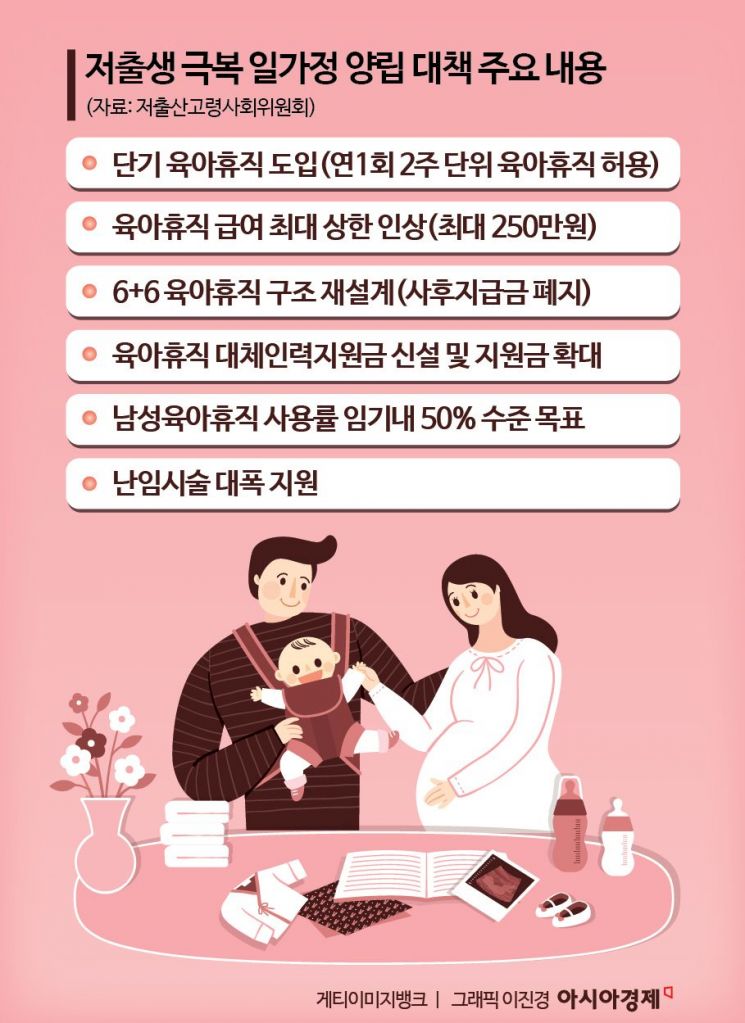
First, to enable anyone to take parental leave without worrying about income, parental leave benefits will be increased from the current 1.5 million KRW per month to a maximum of 2.5 million KRW per month. Currently, 80% of the average wage, equivalent to about 1.5 million KRW per month, is paid evenly for up to one year, allowing a total benefit of up to 18 million KRW for one year of leave. Going forward, with the parental leave benefit rising to a maximum of 2.5 million KRW per month, one year of leave can receive up to 23.1 million KRW in total.
With the increase in the parental leave benefit cap, the 6+6 special case will be comprehensively redesigned. Currently, if both working parents take parental leave to care for a child under 18 months old, the average wage limit is increased to 100% for the first six months. The monthly maximum starts at 2 million KRW in the first month and expands to 4.5 million KRW by the sixth month. The parent who takes parental leave first receives the regular benefit, and if the other parent takes leave afterward, the difference is paid retroactively. This structure results in receiving lower parental leave benefits while raising the child but getting a kind of compensation with higher pay later on.
The government plans to reverse this payment structure to an 'initial intensive' model that concentrates support in the early period. For example, the cap would be 2.5 million KRW for the first three months, 2 million KRW for the next three months, and 1.6 million KRW for the following six months. Choosing this payment method will allow female workers, who are at high risk of career interruption, to receive substantial benefits even with relatively short parental leave. Early return to work helps them adapt quickly to their jobs, reducing the risk of career breaks.
A short-term parental leave system will also be introduced to allow flexible use of leave and time off as needed. The system will be operated flexibly to respond to short-term childcare demands such as temporary closures of daycare centers or school vacations. Parental leave use will be permitted in two-week increments once a year during periods of high childcare demand. If both parents use it once per child annually, they can use up to four weeks per child per year.
The government also aims to significantly increase the male parental leave usage rate from the current 6.8% to about 50% during the president’s term. Paternity leave will be extended from 10 days to 20 days, and the claim period will be expanded from 90 to 120 days, with the number of installments increasing from one to three. For small and medium-sized enterprises, the paid paternity leave period will be extended from 5 days to 20 days.
The eligible child age for reduced working hours during childcare will be expanded from 8 to 12 years old, and a new parental leave system allowing short-term use in two-week increments will be introduced. Additionally, employers will receive a monthly subsidy of 1.2 million KRW to cover replacement workers for employees on parental leave, sharing the burden with colleagues and companies.
Significant Strengthening of Infertility Support... Fertility Examination Expenses Provided to All Men and Women of Reproductive Age
To prevent individuals who wish to conceive from facing obstacles due to aging or other factors, infertility support will be significantly strengthened. The government will provide essential fertility examination expenses up to three times to men and women aged 25 to 49 who wish to receive them, regardless of marital status or number of children. Previously, fertility examinations were supported only once in a lifetime for couples preparing for pregnancy.
Support for egg freezing procedures will also begin. The government will cover the costs of freezing reproductive cells such as eggs and sperm for men and women expected to face permanent infertility and who need fertility preservation, regardless of marital status. Egg freezing is a method of collecting and storing healthy eggs in advance to be used later for actual pregnancy attempts through assisted reproductive technology. While some local governments like Seoul have offered freezing support to applicants, this is the first time the central government has provided support for egg freezing.
Support to reduce infertility treatment costs will be greatly expanded. The government will promote the inclusion of non-covered essential medications such as uterine implantation aids and miscarriage prevention drugs in health insurance coverage. New health insurance coverage will be applied for medications to alleviate nausea and vomiting during pregnancy, and the criteria for coverage of ovulation induction injections will be relaxed. This aims to benefit patients who hesitated to undergo treatment due to cost burdens because they did not meet coverage conditions. Furthermore, infertility leave will be expanded, and flexibility such as hourly split use will be enhanced.
To support healthy childbirth, cesarean section costs will be made free of charge. The out-of-pocket expense will be reduced from the current 5% to 0%, the same as natural delivery. Out-of-pocket expenses for inpatient care for children under two years old will also be set to 0%, and after implementation, usage status and outcomes will be scientifically analyzed to consider phased further reductions in out-of-pocket costs.
© The Asia Business Daily(www.asiae.co.kr). All rights reserved.
![Clutching a Stolen Dior Bag, Saying "I Hate Being Poor but Real"... The Grotesque Con of a "Human Knockoff" [Slate]](https://cwcontent.asiae.co.kr/asiaresize/183/2026021902243444107_1771435474.jpg)















