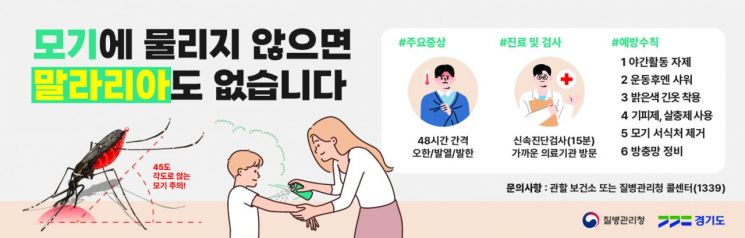
Gyeonggi Province has issued its first malaria alert of the year.
On the 19th, Gyeonggi Province announced that it had issued a malaria alert following the confirmation of two cluster cases in Paju City on the 18th. A cluster case is defined as two or more patients in a malaria risk area who develop symptoms within 14 days of each other and live within 1 km of each other.
Gyeonggi Province will conduct an in-depth epidemiological investigation in Paju City to identify the estimated infection sites of the cluster cases, mosquito habitats in the area, residences, common exposures, and risk factors.
Paju City plans to actively carry out focused publicity through local medical and pharmacist associations, intensive mosquito control, rapid diagnostic testing for early detection, and provision of preventive medication to detect additional cases.
Meanwhile, as of the 18th of this year, there have been 164 malaria patients nationwide according to provisional statistics from the Korea Disease Control and Prevention Agency's infectious disease portal. Of these, 91 patients are in Gyeonggi Province, accounting for 55.5% of the national total.
Yu Young-cheol, Director of the Gyeonggi Province Health and Wellness Bureau, said, "Starting this year, the malaria risk areas in Gyeonggi Province have been expanded from 11 cities and counties last year to 19, and the intensive management areas have also been increased. In malaria risk areas, mosquito control should be strengthened and preventive measures to avoid mosquito bites must be followed. Especially, residents or visitors in risk areas are urged to get tested at nearby public health centers or medical institutions if they develop symptoms suspicious of malaria."
© The Asia Business Daily(www.asiae.co.kr). All rights reserved.
![Clutching a Stolen Dior Bag, Saying "I Hate Being Poor but Real"... The Grotesque Con of a "Human Knockoff" [Slate]](https://cwcontent.asiae.co.kr/asiaresize/183/2026021902243444107_1771435474.jpg)
















