Household Loan Balance Nears 1,110 Trillion Won... "Full Preparation for Stage 2 'Stress DSR'"
Incomplete ELS Sales and Repeated Embezzlement Incidents... "Voluntary Culture Prioritizing Customer Interests Needed"
New Supervisory Measures Established... Fundamentally Inducing Change in Bank Organizational Culture
Rapid Environmental Changes Due to Birthrate, Aging, and AI Technology Utilization... Supporting Discovery of New Growth Engines
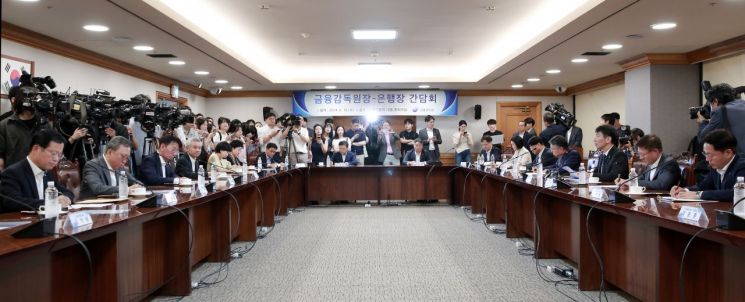
"A soft landing of the real estate project financing (PF) market is an essential prerequisite for the stability of the financial market. Please actively participate in syndicated loans and cooperate so that visible results can appear as soon as possible."
On the 19th, Lee Bok-hyun, Governor of the Financial Supervisory Service (FSS), emphasized this during a meeting with the heads of 20 domestic banks including KB Kookmin Bank, Shinhan Bank, Hana Bank, Woori Bank, and NH Nonghyup Bank at the Bankers’ Hall in Jung-gu, Seoul. He urged, "Please ensure that funds tied up in non-performing projects circulate properly so that the real estate PF market can normalize early."
The financial authorities announced the business feasibility evaluation criteria for real estate PF projects and required the financial sector to establish post-management plans for non-performing projects classified as 'caution' or 'at risk of insolvency' and submit them to the FSS by the end of July. Additionally, a 5 trillion won syndicated loan fund will be formed mainly by 10 financial companies, including the five major commercial banks and five major insurance companies, to restructure non-performing projects coming out through auctions and foreclosures.
Given growing concerns over the recent surge in household loans, which has nearly reached 1,110 trillion won, continuous efforts to manage household debt were also requested. The financial authorities set a target with the financial sector to keep the increase within 1.5?2% so that household loans are managed within the nominal GDP growth rate range from the beginning of the year.
Governor Lee said, "The pace of household debt increase may accelerate further depending on changes in the macroeconomic environment such as interest rates and the housing market, so it is necessary to manage it with renewed vigilance." He added, "Please make thorough preparations for the smooth implementation of the stress Debt Service Ratio (DSR) system."
From July, the 'second phase stress DSR' will be implemented. While only 25% of the stress interest rate was applied to loan products in the first half of the year, the goal is to raise this to 50% from July to increase the loan threshold. If the standard stress interest rate is 1.5 percentage points as in the first half, 0.75 percentage points will be added to the loan interest rate when calculating the DSR.
However, depending on the product, variable, mixed (fixed for 5 years then variable), and periodic (fixed for 5 years) interest rates will be added differentially by 0.75, 0.45, and 0.23 percentage points respectively. This measure aims to enhance household stability by maximizing the fixed interest period and the adjustment cycle of variable interest rates.
Incomplete sales of ELS, successive embezzlement incidents... "A performance reward system prioritizing customer interests must be established"
He also emphasized that management must take the lead in establishing an organizational culture to prevent recurrence of incomplete sales confirmed by the Hong Kong H Index (Hang Seng China Enterprises Index, HSCEI)-linked equity-linked securities (ELS) incident and recent successive embezzlement financial accidents. He announced plans to introduce new supervisory measures to fundamentally induce changes in banks’ organizational culture.
Governor Lee referred to incomplete sales and embezzlement incidents caused by forged documents in derivative-linked funds (DLF), Lime private equity funds, and Hong Kong H Index ELS in recent years in the banking sector, stating, "There are growing voices criticizing employees’ moral insensitivity and lax internal controls. This is a very serious issue that threatens the foundation of banks’ existence as it not only damages the reputation and trust of banking but also increases operational and business risk losses, affecting financial soundness."
He pointed out the limitations of ex-post measures such as employee sanctions, internal control innovation plans, establishment of governance best practices, and accountability structures promoted by the financial authorities. He said, "It is necessary to make bold changes at the organizational culture level so that laws and ethical awareness deeply permeate all employees’ business activities and internal control operations." He emphasized, "The CEO must create a 'culture of speaking up' where any employee can freely raise concerns if they detect the possibility of incomplete sales or financial accidents."
He continued, "The performance reward system that favors short-term achievements even if internal controls or risk management are neglected to meet sales targets must be fundamentally changed." He added, "We will prepare new supervisory measures to fundamentally induce changes in banks’ organizational culture." Referring to the Dutch supervisory authority that operates a dedicated organization including psychological and behavioral analysis experts, and the Australian supervisory authority that conducts surveys of financial company employees to identify strengths and weaknesses of company organizational cultures and induce improvements, he plans to establish a process to diagnose, analyze, and then induce improvements in banks’ organizational culture.
Governor Lee stated, "If the risk of incomplete sales and financial accidents decreases with changes in banks’ organizational culture, we will also consider supervisory incentives in calculating operational risk-weighted assets for capital ratio determination."
Changes in bank customer base... Discover new growth engines to contribute to 'national asset formation'
Governor Lee mentioned that as the bank customer base changes due to low birth rates, aging, and regional exclusion, and as the boundaries of traditional banking business are breaking down due to big tech’s financial entry and expanded use of artificial intelligence (AI) technology, efforts must be made to discover new growth engines for survival.
The financial authorities have been working with the banking sector since last year to improve banking management, business practices, and systems, seeking to strengthen competitiveness through promoting competition in banking. He said, "We will create and support a supervisory and regulatory environment to expand banks’ ancillary and concurrent business scope and enhance asset management service capabilities." He emphasized, "Please consider discovering new growth engines so that their outcomes can lead to strengthening banks’ fund intermediation functions, contributing to national asset formation, and coexisting with local communities."
© The Asia Business Daily(www.asiae.co.kr). All rights reserved.
![Clutching a Stolen Dior Bag, Saying "I Hate Being Poor but Real"... The Grotesque Con of a "Human Knockoff" [Slate]](https://cwcontent.asiae.co.kr/asiaresize/183/2026021902243444107_1771435474.jpg)















