Big 4 Hiring at a Minimum in 10 Years, Record High Number of Successful Candidates
Resignations Decrease Due to Industry Downturn → Reduced Demand for New Hires
Small and Medium Accounting Firms Also Face 'Borikkogae'... First M&A in 5 Years
The head representing accountants in South Korea will change for the first time in four years through the Korean Institute of Certified Public Accountants (KICPA) election held on the 19th. The next leader is expected to face an urgent challenge of an unprecedented "employment crisis." This is because, while this year is expected to produce the highest number of Certified Public Accountant (CPA) exam passers in history, the number of new hires at the Big Four accounting firms (Samil, Samjong, Hanyoung, Anjin) is projected to shrink to the smallest scale since 2020.
On the 19th, the total planned new hires by the Big Four accounting firms this year were estimated to be between 680 and 810. Although the hiring scale has not been finalized, if each firm proceeds with the minimum scale under consideration, the number could drop to the 600s. It seems certain that this will be a decrease from last year's scale (875). Compared to 2022's 1,275, it is about half. If the actual hiring scale falls to the 600s, it will be the smallest in the past decade. On the other hand, the 'minimum number of recruits' for CPAs announced in September this year is a record high of 1,250. This means that at least 500 or more will have to learn their work outside the so-called 'Big Four,' signaling a looming 'employment crisis.'
After the Boom Ends, "It's Colder Outside"... Atmosphere Reluctant to Resign
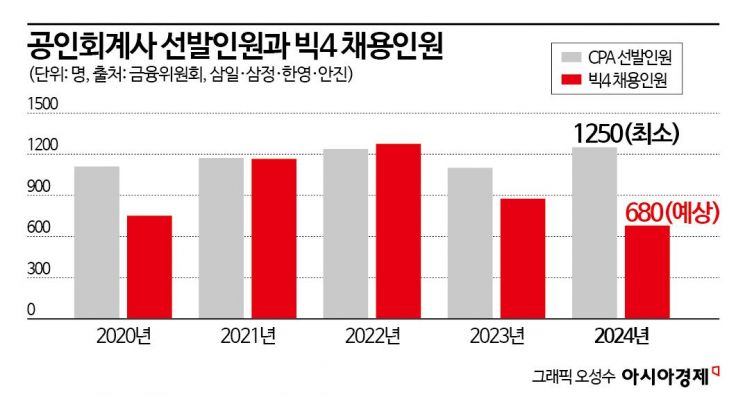
The accounting industry experienced a boom cycle after the introduction of the new External Audit Act (Shin Oegam Act) in 2019. As workloads increased, each firm competitively expanded their size. In fact, in 2022, the Big Four's hiring number (1,275) exceeded the number of final CPA passers (1,237). However, since last year, due to the three highs (high interest rates, high inflation, high exchange rates) and macroeconomic uncertainties, the business environment has rapidly deteriorated, causing a sharp decline in demand for new hires.
A representative from one of the Big Four said, "The number of hires may decrease by about 30% compared to last year," adding, "Compared to the number of passers, this is an unprecedented gap, and there may be direct or indirect pressure from financial authorities to increase the number of hires." Due to the sensitivity of the issue, the hiring numbers by each Big Four firm were compiled on the condition of confidentiality, with the total being at least in the 680s. Another firm representative said, "Since the 52-hour workweek system was established, work-life balance has improved, and the perception that 'it's colder outside' has spread, resulting in fewer resignations compared to before," adding, "Investment sectors such as private equity funds (PEF) and venture capital (VC) are also tightening their belts, leading to decreased demand."
Generally, the Big Four accounting firms are called the 'military academy' for accountants. Due to the nature of the CPA system, one must undergo 1-2 years of trainee education to obtain official CPA qualifications. In the industry, this period is known as the 'paid training period.' Since the Big Four are overwhelmingly preferred as training institutions, this year's exam passers are expected to face record-high competition for employment. Even lowering standards does not make employment easy. Small and medium accounting firms are also making all-out efforts to overcome the difficult business environment, including pursuing mergers and acquisitions (M&A). Recently, Jinil and Sailwon decided to merge, marking the first accounting firm M&A in five years since the introduction of the new External Audit Act.
All Three Candidates Agree: 'There Is a Problem'
Currently, the number of CPA recruits is decided annually by the Financial Services Commission (FSC) in the year before the exam. When the minimum number of passers was set at 1,250 this year, the FSC stated that it was "determined by comprehensively and balancedly considering market supply and demand while maintaining audit quality." The number had been frozen for four years and was increased for the first time in five years, becoming the largest scale ever. Since it is literally the 'minimum number of recruits,' the actual number could increase. The only time the minimum number and final passers matched since 2020 was last year (1,100).
Regardless of which of the three candidates wins the KICPA presidency on the 19th, they are expected to raise issues with the financial authorities regarding the current recruitment method and numbers. Their positions were generally similar during their policy presentations through KICPA. Candidate Choi Un-yeol said, "The number of recruits should be reviewed from scratch," Candidate Lee Jeong-hee said, "It is time to reduce the number, and the necessary number should be decided over a medium to long-term period of 3-5 years rather than annually," and Candidate Na Cheol-ho also pledged to "boldly reduce the number of passers."
© The Asia Business Daily(www.asiae.co.kr). All rights reserved.
![Clutching a Stolen Dior Bag, Saying "I Hate Being Poor but Real"... The Grotesque Con of a "Human Knockoff" [Slate]](https://cwcontent.asiae.co.kr/asiaresize/183/2026021902243444107_1771435474.jpg)
















