$1 Trillion Inflow Over 6 Months
5th Largest Globally After US, China, Japan, Hong Kong
Expectations for Continuity in Modi's Third-Term Economic Policies
Last week, India's benchmark stock indices, the Sensex and Nifty50, both reached all-time highs, pushing the market capitalization of the Indian stock market past $5 trillion. This surge is attributed to Prime Minister Narendra Modi's successful third term and the formation of a coalition government, which ensured continuity in key economic policies and boosted investor sentiment.
According to Bloomberg on the 17th (local time), the National Stock Exchange of India (NSE) has attracted about $1 trillion over the past six months, with last week's market capitalization exceeding $5 trillion (approximately 6,900 trillion KRW). This ranks India as the world's fifth-largest market after the United States, China, Japan, and Hong Kong. Although the Indian stock market briefly hit $5 trillion intraday last month, it fell back to the $4 trillion range by the close.
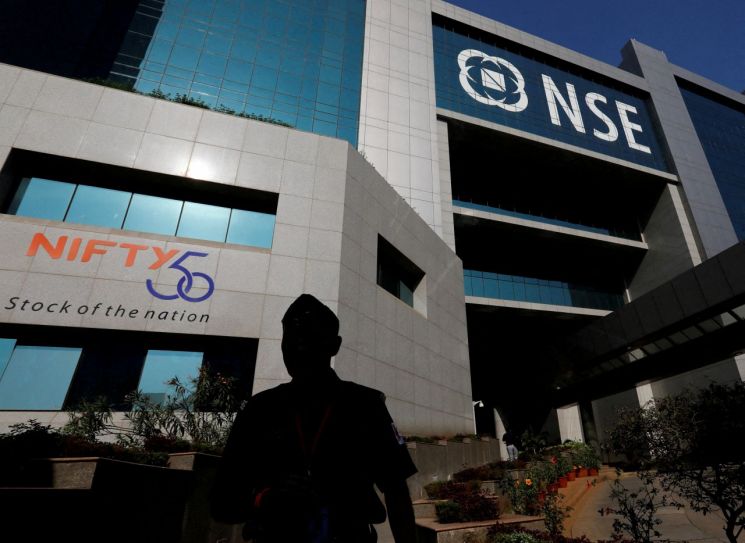
The bullish trend in the Indian stock market is believed to be driven by expectations of future economic policy achievements under the Modi government. The Bharatiya Janata Party (BJP), led by Modi, won fewer seats than expected in the recent general election but formed a coalition government and received strong support from key allies, injecting vitality into the stock market. Over the past decade under Modi's leadership, India has risen to become the world's fifth-largest economy, and forecasts suggest it will maintain an annual economic growth rate of 7 to 7.5% going forward.
Sunil Kaul, a strategist at Goldman Sachs, said in an interview with Bloomberg TV last week, "The decision by Modi's third-term government to retain most key ministers confirms broad policy continuity," adding, "India's macroeconomy remains a very stable market, so continued earnings growth and stock price increases are expected."
Bloomberg also pointed to the increasing participation of millions of young Indian investors as a cause of the stock market boom. According to Morningstar data, over 20 million investment accounts were opened in India last year, and total assets in Indian funds grew by 19% in the first 11 months. Additionally, domestic Indian funds, including banks and insurance companies, purchased over $26 billion worth of stocks this year, while foreign investors sold $3.5 billion during the same period. Furthermore, the recent upgrade of India's sovereign credit rating outlook by international credit rating agency Standard & Poor's (S&P) has positively influenced investor sentiment.
Vino Pathiparampil, head of research at Elara Capital headquartered in Mumbai, said, "Foreign institutional investors, who once dominated the Indian stock market, are no longer the sole drivers of the market." Chetan Seth, a strategist at Nomura Holdings, noted, "Foreign investors, concerned about valuations in the Indian market, have not made sufficient investments and continue to maintain low holdings," adding, "There is ample capital in foreign regional funds waiting to be deployed into the Indian market."
© The Asia Business Daily(www.asiae.co.kr). All rights reserved.
![Clutching a Stolen Dior Bag, Saying "I Hate Being Poor but Real"... The Grotesque Con of a "Human Knockoff" [Slate]](https://cwcontent.asiae.co.kr/asiaresize/183/2026021902243444107_1771435474.jpg)
















