Inflation Continues to Gradually Slow Down
'Assessment of Underlying Price Trends and Recent Inflation Momentum'
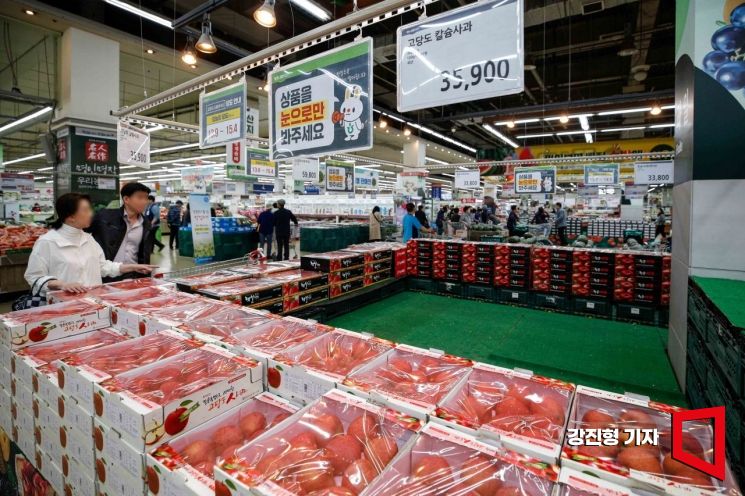 A customer is purchasing apples at Hanaro Mart Yangjae Branch in Seocho-gu, Seoul. Photo by Jinhyung Kang aymsdream@
The Bank of Korea recently stated that the trend of inflation slowdown is expected to continue as core inflation and inflation momentum are weakening, while oil and agricultural product prices are also declining.
In its report on the trend of core inflation and recent inflation momentum released on the 18th, the Bank explained that unlike consumer prices, the upward trend of core inflation has continuously slowed since the second half of 2022, recently falling to the 2% range.
Core inflation excludes temporary disruptive factors from consumer prices, providing useful information on medium-term inflation trends due to its higher persistence and lower volatility.
Looking at the core inflation indicators last month, sticky prices (2.5%) remained in the mid-2% range, but core prices were in the low 2% range (2.2%), weighted median prices (2.0%), UIG (2.1%), and adjusted average prices (2.0%) all slowed to levels close to 2%.
Indicators related to the economy, wages, and expectations, which can gauge core inflationary pressures, are also slowing or moving at low levels.
Although domestic growth expanded in the first quarter of this year, much of it was due to an increase in net exports, which have little impact on prices, and considering that the improvement in consumption was also significantly influenced by temporary factors, additional inflationary pressure from growth rate expansion is assessed to be limited.
While the upward trend of regular wages, representing core wage trends, was maintained at the long-term average level of 3.5% (3.4% in the first quarter), short-term general inflation expectations are showing a gradual slowing trend.
The degree of dispersion in the price increases of items constituting core inflation has weakened this year. Comparing the distribution of price increases by item in core inflation from January to May this year with the high inflation period of the past two years (2022?23), the Bank of Korea explained that a clear downward shift is evident.
Limited Impact of Corporate Product Price Increases on Inflation
Regarding the momentum of core inflation, service prices continue to slow, but the price of goods has somewhat rebounded over the past three months this year.
Additionally, concerns have been raised that inflation momentum could expand again as corporate price increases have recently increased. In fact, since April, reports of product price increases in processed foods, some industrial products, and the dining industry in response to cost pressures such as rising raw material prices have increased.
However, the Bank of Korea judged that the impact of corporate price increases on inflation is currently limited. The consumer price index (CPI) weight of the recently announced price-increased items is small (about 3.3% by weight), and since it is limited to certain sectors, the direct effect is not yet significant.
Lee Seung-ho, director of the Bank of Korea’s Research Department, said, "Although there are upward pressures on prices due to the higher exchange rate and improved growth this year, considering the weakening core inflation and inflation momentum as well as recent declines in oil and agricultural product prices, the trend of inflation slowdown is expected to continue."
However, Director Lee added, "If corporate price increases spread, there is a possibility that supply-side upward risks could combine with this to unsettle expectations. To gain greater confidence in convergence to the inflation target, it is necessary to closely monitor movements in agricultural product prices and international oil prices, the extent of corporate price increases, and domestic demand trends."
© The Asia Business Daily(www.asiae.co.kr). All rights reserved.
![Clutching a Stolen Dior Bag, Saying "I Hate Being Poor but Real"... The Grotesque Con of a "Human Knockoff" [Slate]](https://cwcontent.asiae.co.kr/asiaresize/183/2026021902243444107_1771435474.jpg)
















