Minister of Land, Infrastructure and Transport Park Sang-woo visited the Daejeon Urban Convergence Special Zone on the afternoon of the 17th and urged for the swift promotion of the project. He then held a joint seminar with related agencies to discuss the revision strategy of the '5th National Land Comprehensive Plan (2020?2040)'.
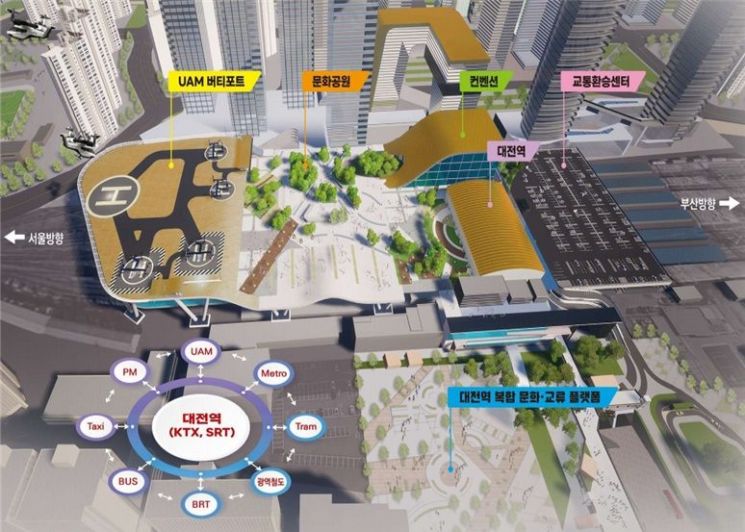 Perspective view of the 'Daejeon Station Future-type Complex Transfer Center,' one of the major projects in the Daejeon Urban Convergence Special Zone / Image provided by the Ministry of Land, Infrastructure and Transport
The Daejeon Urban Convergence Special Zone is a project to develop the area around Daejeon Station and the former Chungnam Provincial Government Office into a future-oriented complex transfer center, station area development, and knowledge industry center, serving as a convergence growth hub. It is being fostered as the starting point of the Chungcheong Mega City and the epicenter of urban spatial innovation.
The Ministry of Land, Infrastructure and Transport plans to approve the basic plan containing the development concept within this year. The Ministry also urged active participation in the project from Daejeon City, Korea Land and Housing Corporation (LH), and Korea Railroad Corporation (KORAIL), who joined the on-site inspection.
Minister Park then hosted a discussion forum titled "Seeking New Directions for the Establishment of the National Land Comprehensive Plan in the Era of Great Transformation" to discuss the revision plan of the 5th National Land Comprehensive Plan. The National Land Comprehensive Plan is the highest-level spatial plan that presents the long-term development direction of the national land for the next 20 years, based on the Constitution and the Framework Act on National Land. Since the first plan in 1972, it has served as the blueprint for the development of South Korea’s national land for over half a century.
The 5th National Land Comprehensive Plan has the vision of "National Land for All, Shared Living Spaces." It previously proposed flexible spatial strategies to respond to the era of low growth, the 4th Industrial Revolution, and improvements in the national land environment. However, since the establishment of the 5th plan, the national land conditions have rapidly changed due to population decline and accelerated risk of local extinction, the COVID-19 pandemic, changes in transportation networks including the Metropolitan Area Express Train (GTX), among others. Accordingly, the government recognized limitations in the existing plan’s ability to guide the establishment of subordinate plans such as urban and transportation plans, and thus began preparing a revision this year.
At the forum, Cho Young-tae, Director of the Population Policy Research Center at Seoul National University, presented on the topic "A Paradigm Shift in Population Concepts for National Land Comprehensive Development." He emphasized the need for policies that expand from residential population to living population to enable balanced utilization of the vast national land, highlighting that expanding the living population is key to "compressing national land space."
Next, Professor Ma Kang-rae of Chung-Ang University’s Urban Planning Department presented on "Strategies for Fostering Ultra-Wide Mega Cities to Respond to the Crisis of Local Population Decline." Professor Ma stated that investment focused on hubs is more effective than dispersed investment in responding to population decline, and that fostering ultra-wide mega cities at the Ministry of Land level, including innovation hubs preferred by youth and transportation connectivity in local areas, is necessary.
The final presenter was Lee Soon-ja, Director of the National Land Research Headquarters at the Korea Research Institute for Human Settlements. Director Lee mentioned in "New Strategies for Establishing the National Land Comprehensive Plan in the Era of Great National Transformation" the fostering of ultra-wide mega cities, setting functions by spatial hierarchy, establishing 15 new national industrial complexes, analyzing spatial compression effects due to GTX, and strengthening execution through setting core management indicators for key strategies.
The Ministry of Land plans to form an expert advisory group with academic societies, national research institutes, local research institutes, and universities in various fields such as national land and urban planning, infrastructure, climate and environment, and digital technology to deeply discuss the revision strategy of the National Land Comprehensive Plan. It will also maintain close communication with local governments through the "National Land-Regional Policy Cooperation Meeting" and "Visiting Regional Briefings."
Minister Park said, "To respond to population decline and the risk of local extinction, it is necessary to concentrate functions in compact hubs and connect them densely, and the National Land Comprehensive Plan needs to be revised to reflect this. The strategies discussed today and those prepared together with regions and experts will be included in the revision plan of the 5th National Land Comprehensive Plan."
© The Asia Business Daily(www.asiae.co.kr). All rights reserved.
![Clutching a Stolen Dior Bag, Saying "I Hate Being Poor but Real"... The Grotesque Con of a "Human Knockoff" [Slate]](https://cwcontent.asiae.co.kr/asiaresize/183/2026021902243444107_1771435474.jpg)















