The Korea Rail Network Authority recently announced on the 17th that it conducted a performance verification test of the railway bridge 'KR-I Girder' at the Korea Railroad Research Institute's experimental building in Uiwang-si, Gyeonggi-do, and received successful results.
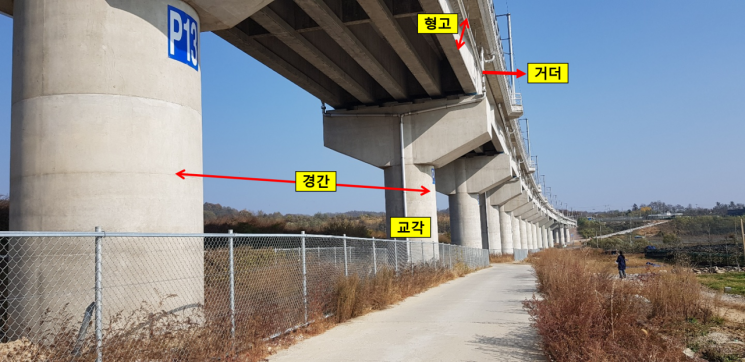
A girder is a 'beam' that supports the deck, and the KR-I Girder was independently developed by the Rail Network Authority. The performance verification test was conducted to confirm the structural safety of the actual height (30m) of the railway bridge deck and to determine whether the design performance could be secured. The test verified the performance by applying a load of 400 tons and measuring the girder's deflection, strain, and crack response.
As a result, the 'KR-I Girder' showed successful experimental outcomes, increasing the possibility of its actual application in the field in the future.
Until now, girder bridges had varying spans (distance between the centers of piers) and heights (girder height) between piers, which was aesthetically unpleasing and caused difficulties in maintenance.
For the same reason, the Rail Network Authority, together with the Korea Railroad Research Institute and DM Engineering Co., Ltd., jointly promoted research on 'railway bridge standardization' and developed the 'KR-I Girder.'
The 'KR-I Girder' has an increased span length of 30m and can be applied as a 4-girder type in double-track lines, improving its technical performance and applicability.
The existing PSC I-type girder bridges were applied as 5-girder types in double-track bridges with spans of 25m or less. PSC (Prestressed Concrete) refers to concrete that is pre-compressed in areas subject to tensile forces to enhance the tensile strength of the concrete.
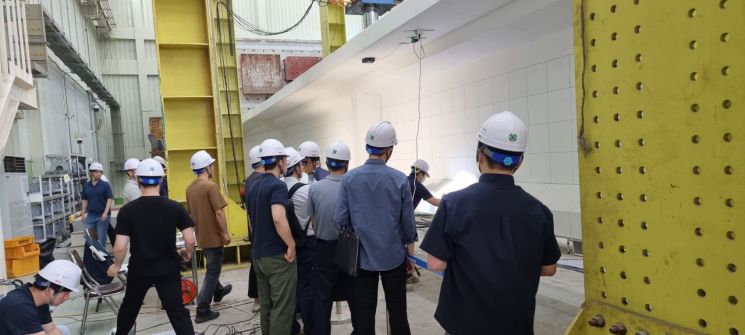 Performance verification for the standardization of railway bridges is being conducted at the experimental building of the Korea Railroad Research Institute in Uiwang-si, Gyeonggi-do. Provided by Korea Rail Network Authority
However, with the development of the 'KR-I Girder,' the applicable span length has expanded from 25m to 30m, allowing for uniform girder height even when railway lines pass through roads or rivers with different spans. This will improve aesthetics, reduce costs, and enhance maintenance efficiency.
Additionally, the reduction in the number of girders (from 5 to 4) is expected by the Rail Network Authority to reduce the superstructure construction cost by more than 10%.
Lee Seong-hae, Chairman of the Rail Network Authority, stated, “Following the 'KR-I Girder,' we plan to conduct a performance verification test of the 45m-long 'KR-U Girder' in August this year. We will strive to ensure that the railway bridge technologies developed by the Rail Network Authority can be applied to actual railway construction sites in the future.”
© The Asia Business Daily(www.asiae.co.kr). All rights reserved.


















