Housing Industry Research Institute 'Measures to Revitalize Housing Supply' Seminar
Single-Person Household Rate, 35.6% of Total Households by 2030
Most Live in Non-Apartments
Villa Supply Plummets Due to Heavy Taxation on Multiple Homeowners and Jeonse Fraud Impact
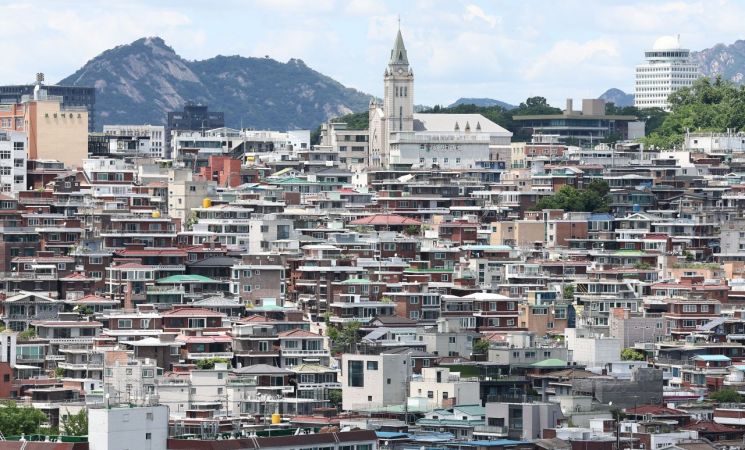
As the age of first marriage rises and the number of divorces and bereavements increase, single-person households are rapidly growing, but it is forecasted that the housing available for them will gradually decrease. Due to the heavy taxation on multiple homeowners and the aftermath of jeonse fraud, the supply of non-apartment housing is declining, which is expected to disrupt the housing supply and demand for single-person households.
At the 'Housing Supply Activation Plan' seminar held on the 17th at the National Assembly Members' Office Building in Yeouido, Seoul, Kim Deok-rye, head of the Housing Research Office at the Korea Research Institute for Human Settlements, who gave the keynote speech, made this prediction. He said, "Around 2020, during the rapid rise in housing prices, single-person households increased significantly, resulting in actual households exceeding the projected number," adding, "However, non-apartment housing, where single-person households mainly reside, is experiencing a sharp decline in supply compared to apartments."
Kim stated, "As of the end of last year, single-person households numbered 7.34 million, accounting for 33.6% of total households," and "Among them, young single-person households numbered 2.57 million, making up 35% of all single-person households, while elderly single-person households (aged 60 and above) numbered 2.67 million, accounting for 36.3%." He added, "Especially due to population aging, elderly single-person households are steadily increasing."
Kim explained that the increase in single-person households is due to the rising age of first marriage among young people. He said, "The average age of first marriage for women rose from 27.3 years in 2003 to 29.6 years in 2013, and 31.4 years last year." He also analyzed that divorces and bereavements have contributed to the increase in single-person households.
The proportion of single-person households is also steadily increasing. The rate rose from 23.9% in 2010 to 33.6% last year. It is expected to reach 35.6% by 2030. However, due to low birth rates, the proportion of young single-person households is expected to peak at 35% last year and then continuously decline. In contrast, the proportion of elderly single-person households is expected to steadily increase due to aging, reaching 43.4% by 2030.
While single-person households are increasing, the housing available for them is expected to gradually decrease. Most single-person households live in non-apartment housing such as villas. However, recently, the supply of non-apartment housing has sharply declined compared to apartments. Due to the heavy taxation on multiple homeowners and the aftermath of jeonse fraud, the supply performance has significantly decreased.From 2017 to 2021, the nationwide annual average of non-apartment housing permits was 134,000 units. This has steadily decreased to 93,000 units in 2022, 52,000 units last year, and an estimated 70,000 units this year.
Kim said, "As of 2022, the housing type with the highest occupancy rate among single-person households is non-apartment housing such as villas, accounting for 58.7% of the total," adding, "The apartment occupancy rate is only 27.5%." The non-apartment residence rate for young single-person households is 60.6%, and for elderly single-person households, it is 59.2%.
© The Asia Business Daily(www.asiae.co.kr). All rights reserved.
![Clutching a Stolen Dior Bag, Saying "I Hate Being Poor but Real"... The Grotesque Con of a "Human Knockoff" [Slate]](https://cwcontent.asiae.co.kr/asiaresize/183/2026021902243444107_1771435474.jpg)
















