Achievement of First Overseas Export of KTX Worth 270 Billion KRW
Positive Signs in Gas Field, Plant, and Nuclear Power Plant Project Orders
Expanding Diplomatic Horizons in Strategic Hub Jungangaro
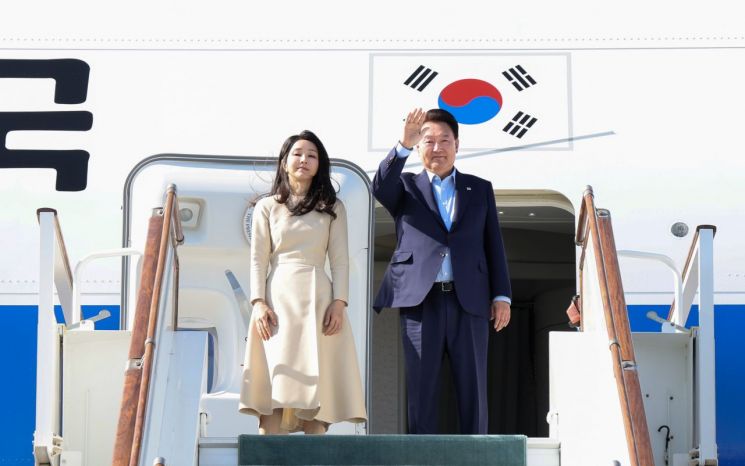 President Yoon Suk-yeol and First Lady Kim Keon-hee, concluding their visit to the ancient city of Samarkand, a UNESCO World Cultural Heritage site, and completing their tour of three Central Asian countries, are seen boarding Air Force One at Samarkand Airport on the 15th (local time) to return home, greeting the crowd.
 [Image source=Yonhap News]
President Yoon Suk-yeol returned to Korea on the 16th after completing his first overseas trip of the year, a state visit to three Central Asian countries. This trip is being evaluated as having laid the foundation for cooperation in the critical mineral supply chain between Korea and resource-rich Central Asia. During the five-night, seven-day itinerary, President Yoon visited Turkmenistan, Kazakhstan, and Uzbekistan consecutively, holding talks with the leaders of each country and working to strengthen cooperation in energy and critical mineral supply chains.
Self-styled as the 'No. 1 Salesperson,' President Yoon actively provided support to help Korean companies operating in Central Asia secure orders. As a result of this trip, Uzbekistan achieved a milestone by exporting Korean high-speed trains overseas for the first time, worth 270 billion won. In Turkmenistan, the possibility of Korean companies participating in large-scale gas field and chemical plant construction projects increased, opening the door to orders worth 6 billion dollars (8.3 trillion won). In Kazakhstan, a 'Critical Mineral Supply Chain Cooperation Partnership Agreement' was signed, and a green light was given for Korean companies to enter nuclear power plant construction projects.
One of the key achievements of this trip was laying the groundwork for the 'K-Silk Road Initiative' and securing full support from participating countries for the 'Korea-Central Asia Five Nations Summit' to be held in Korea next year. It is also noteworthy that this trip expanded Korea's diplomatic horizon to Central Asia, moving beyond diplomacy centered on the 'U.S.-Japan' and 'China-Russia' axes.
Yoon Returns Home After Visiting Three Central Asian Countries
President Yoon and his wife returned to Korea on the early morning of the 16th through Seongnam Seoul Airport after completing state visits to Turkmenistan, Kazakhstan, and Uzbekistan. Departing on the 10th, President Yoon visited Turkmenistan until the 11th, Kazakhstan from the 11th to the 13th, and Uzbekistan from the 13th to the 15th, holding talks with the leaders of each country. On the previous day, President Yoon and Uzbek President Shavkat Mirziyoyev concluded their visit to Samarkand, the ancient city at the heart of the Silk Road and a UNESCO World Heritage site, marking the end of the scheduled visits to the three Central Asian countries.
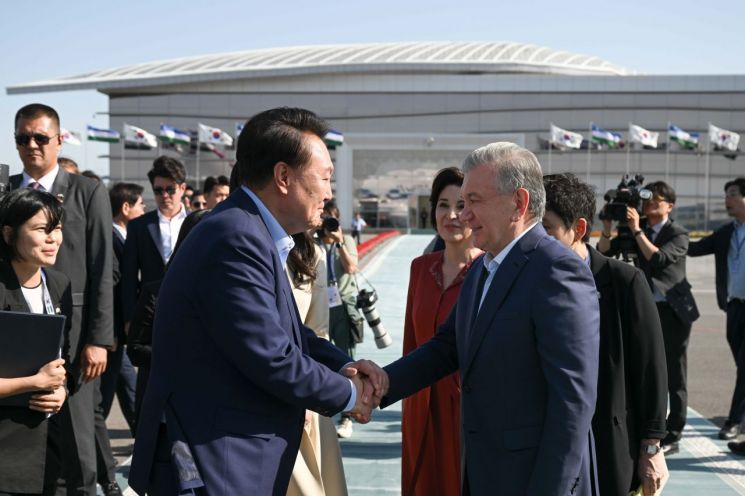 President Yoon Suk-yeol and First Lady Kim Keon-hee, after completing their tour of three Central Asian countries, are saying farewell to President Shavkat Mirziyoyev of Uzbekistan and his spouse at Samarkand Airport, an ancient city and UNESCO World Cultural Heritage site, before returning home on the 15th (local time).
 [Photo by Yonhap News]
Through this trip, President Yoon solidified the cooperation framework with the three Central Asian countries rich in critical minerals and spared no effort as the 'No. 1 Salesperson' to support Korean companies operating in Central Asia in securing orders.
Central Asia is a region abundant in energy resources such as natural gas and crude oil, as well as critical minerals. Notably, tungsten and molybdenum are key minerals used in Korea's major industries, including semiconductors and secondary batteries. During this trip, Korea signed a 'Critical Mineral Supply Chain Cooperation Partnership Agreement' with Kazakhstan and Uzbekistan, establishing a comprehensive cooperation system covering the entire cycle from exploration to development and production of critical minerals such as lithium, manganese, and molybdenum. If economic feasibility is confirmed through mineral exploration, Korean companies are guaranteed priority opportunities to participate in development and production.
An official from the Presidential Office emphasized, "The importance of securing critical minerals from an economic security perspective is increasing, and forming networks with countries possessing critical minerals is crucial. However, it is very difficult for companies to do this on their own, and since China has aggressively pursued securing mineral resources, our government is also continuously signing memorandums of understanding (MOUs) and cooperating on supply chain partnerships to support companies."
Yoon Rolls Up Sleeves to Support Companies, $6 Billion Order in Turkmenistan
As a result of President Yoon's trip, major contracts that had been quietly negotiated by companies and the government materialized into concrete achievements. In Turkmenistan, the first country visited, Hyundai Engineering signed a basic agreement for the 4th desulfurization facility at the Galkynysh gas field, one of the world's top five gas fields, and a cooperation agreement for the second phase of normalizing the Kiyanly polymer plant. Daewoo Engineering & Construction is also fully committed to securing orders for a planned urea and ammonia fertilizer plant in Kiyanly by the Turkmenistan government. The scale of projects won by Korean companies in Turkmenistan is estimated to reach about 6 billion dollars (8.3 trillion won).
In Uzbekistan, Hyundai Rotem and Korea Railroad Corporation (KORAIL) secured a 200 million dollar (270 billion won) contract to supply and maintain high-speed trains ordered by the Uzbekistan Railways. Hyundai Rotem plans to supply a total of 42 high-speed train cars, upgraded from the purely Korean technology-based 'KTX-Eum,' capable of speeds up to 250 km/h. Economic Secretary Park Chun-seop said at a briefing in Tashkent on the 14th (local time), "This year marks the 20th anniversary of the KTX opening, and it is significant that we are exporting high-speed train vehicles developed with our technology for the first time." He added, "This project is being promoted as a loan project by the Export-Import Bank of Korea, with a scale of 200 million dollars, making it the largest Uzbekistan Economic Development Cooperation Fund (EDCF) project to date." The EDCF is a policy fund established in 1987 to support industrialization and economic development in developing countries and to promote economic exchanges between Korea and these countries.
Minister of Land, Infrastructure and Transport Park Sang-woo also commented at the subsequent briefing, "The KTX-Eum trains are currently operating on Korea's Jungang Line. The Korean-style high-speed train vehicles are the result of efforts by the government and private sector to rapidly localize vehicle technology after acquiring high-speed rail technology from France over 20 years ago, and it is a great achievement to export trains developed purely with Korean technology." He emphasized the significance of Korea's full-scale entry into the rapidly growing global high-speed rail market, starting with exports to Uzbekistan.
Next Year’s Korea-Central Asia Five Nations Summit in Korea
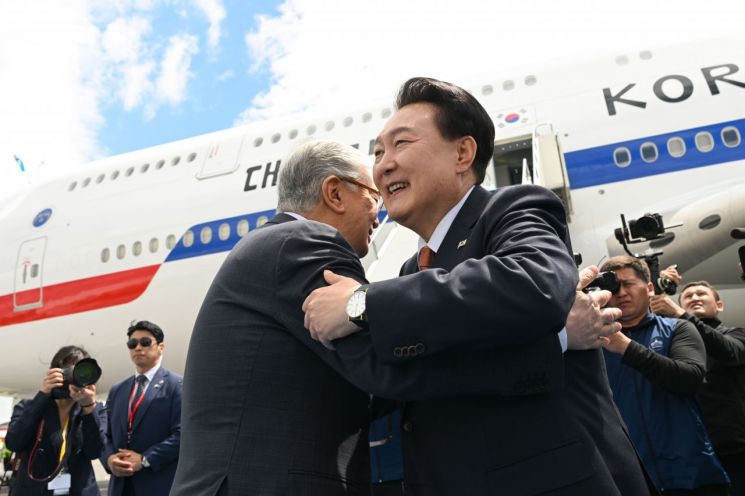 President Yoon Suk-yeol, having completed a state visit to Kazakhstan, is seen embracing Kazakh President Kassym-Jomart Tokayev, who came to see him off at Astana Airport in Kazakhstan on the 13th (local time), exchanging farewell greetings.
 [Photo by Yonhap News]
Another major achievement of this trip was securing the full support of the three countries for the Korean government's 'K-Silk Road Initiative.' The K-Silk Road is the third regional strategy announced by the Yoon Suk-yeol administration, following the 'Indo-Pacific Strategy' and the 'Korea-ASEAN Solidarity Initiative.' This is the first time the Korean government has presented a diplomatic strategy specialized for Central Asia, aiming to create a new cooperation model by linking Korea's innovative capabilities with Central Asia's abundant resources and development potential.
President Yoon explained the 'K-Silk Road' initiative in detail to the leaders of the three countries, actively advocating the necessity and importance of cooperation between Korea and Central Asia. In response, all three leaders expressed their agreement with the K-Silk Road initiative and pledged full support for the Korea-Central Asia Summit to be held in Korea next year.
Kim Tae-hyo, First Deputy Director of the National Security Office, remarked, "Central Asia is an emerging strategic region, and only last year did the U.S. and China hold their first Central Asia summits in May and September, respectively. We have decided to hold the first such summit next year," highlighting its significance. He added, "Amid escalating global energy and supply chain crises caused by various wars and conflicts, Central Asia's geopolitical and geoeconomic value is rapidly rising because it is not only a resource-rich region but also a key geographical hub connecting East and West."
Kim further stated, "We will appropriately combine our hard power and soft power to foster Central Asia's favorable view of Korea and encourage strategic cooperation. We will continue economic security diplomacy that expands the activities of our people and companies, builds more allied networks for cooperation, and continuously expands and creates jobs and national wealth."
"Korea-Central Asia Building Foundations for a Sustainable Future"
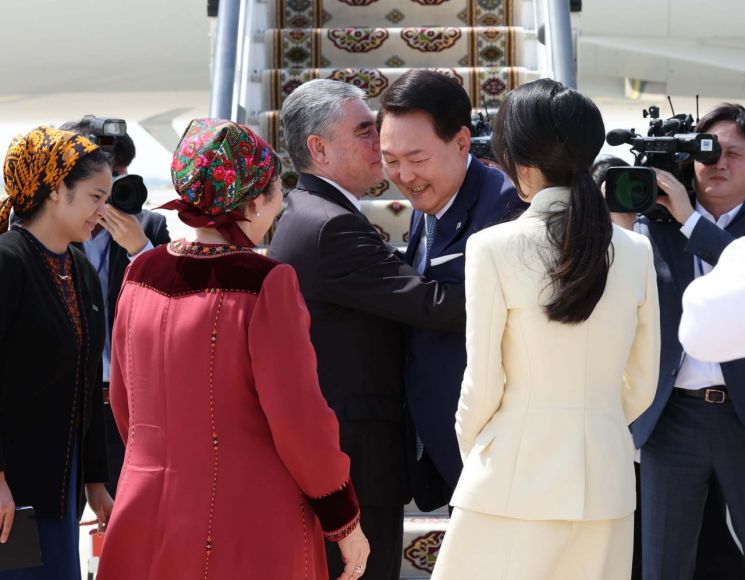 President Yoon Suk-yeol and First Lady Kim Keon-hee, after completing their state visit to Turkmenistan, greet former President Gurbanguly Berdimuhamedow, the country's Supreme Leader and Chairman of the People's Council, and his wife, who came to see them off at Ashgabat Airport on the afternoon of the 11th (local time), before boarding Air Force One, their official aircraft, to head to their next state visit destination, Kazakhstan.
 [Image source=Yonhap News]
The Presidential Office evaluated the outcomes and significance of this trip, stating, "Through summit diplomacy targeting the three core Central Asian countries, we have established a sustainable strategic partnership beyond a mere partnership with Central Asian countries." President Yoon focused on building deep trust among leaders through close diplomatic engagement with Turkmenistan, Kazakhstan, and Uzbekistan, which are driving Central Asia's development.
Moreover, cooperation expanded beyond traditional energy and infrastructure sectors to global issues such as nuclear non-proliferation, digital transformation, and climate crisis response. Efforts were made to build a foundation for sustainable future cooperation between Korea and Central Asia through professional training and education, support for youth startups, and activation of exchanges among next-generation scientists and researchers.
Amid the intensifying global energy competition due to the Ukraine war and geopolitical rivalry among major powers, securing supply chains for critical minerals needed in future core industries such as nuclear power, semiconductors, and secondary batteries was also a notable achievement. President Yoon expressed his determination to support Korea's future growth engines by expanding comprehensive cooperation on petroleum, natural gas, uranium (nuclear fuel), lithium and molybdenum (battery materials), and tungsten (semiconductor materials).
Firm support from the three core Central Asian countries for North Korea's complete denuclearization and the Korean government's 'Bold Initiative' was also confirmed. They condemned North Korea's illegal nuclear and missile development and successive provocations and reached a consensus on the thorough implementation of UN Security Council sanctions resolutions to block North Korea's illegal funding.
The Presidential Office added, "As faithful implementers of the 'Central Asia Nuclear-Weapon-Free Zone Treaty' and global leaders in denuclearization, the three Central Asian countries reaffirmed their firm commitment to denuclearization and non-proliferation." It further stated, "We expanded the scope of Korea-Central Asia security cooperation by strengthening cooperation to address cross-border issues such as terrorism, transnational crime, and cybersecurity, not only the North Korean nuclear issue."
© The Asia Business Daily(www.asiae.co.kr). All rights reserved.
![Clutching a Stolen Dior Bag, Saying "I Hate Being Poor but Real"... The Grotesque Con of a "Human Knockoff" [Slate]](https://cwcontent.asiae.co.kr/asiaresize/183/2026021902243444107_1771435474.jpg)

















