Lovebugs Appear a Month Earlier Than Usual
Due to Early Heat and Frequent Rainfall
Every summer, lovebugs (Plecia nearctica) that cause discomfort appear, and this year they showed up about a month earlier than usual. This is due to early heat and frequent rain, among other weather changes.
According to local governments on the 16th, lovebugs have already been seen in some parts of the Chungcheong region since last month. Accordingly, Heungdeok Health Center in Cheongju City conducted intensive pest control on the 3rd of last month, focusing on areas with a large outbreak of lovebugs. Following this, Chungju City in North Chungcheong Province also launched an emergency pest control operation against lovebugs on the 9th of last month.
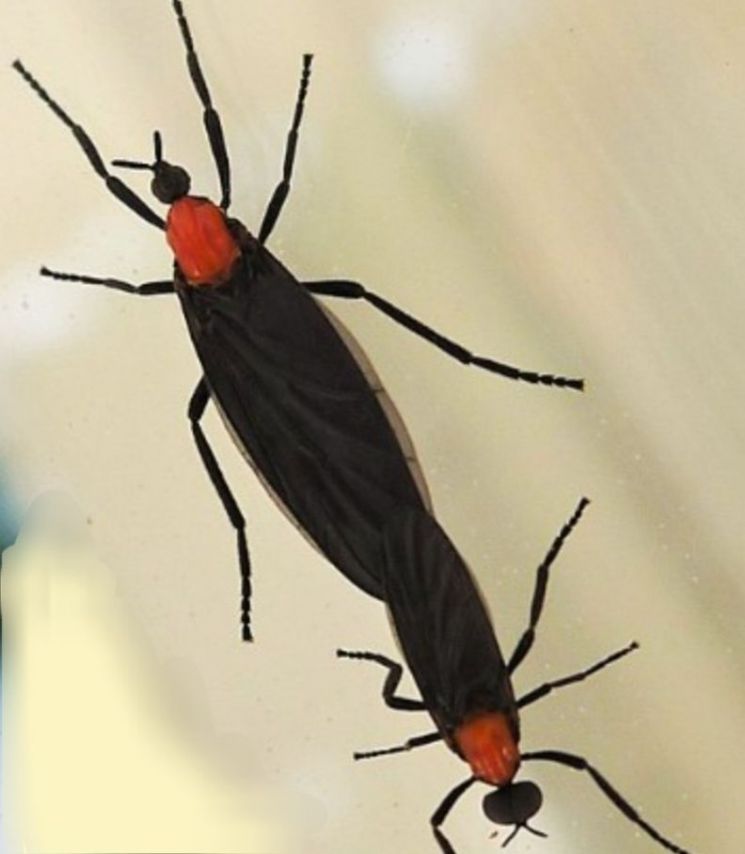
This month, lovebugs have appeared in Seoul and the metropolitan area as well. Officially called 'bulgeundengudan-teolpari' (red-backed lovebug), these insects fly or feed while attached in mating pairs, which is why they are called lovebugs. The adult bugs survive only about 3 to 5 days after reaching maturity.
Although their behavior of clustering on windows or flying in pairs and swarming people causes discomfort and fear among citizens, lovebugs are actually classified as beneficial insects. Their larvae decompose fallen leaves, enriching the soil, and the adults help pollinate flowers like butterflies and bees. They do not bite humans nor transmit diseases.
The presence of lovebugs became widely known starting two years ago in 2022. In 2022 and last year, lovebugs began appearing and spreading from mid-June, mainly in the northwestern metropolitan area including Eunpyeong-gu in Seoul and Goyang City in Gyeonggi Province. However, this year they appeared in the Chungcheong region from late April and surged in May. The Infectious Disease Control Division of the Seoul Metropolitan Government’s Citizen Health Bureau stated, "Lovebugs lose activity when exposed to sunlight and gradually die off naturally," and suggested the following measures to cope with lovebugs: ▲repair window screens ▲wear dark-colored clothes during outdoor activities ▲use sticky traps.
 The appearance of an Oriental mayfly found in the subway last month [Image source=Online community capture]
Meanwhile, last month, so-called 'Tinkerbell' Oriental mayflies appeared in large numbers across Seoul, causing difficulties for each district’s pest control efforts. Oriental mayflies are
characterized by green wings and are also called 'Tinkerbell' after the fairy in the novel Peter Pan. This year, Oriental mayflies appeared earlier than usual and were found simultaneously inside subway trains crossing the city, causing fear and inconvenience among citizens.
Oriental mayflies are large mayflies measuring 10?20 mm in body length and 50 mm in wingspan. They are distributed in Korea, Japan, China, and other regions, inhabiting second-class water quality environments. They usually hatch intensively in June and July, but this year they appeared earlier due to warm weather. Oriental mayflies are not pests that transmit infectious diseases such as viruses or bacteria. They focus solely on mating, and after mating, they land on the water surface to lay 2,000 to 3,000 eggs before dying immediately. Their larvae feed on organic matter in streams, thus contributing to ecological cycling.
© The Asia Business Daily(www.asiae.co.kr). All rights reserved.
![Clutching a Stolen Dior Bag, Saying "I Hate Being Poor but Real"... The Grotesque Con of a "Human Knockoff" [Slate]](https://cwcontent.asiae.co.kr/asiaresize/183/2026021902243444107_1771435474.jpg)
















