The Tripartite Commission Launches the 'Work-Life Balance Committee' on the 21st
Flexible 52-Hour Workweek vs. Divided Opinions on the 4-Day Workweek
Tripartite social dialogue to discuss measures such as working hours reform in search of work-life balance will officially begin this week.
On the 16th, the Economic, Social and Labor Council (ESLC), a social dialogue body under the direct control of the president, announced that it will launch the 'Work-Life Balance Committee,' a subcommittee by agenda, on the 21st and hold its first plenary meeting.
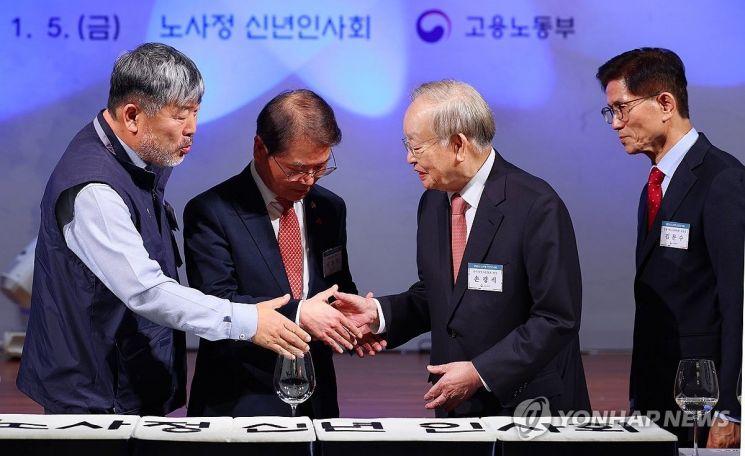 On the afternoon of January 5th this year, at the New Year's Labor-Management-Government Meeting held at the Seoul Central Post Office in Jung-gu, Seoul, Lee Jeong-sik, Minister of Employment and Labor (center), cut a congratulatory rice cake and then shook hands with Kim Dong-myeong, Chairman of the Korean Confederation of Trade Unions (left), and Son Kyung-sik, Chairman of the Korea Employers Federation. On the right is Kim Moon-soo, Chairman of the Economic, Social and Labor Council.
 [Photo by Yonhap News]
The Work-Life Balance Committee is one of the three committees agreed upon by labor, management, and government at the ESLC plenary meeting last February. Its launch was delayed due to fallout from labor-government conflicts over the composition of other special committees under the ESLC, but at the end of last month, the 'Special Committee for Sustainable Jobs and Future Generations' was launched belatedly first among the three committees, followed by the Work-Life Balance Committee.
It is composed of 12 members, including labor, management, and government-appointed members as well as public interest members. Over the next year, the committee will discuss working hours reform such as the 'transition to a four-day workweek,' protection of health rights, and improvement of working methods. The term may be extended.
The most contentious and sensitive issue among the topics is the 'solution to long working hours.' While all parties agree on the need to improve the reality of workers working long hours, they have not been able to narrow their differences on how to specifically reform working hours-related systems. This is why both 'reduction' and 'flexibility' of working hours are included side by side in the agenda.
The business community insists that companies should be able to operate the current '52-hour workweek' system (40 hours of statutory work plus 12 hours of overtime) more flexibly. They are requesting permission to allow working more than 52 hours a week in situations where workloads accumulate.
The government also basically maintains the framework of the 52-hour workweek system while proposing last year a reform plan to operate it more flexibly.
On the other hand, the labor side opposes the flexibilization of working hours, arguing that it will ultimately lead to long working hours and infringe on workers' health rights. Since the Korean Confederation of Trade Unions and the Federation of Korean Trade Unions have listed the 'four-day workweek' as a priority legislative task for the 22nd National Assembly, the gap between the two sides is expected to be difficult to bridge.
Son Kyung-sik, chairman of the Korea Employers Federation, recently told reporters in Geneva, Switzerland, "We agree that long working hours should be somewhat restrained," but added, "Rather than thinking about minimum working hours within limited time, we need to think more broadly."
© The Asia Business Daily(www.asiae.co.kr). All rights reserved.

















