A Decisive Move to Overcome the Defeat in the European Parliament Election
Marine Le Pen-led National Rally to Become the Largest Party
French President Emmanuel Macron has called an early general election to recover from his party's defeat in the European Parliament elections, but the far-right party is expected to become the majority. Rather than achieving the goal of curbing the spread of far-right forces, the early election may turn into a 'self-defeating move' that hands the next presidency to far-right politician Marine Le Pen.
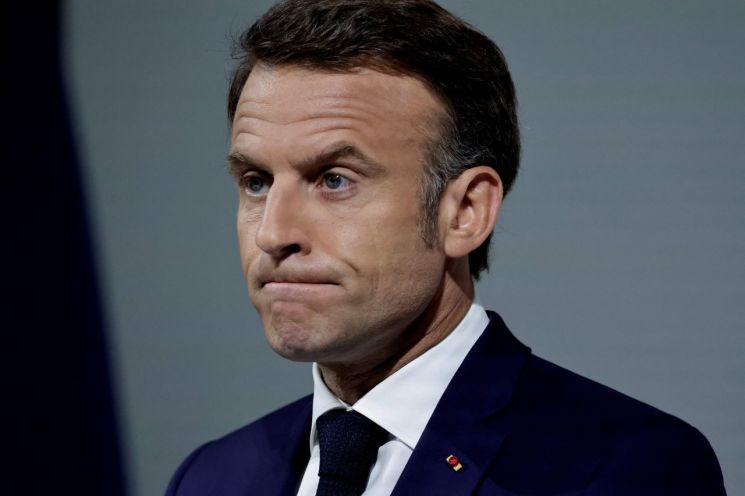
According to the Wall Street Journal (WSJ) in the United States and the British daily The Times on the 14th (local time), a BFMTV-Elabe poll released on the 12th predicted that the far-right National Rally (RN) would secure 220 to 270 seats out of the total 577, becoming the largest party.
Although this falls short of the majority of 289 seats, it represents a tripling of their current 88 seats.
In contrast, President Macron's Renaissance party and its allied ruling coalition are expected to win only 90 to 130 seats. This means they will lose their majority status to the RN and even fall behind the left-wing coalition, which is expected to win 150 to 190 seats.
After the ruling party suffered a double-score defeat to the RN in the European Parliament elections that ended on the 9th, President Macron launched the 'shock therapy' of an early general election, aiming to halt the rapid rise of the far-right and secure political momentum for the remainder of his term, which is more than half left.
This move was based on the calculation that, unlike in the European Parliament elections, the far-right would not achieve a landslide victory in the general election.
With only three weeks left until the first round of voting on June 30, it was assumed that the left would not have enough time to unite behind a single candidate, and if the runoff on July 7 is reached, voters would ultimately choose the pro-business ruling party over the extremes on both the left and right.
The French general election is conducted in a way that if no candidate obtains a majority in the first round in a constituency, a runoff is held to determine the final winner.
As President Macron hoped, the early election is unfolding like a referendum on Le Pen, but the results are diverging significantly from expectations.
The left-wing coalition 'People's Front' quickly organized by agreeing on the distribution of constituencies among parties, and the RN is predicted to continue its far-right surge as the largest party.
As a result, there are forecasts that President Macron's early election gamble could become a 'failed bet.'
The WSJ noted, "President Macron's hasty decision to call an early election may backfire," adding, "Macron's gamble to block Le Pen is instead creating the risk of leading her to power."
The newspaper also pointed out that President Macron "may go down in history as the person who brought Le Pen and her far-right party to the doorstep of French power." Concerns are growing in French political circles that with Macron, who was re-elected in 2022, unable to run for another term, Le Pen could seize the next presidency.
There is also analysis that this early election could follow the path of the Brexit (the UK's withdrawal from the EU) referendum.
Former Prime Minister David Cameron, during his tenure in January 2013, when Euroscepticism was rising in the UK, pledged in his general election campaign to negotiate changes to the UK's status in the EU and member states, and announced that a referendum on EU membership would be held by 2017.
This was a gamble based on the calculation that voters would choose to remain in the EU, but contrary to expectations, the June 2016 referendum resulted in a decision to leave the EU. Cameron took responsibility and resigned, and the UK experienced significant division and turmoil.
Muztaba Rahman of the political consulting firm Eurasia Group said, "Cameron made an all-in gamble and lost. He thought the 'fear project' (which emphasizes pessimistic scenarios if the UK left the EU) would win, but he was wrong," adding, "Macron is doing exactly the same thing."
© The Asia Business Daily(www.asiae.co.kr). All rights reserved.
![Clutching a Stolen Dior Bag, Saying "I Hate Being Poor but Real"... The Grotesque Con of a "Human Knockoff" [Slate]](https://cwcontent.asiae.co.kr/asiaresize/183/2026021902243444107_1771435474.jpg)















