The General Insurance Association Reveals Common Types of Car Accidents During Summer Vacation Season
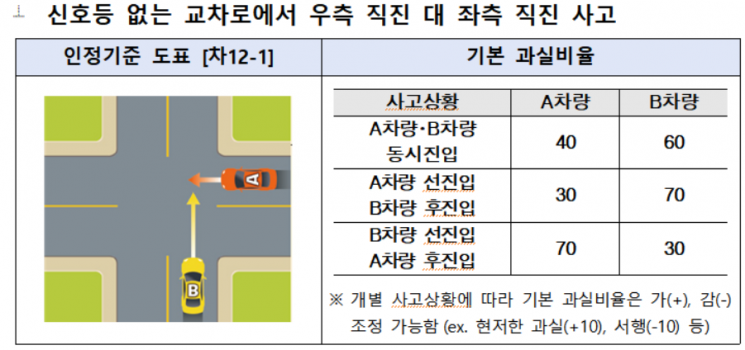
There are intersections without traffic lights. When Vehicle A enters from the right road and goes straight, and Vehicle B enters from the left road and goes straight, whose responsibility is greater in case of a collision? In general, the fault ratio for this accident is 40 (Vehicle A) to 60. If Vehicle A entered first, Vehicle B’s fault increases.
Article 26 of the Road Traffic Act states that at intersections of equal width without traffic lights, when vehicles enter simultaneously, the vehicle entering from the right road has the right of way. However, since the vehicle must also slow down or come to a complete stop before entering the intersection, the fault ratio may vary depending on whether the vehicle entered first or not.
The General Insurance Association disclosed on the 16th the types of car accidents that frequently occur in preparation for the summer vacation season. They analyzed about 130,000 cases of fault ratio dispute decisions over three years from the Automobile Accident Fault Ratio Dispute Deliberation Committee to select accident types with frequent fault ratio disputes.
Disputes over accidents occurring during lane changes by two vehicles traveling in the same direction ranked first and second (47,000 cases, 35.9%). Disputes caused by accidents at intersections without traffic lights and on roads without center lines ranked third (about 8,500 cases, 6.5%) and fourth (about 6,800 cases, 5.2%), respectively. Disputes caused by rear-end collisions due to failure to maintain a safe distance or negligence in forward attention ranked fifth (about 4,500 cases, 3.5%).
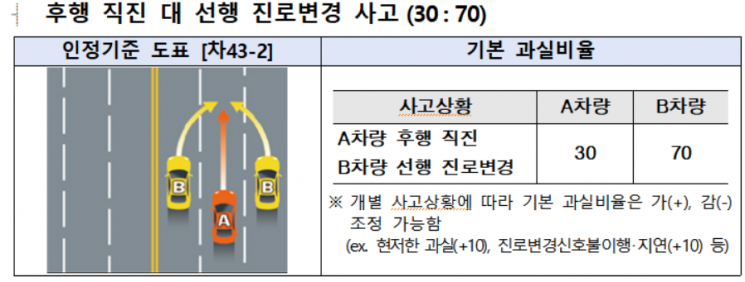
When Vehicle B, which is ahead on the road, changes lanes and collides with Vehicle A, which is following in the same direction, the fault ratio is generally 30 (Vehicle A) to 70. The leading vehicle has the obligation to secure sufficient distance from the following vehicle and to change lanes without causing danger, so it bears greater fault. However, since the following vehicle also has a duty of care to prevent accidents by decelerating or braking, this ratio was determined based on related precedents. If the lane change signal is delayed or not executed, or if the lane is changed suddenly at a close distance, the fault ratio may increase. It is essential to develop the habit of turning on the turn signal before changing lanes and to change lanes only when a sufficient distance from the following vehicle is secured.
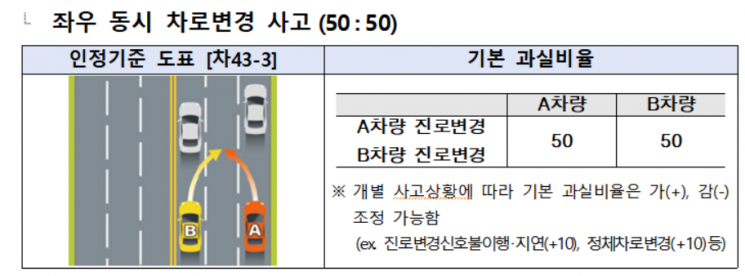
The fault ratio for an accident where Vehicle A changes lanes from the right 3rd lane to the 2nd lane and Vehicle B changes lanes from the left 1st lane to the 2nd lane and they collide is 50 to 50. Since both vehicles changed lanes simultaneously from opposite sides, both bear fault for violating lane change methods. Vehicles changing lanes while waiting in congested lanes may have their fault increased (by 10%) considering causality with the accident. Therefore, it is necessary to check once more whether there are any vehicles approaching from behind or the side before changing lanes.
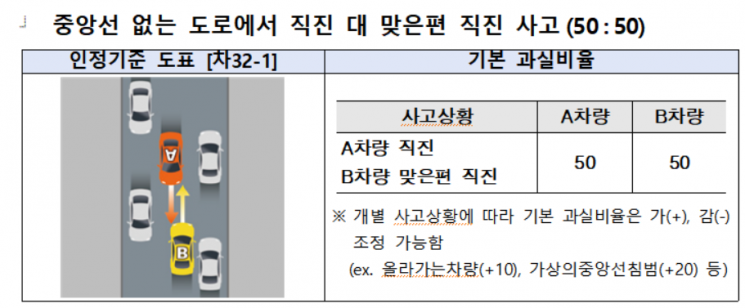
When a vehicle going straight and an oncoming vehicle collide on a road without a center line, such as an alley or a side street, the fault ratio is 50 to 50. On such roads, both vehicles often cross an imaginary center line while driving, and ordinary drivers should anticipate this situation and yield accordingly. Considering that both vehicles violate this duty equally, related precedents have standardized this fault ratio. If a vehicle going uphill on a narrow, steep road fails to yield the lane, fault may be increased (by 10%). When there is a vehicle coming downhill, the uphill vehicle should yield the lane.
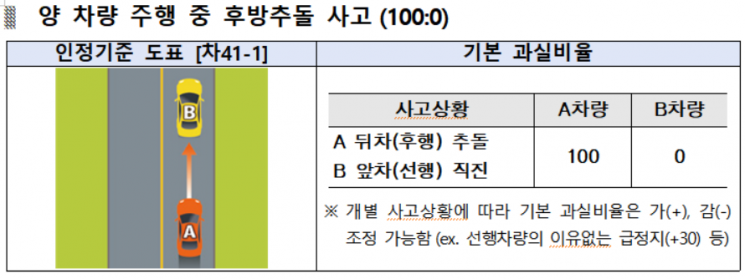
When Vehicle A, following behind on the road, rear-ends Vehicle B traveling ahead in the same direction, the fault ratio is 100 (Vehicle A) to 0. If the leading vehicle suddenly stops without reason (such as stopping abruptly to pick up a taxi passenger or pressing the brake instead of the accelerator due to driver inexperience), or if the brake lights are malfunctioning and do not illuminate, the leading vehicle’s fault may be increased (by 10?30%). Therefore, it is necessary to regularly check the operation of brake lights.
An official from the General Insurance Association stated, "We will continue to strengthen guidance on frequently occurring traffic accident cases and fault ratios in daily life to improve consumer understanding and reduce unnecessary disputes. We will also strive to protect consumer rights by ensuring the fair operation of the Deliberation Committee and enhancing the rationality of fault ratio recognition standards."
© The Asia Business Daily(www.asiae.co.kr). All rights reserved.
![Clutching a Stolen Dior Bag, Saying "I Hate Being Poor but Real"... The Grotesque Con of a "Human Knockoff" [Slate]](https://cwcontent.asiae.co.kr/asiaresize/183/2026021902243444107_1771435474.jpg)

















