"Losers of the world gathered at the Group of Seven (G7) summit." (Axios)
"Six lame ducks and Giorgia Meloni." (Politico)
"Welcome to the unprecedentedly unpopular G7 summit." (The Telegraph)
These are the headlines from major foreign media reporting on the G7 summit that opened on the 13th (local time) in Italy. There is a reason why the G7 leaders, gathered in one place for the first time in a while, were called losers. Except for Italian Prime Minister Giorgia Meloni, all other leaders are in a 'lame duck' status, with weakened political standing.
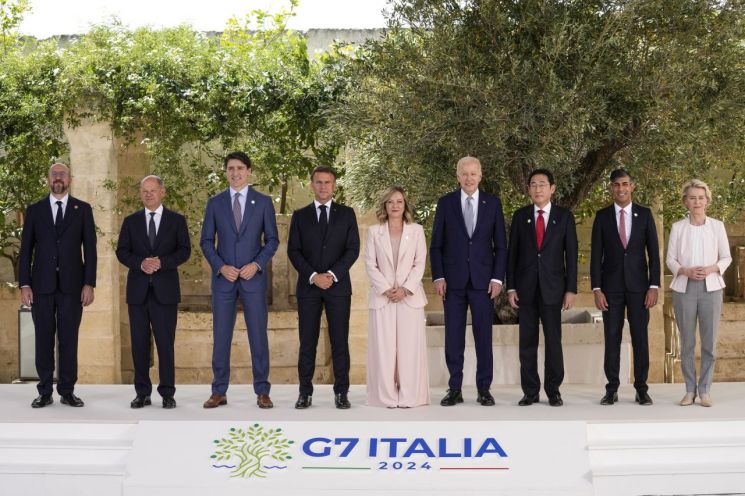
G7 Leaders Except Meloni Cornered by Dismal Approval Ratings
According to Axios, Prime Minister Meloni is classified as a unique figure among this year’s G7 leaders. This is not because of her far-right political stance evident in her political career, but because her approval rating exceeds 40%.
In the Italian election for the European Parliament that ended on the 9th, the far-right Italy Brothers (FdI) led by Meloni made significant gains, securing the highest vote share. Meloni is especially regarded as the biggest winner of the European Parliament election and has emerged as a kingmaker within the European Union (EU).
On the other hand, the approval ratings of the other G7 leaders are dismal. According to Morning Consult, U.S. President Joe Biden’s approval rating is 37%, and Canadian Prime Minister Justin Trudeau’s is 30%. German Chancellor Olaf Scholz, who was defeated by far-right forces in the European Parliament election, has an approval rating of only 25%. British Prime Minister Rishi Sunak, facing an early general election, and French President Emmanuel Macron also have low ratings of 25% and 21%, respectively. Japanese Prime Minister Fumio Kishida’s approval rating is the lowest among them at 13%.
Politico described this week’s G7 summit as "more of a last supper than a show of Western power," noting that "most attendees are struggling due to political or domestic issues." The Times also defined this meeting as a "lame duck summit of G7 leaders punished by voters and suffering steep drops in approval ratings."
Except for Meloni, the European G7 leaders have been cornered by the European Parliament elections held from the 6th to the 9th. President Macron’s Renaissance party suffered a crushing defeat to the far-right National Rally (RN), prompting him to gamble his political life on an early general election. Chancellor Scholz also endured the humiliation of falling to third place behind far-right parties. British Prime Minister Sunak is expected to step down after the July 4 general election, likely handing power to the Labour Party for the first time in 14 years.
It is not only the European leaders. Canadian Prime Minister Trudeau, whose approval ratings are clearly declining, recently publicly declared he would quit his "crazy" job. Japanese Prime Minister Kishida, facing a resignation crisis due to a so-called "slush fund scandal," has suffered setbacks in consecutive elections, damaging his administration. If this continues, he is unlikely to retain his position in the Liberal Democratic Party leadership election scheduled for late September.
Moreover, U.S. leadership is also shaken ahead of the November presidential election. President Biden’s second son, Hunter Biden, was convicted on three felony charges, including illegal firearm possession, just before the G7 summit. This verdict, coming amid already low approval ratings, is expected to inevitably disrupt Biden’s future election campaign.
Ivo Daalder, former U.S. ambassador to NATO under the Barack Obama administration, said, "Except for Meloni, the G7 leaders are very vulnerable. Trudeau is unlikely to win the next election, Biden is in a fierce contest, Scholz and Macron have weakened, Sunak is a 'walking dead man,' and Kishida also faces serious internal problems."
The British Daily Mail sarcastically remarked, "Meloni might teach her fellow leaders how to become a popular leader." The Guardian highlighted the group photo released on the first day, noting that "Meloni, who topped the European Parliament election, was comforting the procession of the dead (the other leaders dressed in dark suits) while wearing a light pink pantsuit."
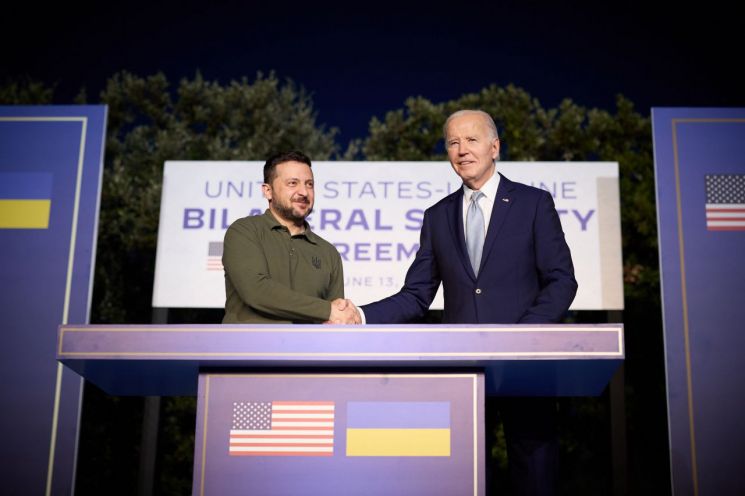
Will G7 Unity Weaken? Unified Voice on Ukraine Support on First Day
The weakened position of G7 leaders raises concerns that the G7’s leadership, which must jointly respond to global challenges, could also be undermined. The New York Times (NYT) called it "an ominous sign reflecting political turmoil shaking the entire Western world," warning that it could lead to Western division and affect G7 unity.
For example, if the Conservative Party led by Sunak loses the general election next month, there could be changes in policies on China containment and support for Ukraine. The rise of far-right forces spreading across Europe and the possibility of former U.S. President Donald Trump winning the presidential election and overturning existing policies also highlight these concerns.
On the second day of the summit, the 14th, G7 leaders are expected to criticize China’s unfair economic practices and support for Russia. Bloomberg News, citing diplomats, reported that "Western countries will unanimously express concern over China’s overproduction." Earlier, the outlet reported that the draft joint statement to be released after the G7 summit includes language stating that "China’s policies are causing global ripple effects, market distortions, and harmful overproduction in various sectors."
However, unlike the U.S., which wants to actively participate in China containment, cautious opinions prevail in Europe, advocating to avoid a full-scale trade war with China if possible. Therefore, it remains uncertain what specific sanctions will follow.
The only area where G7 leaders have confirmed consensus is support for Ukraine. On the first day of the meeting, the G7 discussed expanding support for Ukraine and agreed to provide $50 billion (approximately 68.5 trillion KRW) to Ukraine using frozen Russian assets. Ukrainian President Volodymyr Zelensky attended a special session on Ukraine held that afternoon.
On that day, President Biden signed a 10-year security agreement with President Zelensky, emphasizing, "This agreement will enable Ukraine to become self-sufficient and set it on the path to NATO membership." President Zelensky also welcomed it as a "historic day."
© The Asia Business Daily(www.asiae.co.kr). All rights reserved.
![Clutching a Stolen Dior Bag, Saying "I Hate Being Poor but Real"... The Grotesque Con of a "Human Knockoff" [Slate]](https://cwcontent.asiae.co.kr/asiaresize/183/2026021902243444107_1771435474.jpg)
















