Air Premia Beats Eastar Jet
High Evaluation in Qualitative Areas Including Business Continuity
Korean Air and Asiana Airlines Merger Passes Critical Milestone
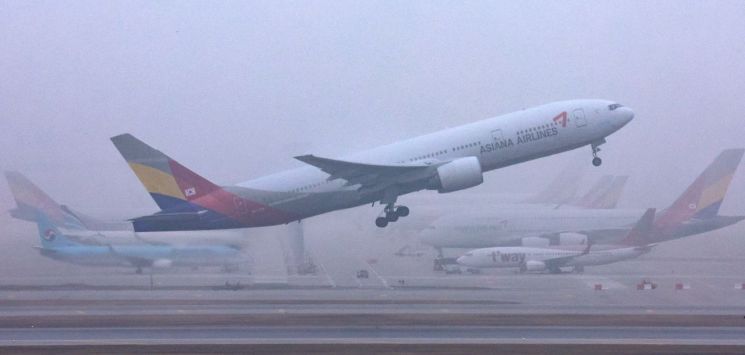
Air Incheon overcomes competition from Air Premia and Eastar Jet to acquire Asiana Airlines' cargo division. With the European Commission (EC) resolving concerns over cargo business monopolies as a condition, Korean Air's merger with Asiana Airlines has also passed a critical milestone.
According to industry sources on the 14th, Korean Air has designated Air Incheon as the preferred bidder for acquiring Asiana Airlines' cargo division. The board of directors is scheduled to hold a meeting on the 17th to give final approval for the sale and notify Air Incheon. Korean Air stated, "The process is still ongoing."
Air Incheon, whose largest shareholder is the private equity firm Socios, formed a consortium with Korea Investment Partners and others. The acquisition financing group includes Korea Investment & Securities and Shinhan Investment Corp. The Air Incheon consortium reportedly offered around 500 billion KRW for Asiana Airlines' cargo division. Other bidders such as Air Premia and Eastar Jet also reportedly submitted bids around 500 billion KRW.
Due to the nature of airline transactions, Air Incheon appears to have received high marks for qualitative factors such as management and business continuity. Air Incheon is the only dedicated cargo airline in South Korea. There are no concerns regarding the compliance orientation of its major shareholders or foreign effective control. In contrast, Air Premia brought in MBK Partners as a financial investor, but the Ministry of Land, Infrastructure and Transport raised objections because MBK Partners' fund included foreign shareholders such as Dial Capital. Ultimately, MBK withdrew from the deal, and Meritz Securities filled the vacancy.
With this acquisition, Air Incheon will instantly become the second-largest cargo operator in South Korea. It is expected to expand its business scope from short-haul cargo transport to long-haul routes. Asiana Airlines' cargo division held a market share of 19.4% as of the first quarter, ranking second after Korean Air's 45.2%. Last year, the cargo division recorded sales of 1.6071 trillion KRW and an operating profit of 70 billion KRW.
With the sale of Asiana Airlines' cargo division finalized, the merger process between Korean Air and Asiana Airlines is also progressing smoothly. The EC approved the corporate merger, having met conditions including the allocation of key European passenger route traffic rights and the separate sale of Asiana Airlines' cargo division. Approval has been obtained from 13 of the 14 mandatory merger notification countries, leaving only the United States' decision pending. Cho Won-tae, chairman of Korean Air, stated in an interview with foreign media earlier this month, "We expect to receive approval from the U.S. government by the end of October."
Once the U.S. authorities complete their review, the full merger of Korean Air and Asiana Airlines will commence. Korean Air plans to first incorporate Asiana Airlines as a subsidiary and move toward an integrated airline within two years. The merged entity is expected to become a top 10 global mega airline.
© The Asia Business Daily(www.asiae.co.kr). All rights reserved.
![Clutching a Stolen Dior Bag, Saying "I Hate Being Poor but Real"... The Grotesque Con of a "Human Knockoff" [Slate]](https://cwcontent.asiae.co.kr/asiaresize/183/2026021902243444107_1771435474.jpg)















