Bank of Korea's 'April Money and Liquidity'
Money Supply Increases for 11 Consecutive Months Mainly Due to Time and Installment Savings
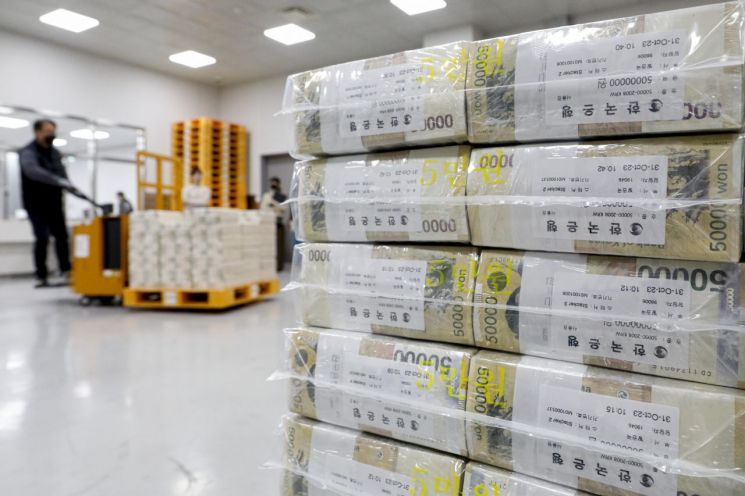
As concerns over a delay in interest rate cuts increased demand for safe assets, the money supply in the market has risen for the 11th consecutive month, mainly in time deposits and installment savings. The growth rate narrowed to 0.4% compared to 1.7% in the previous month.
According to the 'April 2024 Money and Liquidity' report released by the Bank of Korea on the 14th, the broad money supply (M2, seasonally adjusted, average balance basis) in April reached 4,013 trillion won, an increase of 16.7 trillion won from the previous month. The money supply has been increasing for 11 consecutive months since June last year, when it rose by 0.4%.
M2 is an indicator used to represent the amount of money circulating in the market. It includes narrow money (M1), which covers cash, demand deposits, and savings deposits with check-writing privileges, as well as financial products such as money market funds (MMF), time deposits and installment savings under two years, beneficiary certificates, negotiable certificates of deposit (CD), and repurchase agreements (RP).
By product, time deposits and installment savings (10.2 trillion won), market-type products (7.9 trillion won), and beneficiary certificates (6.9 trillion won) increased. On the other hand, savings deposits with check-writing privileges (-7.3 trillion won) and demand deposits (-2.8 trillion won) decreased.
Time deposits and installment savings increased due to rising demand for safe assets amid concerns over delays in domestic and international monetary policy pivots and conflicts in the Middle East. Market-type products grew as banks expanded CD issuance to manage liquidity coverage ratio (LCR). Beneficiary certificates increased mainly in bond funds due to rising government bond yields.
Lee Ji-seon, head of the Financial Statistics Team at the Bank of Korea, said, "The increased demand for safe assets contributed to the rise in time deposits and installment savings," but added, "It is not a money move to safe assets to the extent that the increase in time deposits and installment savings recorded an all-time high early last year due to safe asset preference."
She explained, "As expectations grow that financial authorities will raise the LCR regulatory ratio from July, banks' demand to secure funds through CDs, RPs, and other instruments has increased."
Savings deposits with check-writing privileges and demand deposits decreased due to a base effect from education grants in the previous month, as well as outflows to other investment destinations such as gold, time deposits and installment savings, and initial public offering (IPO) subscriptions.
Lee explained, "Usually, in March, education grants are paid to local governments, temporarily increasing balances, but balances decrease from mid to late March as grants are withdrawn."
By economic agents, corporations, other financial institutions, households, and non-profit organizations all increased. Corporations (18.9 trillion won) increased mainly in demand deposits and market-type products; other financial institutions (2.5 trillion won) increased mainly in market-type products and beneficiary certificates; households and non-profit organizations (1.7 trillion won) increased mainly in time deposits and installment savings. Conversely, other sectors (-6 trillion won) decreased mainly in time deposits, installment savings, and demand deposits.
Meanwhile, narrow money (M1, seasonally adjusted, average balance basis) was 1,234.8 trillion won, down 9.6 trillion won from the previous month. As savings deposits with check-writing privileges and demand deposits decreased, the growth rate turned negative from 2.2% in the previous month to -0.8%.
© The Asia Business Daily(www.asiae.co.kr). All rights reserved.
![Clutching a Stolen Dior Bag, Saying "I Hate Being Poor but Real"... The Grotesque Con of a "Human Knockoff" [Slate]](https://cwcontent.asiae.co.kr/asiaresize/183/2026021902243444107_1771435474.jpg)















