First 0.6% Delinquency Rate Since 2012
Self-Employed Struggling with Debt Due to High Interest Rates and Inflation Increase
Mr. A, a self-employed business owner in his 50s who ran a restaurant in Suwon-si, Gyeonggi Province, recently closed the store he had operated for the past 10 years. Although he barely survived the COVID-19 pandemic, the recent rise in raw material prices and decline in sales made it difficult to even cover the rent, let alone the loan interest. He lamented that his debt snowballed as he resorted to card loans and private lenders to refinance his loans.
It has been revealed that the delinquency rate on loans for self-employed individuals has soared to the highest level in 11 years due to prolonged high inflation and an economic downturn.
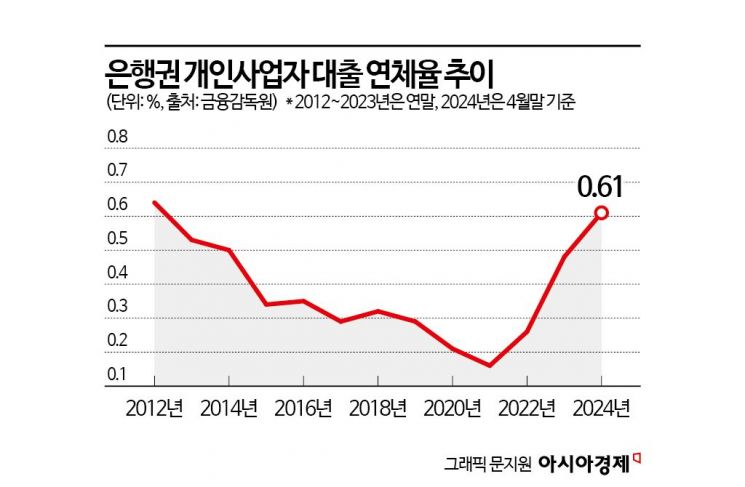
According to the Financial Supervisory Service on the 13th, the delinquency rate on personal business loans at domestic banks stood at 0.61% at the end of April, up 0.07 percentage points from 0.54% in the previous month. Compared to the same period last year (0.41%), it surged by 0.2 percentage points. The delinquency rate on personal business loans reaching the 0.6% range is the highest in 11 years and 4 months since the end of 2012 (0.64%).
The Financial Supervisory Service analyzed that the delinquency rate is rising as more self-employed individuals fail to repay their debts on time due to high interest rates and inflation. Consequently, the closure rate of self-employed businesses is also increasing. Last year, the closure rate for personal business owners was 9.5%, up 0.8 percentage points from the previous year. During the same period, the number of closures increased by 111,000 to 911,000.
At the end of April, the delinquency rate on won-denominated loans in the banking sector (based on principal and interest overdue for more than one month) was 0.48%, up 0.05 percentage points from 0.43% in the previous month. The amount of newly delinquent loans was 2.6 trillion won, an increase of 200 billion won from the previous month. The new delinquency rate rose by 0.01 percentage points to 0.12% from 0.11% in the previous month.
By sector, the delinquency rate on corporate loans was 0.54%, up 0.06 percentage points from 0.48% in the previous month. During the same period, the delinquency rate on large corporate loans rose by 0.02 percentage points to 0.11%. The delinquency rate on small and medium-sized enterprise loans increased by 0.08 percentage points to 0.66%.
The delinquency rate on household loans was 0.40%, up 0.03 percentage points from 0.37% in the previous month. During the same period, the delinquency rate on mortgage loans rose by 0.01 percentage points to 0.26%, while the delinquency rate on other loans (such as credit loans) increased by 0.06 percentage points to 0.79%.
A Financial Supervisory Service official stated, "As high interest rates and inflation persist, we must prepare for the possibility of expanding new delinquencies, especially among vulnerable borrowers such as self-employed individuals in economically sensitive industries." He added, "We will encourage debt restructuring for borrowers at risk of delinquency to support the alleviation of their repayment burdens."
© The Asia Business Daily(www.asiae.co.kr). All rights reserved.
![Clutching a Stolen Dior Bag, Saying "I Hate Being Poor but Real"... The Grotesque Con of a "Human Knockoff" [Slate]](https://cwcontent.asiae.co.kr/asiaresize/183/2026021902243444107_1771435474.jpg)















