Gallup Announces '2024 Global Workplace Report'
"1 in 5 Workers Worldwide Experience Loneliness in Daily Life"
Remote Workers Report More Loneliness Than On-site Workers
Feeling Engaged at Work Greatly Reduces Loneliness
One in five workers worldwide reported feeling lonely in their daily lives. Despite meeting and conversing with various people during their work life, a significant number of employees experience social isolation and loneliness. In particular, in South Korea, many workers were found to struggle with fully immersing themselves in their work and job tasks. The proportion of workers who reported feeling engaged during work was only 13% in South Korea, significantly lower than both the global average and the East Asian average (18%).
Gallup revealed on the 12th, through the "2024 Global Workplace Report," that 20% of workers worldwide experience loneliness. There was no gender gap between men and women, but workers under 35 years old (22%) felt lonelier than those aged 35 and above (19%). This is interpreted as younger workers having less social experience and fewer workplace networks, leading to more frequent feelings of loneliness.
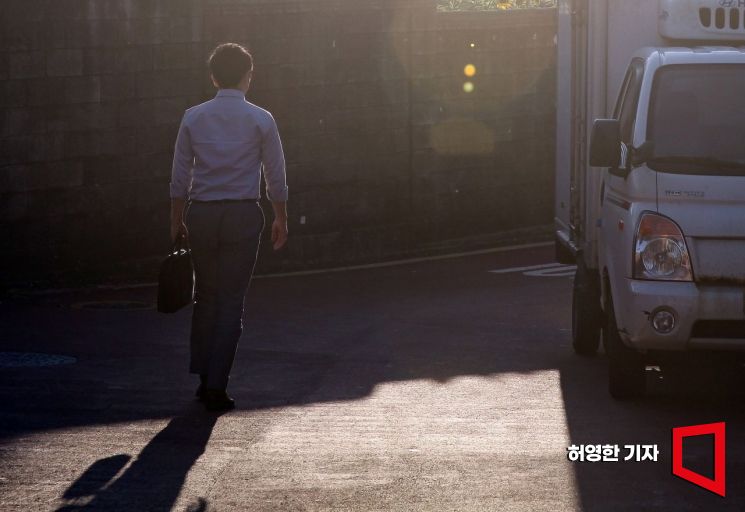 A office worker is walking through an alleyway in Seoul, bathed in the afternoon sunlight. Photo by Heo Young-han
By region, South Asian workers reported the highest rate of loneliness at 29%, followed by Sub-Saharan Africa (26%), the Middle East and North Africa (23%), and Southeast Asia (20%), all above the average. East Asia, including South Korea, was slightly below average at 18%, followed by the United States and Canada (18%), Europe (14%), and Latin America and Australia/New Zealand (13%).
The Gallup survey also revealed that the degree of loneliness felt by workers varied significantly depending on their workplace setting. Among those working remotely full-time, 25% reported feeling lonely, which was 9 percentage points higher than those working exclusively on-site. Hybrid workers, who split their time between on-site and remote work, reported a 21% loneliness rate.
The higher the proportion of remote work, the fewer opportunities workers have to meet colleagues, which explains these results. During the pandemic, companies that adopted widespread remote work faced issues with employees expressing loneliness, prompting efforts such as organizing meal gatherings to alleviate loneliness and prevent it from negatively impacting work efficiency.
Lisa Berkman, a senior scientist at Gallup and a professor at Harvard University, analyzed nine years of research and concluded that social isolation and chronic loneliness cause severe damage to physical and mental health. Regardless of physical health or socio-economic status, individuals lacking community and social bonds have twice the risk of death compared to those who frequently interact socially.
Loneliness experienced by employees at work was particularly linked to "employee engagement," which refers to actively participating in one’s work and feeling a sense of belonging. Among workers who felt disengaged at work, 31% reported feeling lonely, nearly double the 17% loneliness rate among those who felt engaged. Gallup explained, "Employees who feel their opinions are respected at work or believe they are doing their best every day are less likely to feel lonely."
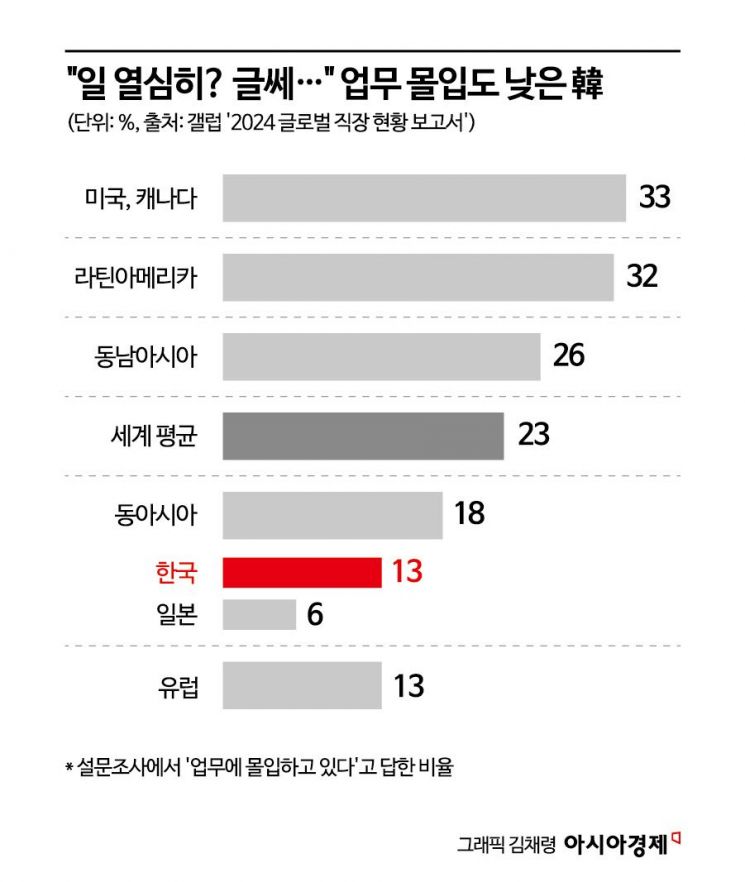
Employee engagement is a key factor that management should pay attention to when running an organization. In this survey, 23% of workers reported feeling engaged in their work, marking a high level. However, 62% still said they were not engaged, and among them, 15% said they had no intention of feeling engaged. Considering the scale of disengaged workers, Gallup estimated a global productivity loss of $8.9 trillion (approximately 1,225.3 trillion KRW).
In South Korea, only 13% of workers reported feeling engaged during work, significantly below both the global average and the East Asian average (18%). Among East Asian countries, Japan and Hong Kong had particularly low engagement rates, with only 6% of workers reporting feeling engaged.
Among the unemployed, more than three out of ten (32%) reported feeling lonely in daily life, 12 percentage points higher than workers (20%). This difference is interpreted as workers having more opportunities to communicate with others through their jobs. However, the loneliness rate among workers who have no intention of feeling engaged at work (31%) was almost the same as that of the unemployed.
While loneliness and social isolation among workers are global issues, it has also been confirmed domestically that workers experience severe isolation after starting their jobs. According to a survey conducted by Asia Economy in cooperation with the anonymous workplace community app Blind from March 26 to April 5, among 294 respondents (completed responses), more than half (56%) said their sense of isolation worsened after starting work. Only 13% said their isolation decreased after joining a company, less than half the rate of those who felt it worsened. Thirty-one percent said their sense of isolation was about the same before and after starting work.
© The Asia Business Daily(www.asiae.co.kr). All rights reserved.
![Clutching a Stolen Dior Bag, Saying "I Hate Being Poor but Real"... The Grotesque Con of a "Human Knockoff" [Slate]](https://cwcontent.asiae.co.kr/asiaresize/183/2026021902243444107_1771435474.jpg)
















