If Delivery Trucks Are Blocked from Entering the Ground Level
Refusal of Front Door Delivery as a Response
Seeds of Conflict Remain After the First Crisis
Conflicts between delivery drivers trying to enter apartment grounds to deliver packages and residents trying to prevent this due to safety concerns often escalate into so-called 'delivery crises.' This time, a delivery crisis occurred at an apartment complex in Gimpo. However, the residents expressed sympathy for the drivers who gave up on deliveries and showed a restrained attitude, saying, "Let's stop the power abuse now."
"Please do not allow delivery trucks to enter apartment grounds"... Another conflict erupts
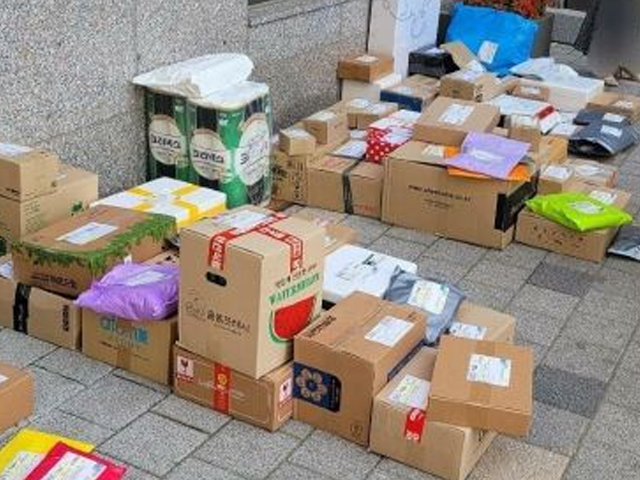 Parcels piled up in the office of an apartment complex in Gimpo. [Image source=Online community capture]
On the 12th, a post titled "Current situation at an apartment in Gimpo" was uploaded on an online community. The author explained, "A delivery driver spent 4 million won to modify his truck into a low-floor delivery vehicle after receiving a resident complaint asking that vehicles other than low-floor delivery trucks not enter the grounds," adding, "However, just as the modification was completed and he was about to enter again, he witnessed another delivery truck entering the grounds."
He continued, "Seeing this, the driver could not contain his anger over being discriminated against and left all the packages in front of the management office," adding, "The residents were told to come and pick them up themselves." The attached photo showed packages piled up in front of the apartment management office.
New apartment parking lot with about 2.1m clearance sparks delivery crisis
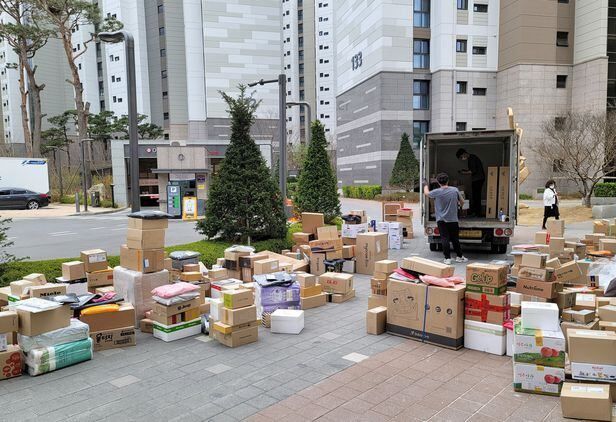 The scene during the 2021 parcel delivery crisis in Godeok-dong, Gangseo-gu, Seoul [Image source=Yonhap News]
A low-floor vehicle refers to a vehicle with a lowered cabin or chassis height. In particular, low-floor trucks are easier to enter underground parking lots of typical apartments, which have a height clearance of about 2.1 to 2.2 meters.
However, low-floor trucks have also been the cause of so-called 'delivery crises.' Some apartment residents raised safety concerns and demanded that all delivery trucks be modified into low-floor vehicles or that delivery trucks not enter the apartment grounds but instead deliver packages using carts. Such conflicts reached a peak in 2021 when demand for contactless services surged due to the COVID-19 pandemic.
A representative case was the delivery crisis at an apartment in Godeok-dong that erupted that year. When an apartment complex in Godeok-dong, Gangdong-gu, Seoul, blocked delivery trucks from entering the grounds, delivery drivers collectively refused to deliver packages to residents' doors for several weeks. Although door-to-door delivery resumed after residents' protests and pressure from delivery companies, many pointed out that this was only a temporary fix. In fact, large and small delivery crises have continued to occur since the Godeok-dong incident.
If delivery trucks cannot enter, door-to-door delivery is practically impossible
From the delivery drivers' perspective, banning entry into apartments is an unreasonable demand. During the Godeok-dong incident, the delivery workers' union explained that if entry into apartments is prohibited, the work time would increase by about 3 hours and 30 minutes to 4 hours. As work time decreases, the potential income of delivery drivers also shrinks.
Moreover, low-floor trucks have less cargo capacity than regular trucks. Consequently, the number of loading and unloading tasks?which require the most physical effort in the delivery process?increases, leading directly to musculoskeletal disorders among drivers. According to a 2020 survey by the Delivery Workers' Death Countermeasures Committee of 821 delivery workers, 83.6% reported lower back pain from loading and unloading labor, 87.7% reported upper body pain, and 85.2% reported lower body pain.
The cost of modifying trucks is also a significant burden, as individual business owners must pay between approximately 2 million and 4 million won.
"I am truly sorry"... Residents also support delivery drivers
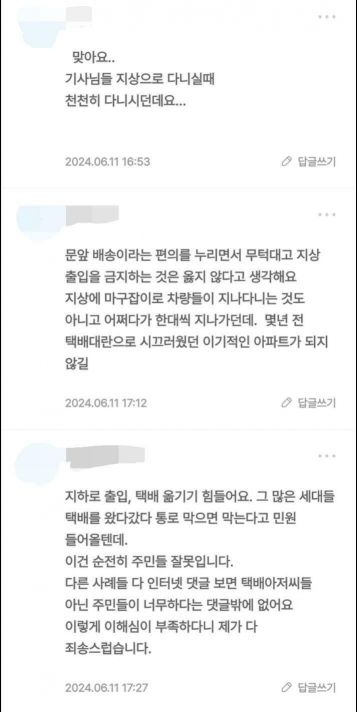
Because of this, residents of the Gimpo apartment complex where the delivery crisis occurred are showing more sympathy for the drivers' position.
On a community cafe where residents of the apartment complex gathered, reactions included, "Is it right to arbitrarily ban entry while enjoying the convenience of door-to-door delivery?", "We don't want to be seen as a selfish apartment," "Isn't this entirely our fault as residents? Other cases on internet comments only had residents being criticized," "I am truly sorry," and "Let's stop the power abuse. This only damages the apartment's image further."
© The Asia Business Daily(www.asiae.co.kr). All rights reserved.
![Clutching a Stolen Dior Bag, Saying "I Hate Being Poor but Real"... The Grotesque Con of a "Human Knockoff" [Slate]](https://cwcontent.asiae.co.kr/asiaresize/183/2026021902243444107_1771435474.jpg)

















