DNA-Based System Instead of Hash Values
Detects Edited Versions Including Subtitles and Black-and-White Conversion
Preparing to Enhance 'Face Recognition' System
No Legal Basis for Establishment... "Legal Revision Needed"
"We utilize DNA technology to collect even transformed, edited, and processed footage. Based on information like the unaltered human 'gene,' we detect illegal footage."
Digital sexual crime damage is fatal because it is easy for the harm to spread and be distributed. Therefore, discovering and deleting victim videos and photos distributed online is of utmost importance. In Korea, the Digital Sexual Crime Victim Support Center (DiSeong Center) under the Korea Women's Human Rights Institute plays a significant role. Since its establishment in 2018, it has deleted over 1 million illegal footage cases in six years. Last year alone, it supported the deletion of 275,520 videos within one year.
The reason behind achieving hundreds of thousands of support results with a small workforce is the self-developed 'DNA search-based system.' Shin Bora, President of the Korea Women's Human Rights Institute, said, "The DNA analysis program is a core system with a higher illegal footage matching rate than other PC-based programs," adding, "DiSeong Center staff monitor this system 365 days a year to support deletions."
'Finding Illegal Videos by 'DNA,' Not 'Fingerprint'
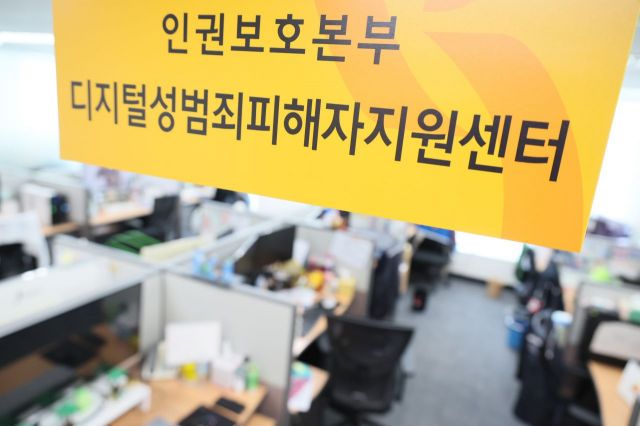 Inside the office of the Digital Sexual Crime Victim Support Center in Jung-gu, Seoul, on Tuesday, the 11th. Photo by Ministry of Gender Equality and Family
The DiSeong Center has built the 'Deletion Support System 2.0' based on DNA, which captures information remaining even after videos are heavily altered, to catch illegal videos. Here, DNA literally means information like the unchanging human gene. It contains data such as color, motion, scene transitions, and feature points. The advantage is that even edited videos?such as those converted to black and white, cropped, or with subtitles inserted?can be detected through DNA. The DiSeong Center developed its own deletion support system in collaboration with a private company that holds a patent for this DNA technology.
Overseas organizations search videos using hashes rather than DNA. A hash is a value containing information like video length and file size, comparable to a 'fingerprint' in humans. Just as worn or damaged fingerprints cannot be matched, hashes cannot detect footage altered by resolution changes, subtitles, and so forth.
The deletion support system is also preparing to advance its technology to better detect deepfake sexual content. By integrating the 'face search system' developed with the Electronics and Telecommunications Research Institute (ETRI), it aims to identify identical faces in victim footage. Although the face search system's technology development is complete, additional budget is needed to upgrade the system sufficiently for victim support application. The Institute plans to request an additional 3 billion KRW budget from the Ministry of Economy and Finance for system enhancement.
The DiSeong Center handles the entire process from deletion support requests to counseling through the 'Deletion Support System.' The system automatically crawls illegal footage from 310 adult sites 24/7. Crawling means extracting data by directly fetching web pages. Victims, investigative agencies, or dedicated organizations can request deletion support through a system portal by submitting the original footage or URL. Once a person in charge is assigned, the DNA search system compares similarities across all footage collected from illegal sites via crawling to find the relevant video. The center explains that it can detect similarities with over 99% accuracy, even for black-and-white conversions, screen flips, subtitle additions, and sped-up videos.
The person in charge personally verifies the results deemed similar by the system and requests video deletion from the site. If the site operator refuses the deletion request, the hosting provider is also asked to delete the content. For overseas server sites, a 'proof of illegality official letter' is sent, using the ongoing investigation case number to enhance credibility. However, the average time for deletion varies greatly depending on cooperation. Park Seong-hye, head of the deletion support team, said, "Some sites refuse deletion requests entirely, while others delete more than half of the requested content, so it's hard to give an average. For uncooperative sites, we are trying international cooperation and enhancing official letters."
Cannot Respond When Illegal Sites Ask for 'Authority'... Legal Basis Needed
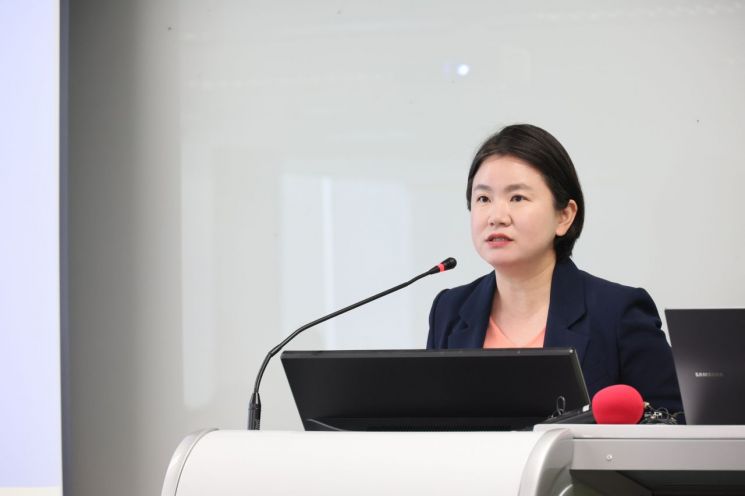 On the 11th (Tuesday), Shin Bora, President of the Women's Human Rights Promotion Institute, is giving a greeting at the Digital Sexual Crime Victim Support Center in Jung-gu, Seoul. Photo by Ministry of Gender Equality and Family
To respond to uncooperative sites, the DiSeong Center collectively agrees that a 'legal basis for establishment' including the center's name and functions must be enacted. Team leader Park said, "When we request deletion, illegal sites reply asking, 'What authority does your center have?'" She emphasized, "We want to respond with a legal basis specifying our institution's name, but currently, there is no legal basis for establishment at all." Currently, the Sexual Violence Prevention Act only states that "support for deletion of footage or copies can be provided to persons harmed by the distribution of such footage."
Another issue is the small number of personnel compared to the workload. Currently, the deletion support team has only 15 to 20 members. Considering last year's 240,000 cases, each person handles about 12,000 videos. The high proportion of contract workers also causes difficulties in training and familiarization. Since there is no separate education system or institution for illegal footage deletion, staff pass on knowledge through mentoring among themselves.
Accordingly, the Korea Women's Human Rights Institute and the Ministry of Gender Equality and Family are preparing legal amendments to include the legal basis for the DiSeong Center's establishment and to add local governments as deletion support entities. Such amendments to the Sexual Violence Prevention Act were proposed through the office of National Assembly member Joe Eun-hee of the People Power Party during the 21st National Assembly but were discarded as the assembly's term expired.
© The Asia Business Daily(www.asiae.co.kr). All rights reserved.
![Clutching a Stolen Dior Bag, Saying "I Hate Being Poor but Real"... The Grotesque Con of a "Human Knockoff" [Slate]](https://cwcontent.asiae.co.kr/asiaresize/183/2026021902243444107_1771435474.jpg)
















