Geonsanyeon, Construction and Real Estate Market Outlook for Second Half
Nationwide 1.3% Decline Expected, 0% in Capital Area, 2.5% Decline in Provinces
"Low Policy Finance Balance and Limited Interest Rate Cuts Maintain Downtrend"
Nationwide Jeonse Prices Expected to Rise Additional 2.8% in Second Half
It is forecasted that nationwide housing sale prices will decline by 1.3% and jeonse prices will rise by 2.8% in the second half of this year. While the metropolitan area, which had recorded increases in transaction volume and sale prices, is expected to maintain a stable trend, the decline is likely to be more significant in provincial areas. Although demand sentiment has improved due to factors such as the special newborn loan, the balance is insufficient and interest rate adjustments remain variables, so sale prices are expected to fall by 1.8% this year.
 On the 11th, the Construction Industry Research Institute held the "2024 Second Half Construction and Real Estate Market Outlook Seminar" at the Construction Hall in Gangnam-gu, Seoul.
On the 11th, the Construction Industry Research Institute held the ‘2024 Second Half Construction and Real Estate Market Outlook Seminar’ at the Construction Hall in Gangnam-gu, Seoul. The institute analyzed that nationwide housing sale prices will fall by 1.8% annually this year, while jeonse prices will rise by 3.0%. It forecasted that nationwide sale prices will decline by 1.3% in the second half, with the metropolitan area remaining flat at 0.0% and provincial areas falling by 2.5%. Jeonse prices are expected to increase by 2.8% in the second half.
Metropolitan Area Apartments Rose 1-3 Months, Stable in Second Half... Provinces Declining
The institute noted an upward trend centered on the metropolitan area but predicted it would be difficult to continue into the second half. In the first quarter (January to March) of this year, apartment sale prices in the metropolitan area rose by around 0.8%. The sale price change rates from January to March were 1.0% in Seoul, 1.39% in Incheon, and 0.58% in Gyeonggi. Compared to the previous peak in October 2021, prices remain down by 18.52%.
Kim Seonghwan, a senior researcher at the institute, said, "The remaining balance of sale-related policy financing available for operation in the rest of 2024 is relatively low, and considering bank loan margins, the potential for interest rate cuts is limited, so the downward trend is expected to continue."
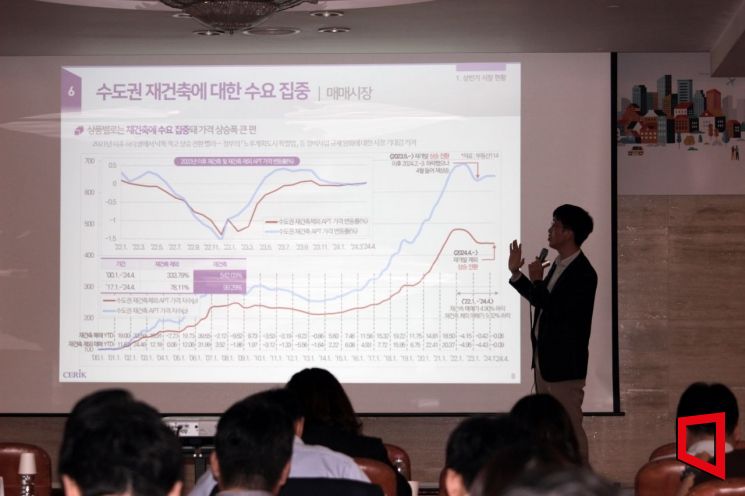 On the 11th, at the '2024 Second Half Construction and Real Estate Market Outlook Seminar' hosted by the Construction Industry Research Institute, Kim Seonghwan, Associate Research Fellow at the institute, is presenting the housing real estate market outlook for the second half of the year.
While the metropolitan area is expected to remain stable in the second half, the trend of narrowing declines in provinces until April is likely to reverse, leading to renewed decreases in the second half. The institute anticipates that with limited room for interest rate cuts and a political landscape dominated by opposition parties, the decline will continue mainly in provincial areas. Concerns over real estate project financing (PF) require the cleanup of insolvent projects, and the expected intensification of financial instability in the second half may also impact demand contraction.
Jeonse Prices to Rise 3.0% This Year... 2.8% Increase in Second Half
The upward trend in jeonse prices is expected to accelerate. Jeonse prices rose by 0.2% in the first half and are forecasted to increase by 2.8% in the second half. More jeonse policy funds flowed in than for sales until April, and the avoidance of jeonse in multi-family and row houses suggests that the rise will likely continue, especially in small apartments.
As of April, the number of apartment jeonse listings decreased by 29.5% in Seoul and 29.3% in the metropolitan area compared to the previous year. Jeonse transaction volumes in April also increased by 18.4% in Seoul and 20.0% in the metropolitan area compared to the five-year average for April. The impact of jeonse fraud is expected to accelerate the shift to monthly rent in the non-apartment rental market.
This year’s permits and public supply volumes meet the levels mentioned in supply measures but are expected to have limited impact on the private sector. Permits are estimated at 370,000 households and pre-sale volumes at 260,000 households this year. Compared to last year, permits decreased by about 59,000 households, while pre-sale volumes increased by 68,000 households.
Senior researcher Kim said, "Although the backlog of unstarted construction since 2022 has improved compared to last year (192,000 households), this is due to a base effect," adding, "The supply volume is at the same level as in 2008 when the global financial crisis occurred."
Construction Orders to Decline 10.4% This Year
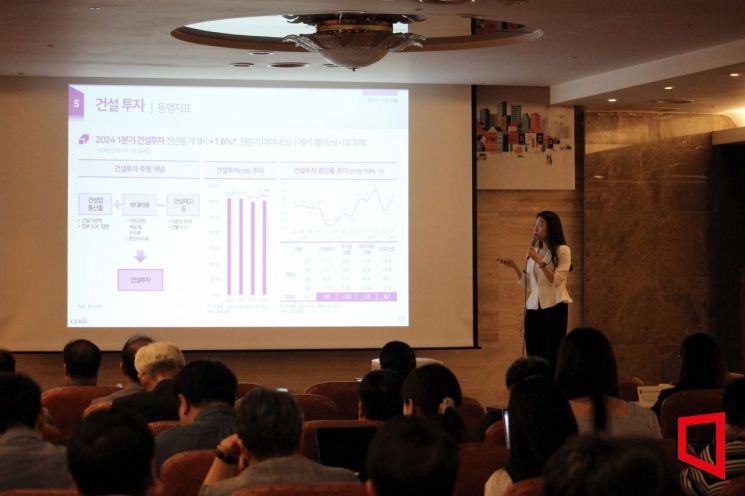 On the 11th, Ji-hye Lee, a research fellow at the Construction Industry Research Institute, is presenting the outlook for the construction market in the second half of 2024 at the "2024 Second Half Construction and Real Estate Market Outlook Seminar" hosted by the Construction Industry Research Institute.
Leading indicators related to the construction market are deteriorating, suggesting continued difficulties for the construction industry. The institute analyzed that domestic construction orders will decrease by 10.4% compared to last year. Construction orders, which reached a record high of 229.7 trillion won in 2022, fell by 17.4% to 189.8 trillion won last year and are estimated to decline further by 10.4% to 170.2 trillion won this year.
The institute also analyzed that domestic construction investment will decrease by 1.3% to 302.1 trillion won this year. Due to the decline in building starts in 2022 and last year, sluggishness is expected in residential and non-residential construction, with a downward trend anticipated in the second half.
Researcher Lee Ji-hye said, "High interest rates will continue in 2024, and real estate PF restructuring will intensify in the second half, causing ongoing difficulties in corporate financing conditions," adding, "Construction companies need to manage liquidity and financial stability, seek ways to enhance mid- to long-term competitiveness through technological investment, and continue efforts to diversify their portfolios."
Bleak Construction Market... Concerns Over Domestic and International Uncertainties and Liquidity Deterioration
Experts participating in the discussion expressed concerns about the sluggish construction market, uncertainties in domestic and international economic conditions, and worsening liquidity in the construction industry. Professor Kim Taehwang of Myongji University said, "Even if fluctuations and price increases occur in the real estate market, the linkage to construction market recovery will gradually weaken," explaining, "The construction market’s dependence on domestic and international economic conditions is increasing, and the policy-driven support for the construction market will weaken. As welfare spending increases and tax revenues decrease, government budget expenditures for the construction sector may shrink."
The combined effects of rising construction costs, interest rate hikes, and labor cost increases are seen as constraints on housing supply, which is a source of concern. Cho Hyunwook, head of the Songdo Landmark City development project, pointed out, "Private housing supply is rare, so prices may rise significantly in two years. The private (apartment) market is unprofitable and unable to supply, but if supply shortages begin to grow, prices could surge."
The Ministry of Land, Infrastructure and Transport is also considering various measures such as realistic construction cost adjustments, smooth real estate PF transitions, and housing supply expansion. Lee Ikjin, director of the Construction Policy Division at the ministry, said, "We are internally reviewing ways to ease construction cost pressures, including diversifying supply sources for rebar, cement, and aggregates," adding, "Construction orders have decreased by about 15%, and considering that they lead actual construction work by 5 to 8 quarters, the situation in the second half of next year is expected to be worse. The construction industry urgently needs to diversify portfolios through overseas orders and new businesses and improve management efficiency."
© The Asia Business Daily(www.asiae.co.kr). All rights reserved.
![Clutching a Stolen Dior Bag, Saying "I Hate Being Poor but Real"... The Grotesque Con of a "Human Knockoff" [Slate]](https://cwcontent.asiae.co.kr/asiaresize/183/2026021902243444107_1771435474.jpg)

















